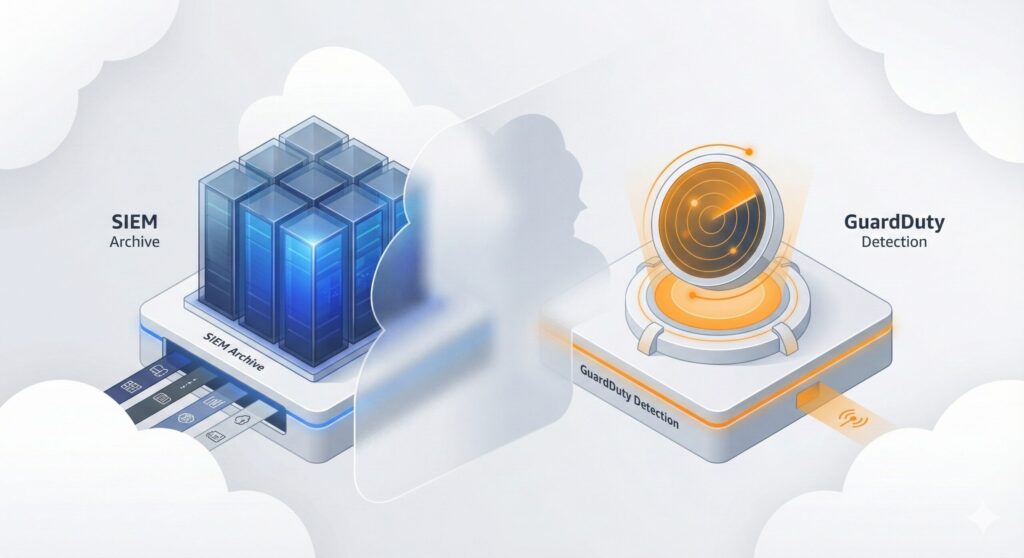
Is AWS GuardDuty a SIEM? Why This Question Keeps Coming Up
To better understand whether AWS GuardDuty is a SIEM, we need to recognize that traditionally, SIEMs were the central security analytics platform. They collected, analyzed, and correlated security-relevant logs and events from many systems before the advent of cloud computing. This started changing with the rise of cloud-native, managed detection services alongside SIEMs. This led to overlapping terminology between threat detection, monitoring, and logging. However, there is a natural tendency to map new cloud services onto familiar legacy categories.
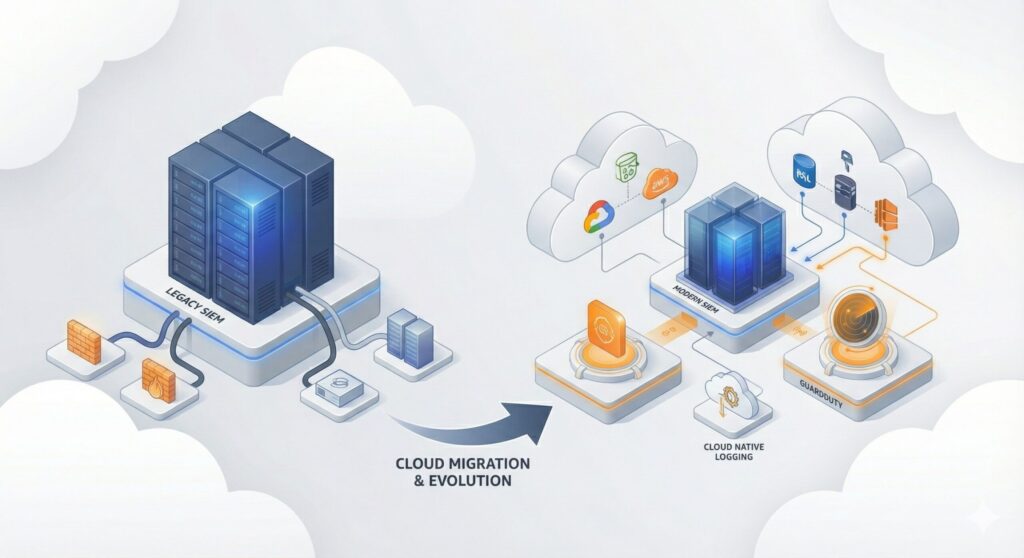
As cloud providers refined their architectures and services, they implemented different security tools optimized for detection, aggregation, and investigation. Subsequently, these managed services started redefining the traditional tooling boundaries that existed before cloud computing. However, it was easy for architects and engineers to assume that one tool replaced another. When this was not the case, but different tools were overlapping each other. A better paradigm is to design security stacks as complementary layers rather than single platforms.
What Is a SIEM?
Core Purpose of a SIEM
To reiterate, SIEM traditionally served as a centralized collection of security logs and events from diverse systems. It also performed normalization and indexing of heterogeneous log formats for coherent processing. Additionally, it performed event correlation across time, users, and infrastructure components. Subsequently, it applied these correlation outcomes to drive alerting and investigative workflows.
Organizations benefited from SIEM systems since they served as a single source of truth for security-related events across the environment. They also provided organizations the ability to reconstruct incidents and timelines after detection. Additionally, SIEM logs, events, and their correlation provided the basis for regulatory, audit, and compliance reporting requirements. Therefore, SIEMs became the foundation for security operations and incident response workflows across the industry.
What SIEMs Are Designed — and Not Designed — to Do
SIEMs’ original intent was to provide long-term storage and retention of large volumes of security logs. Also, applying an espionage mindset, another core requirement was to perform cross-system correlation and rule-based analysis. Next was to provide a command and control with centralized alerting and investigation dashboards. Additionally, following on from the crime scene analogy, they were intended to support historical analysis and forensic workflows.
However, the intent was never to provide real-time behavioral threat detection without prior log context. Also, performing managed threat intelligence ingestion or curation was never a requirement for SIEMs. Neither was performing autonomous detection tuning, or suppression of noisy systems; this was for complementary systems. Moreover, operating as a fully managed security detection service was not part of their requirements.
Is AWS GuardDuty a SIEM? What GuardDuty Actually Does
Core Function of AWS GuardDuty
GuardDuty’s primary activity is continually analyzing AWS telemetry sources such as CloudTrail, VPC Flow Logs, DNS logs, and EKS signals, in contrast to SIEM. Furthermore, it applies AWS-managed threat intelligence feeds and behavioral analysis models, deriving richer insights into telemetry data. Its key strength is that it identifies suspicious or malicious activity rather than raw event collection. AWS GuardDuty subsequently generates high-confidence security findings instead of correlated log streams like SIEMs.
Moreover, GuardDuty is a fully managed threat detection service that does not require customer-maintained rules or correlation logic. Given that it is AWS-native, AWS-curated detection logic and model updates are automatically applied to it. This extends to having native integration with other AWS security and response workflows. Additionally, it prioritizes its findings to reduce noise and false positives that clutter visibility into the threat environment.
What GuardDuty Is Designed — and Not Designed — to Do
AWS developed GuardDuty primarily as a native service that detects potentially malicious activities within AWS environments. AWS also intended it as a value-added service over raw events by surfacing high-confidence security findings. Additionally, it had to reduce alert noise through curated detections and managed logic, providing a clean view of the security landscape. Furthermore, it was to integrate with other AWS native services that performed investigations, responses, and automated workflows.
Since there were other AWS services that provided long-term storage or retention of security logs, AWS never meant this for AWS GuardDuty. Additionally, GuardDuty never needed to perform broad log aggregation or cross-platform event correlation, which other services performed. Unlike SIEM, AWS never designed GuardDuty to act as a compliance reporting or audit system of record. Overall, AWS GuardDuty’s intended role was never meant to replace SIEM platforms or centralized security analytics tooling.
Is AWS GuardDuty a SIEM?
The Short Answer
We have considered the functions and roles of both AWS GuardDuty and SIEMs. We can therefore confidently say that GuardDuty is not a SIEM and does not replace SIEMs. SIEM’s key role is as a centralized system of record for security logs and events. In contrast, GuardDuty’s core role is operating as a managed threat detection service within AWS. Another key difference is that GuardDuty produces security findings rather than aggregating raw logs, which SIEMs perform. In summary, GuardDuty complements SIEMs through integration rather than acting as a substitute.
Why the Confusion Exists
It is easy to think of GuardDuty as an SIEM, given that historically, SIEMs dominated as the central security analytics platform. Instead, GuardDuty is one of the cloud-native, managed detection services that emerged alongside SIEMs. However, the confusion arose when there were overlapping surface features, such as alerts, dashboards, and findings, with these emergent services. Therefore, there was a tendency to map these new cloud services onto familiar legacy security platforms, such as SIEMs. This was further made ambiguous due to cloud providers moving security capabilities up the stack and thereby blurring boundaries. Moreover, the integration of GuardDuty and SIEMs led to misinterpreting these tools as functional equivalents.
AWS GuardDuty vs SIEM comparison
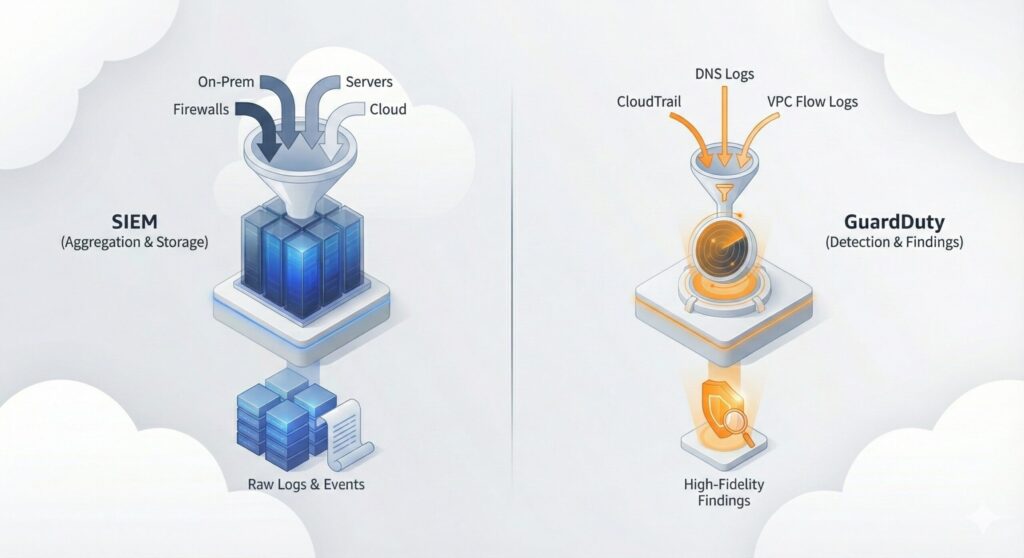
Primary Role and Focus
In contrast to SIEMs, AWS developed GuardDuty to focus primarily on proactive threat detection within AWS environments. On the other hand, SIEMs’ primary focus is on centralized aggregation and analysis of security events. Also, AWS GuardDuty’s design differs significantly from that of SIEMs, as it is intended to generate security findings rather than collect logs. Whereas SIEMs are designed to serve as a system of record for security telemetry. Another core characteristic is that AWS has optimized GuardDuty to identify suspicious activity early. However, SIEM optimization is around investigation, correlation, and historical analysis, making it more passive in contrast to GuardDuty.
Data Sources and Outputs
Another stark contrast between AWS GuardDuty and SIEM is their data sources and outputs. AWS has narrowly focused GuardDuty data sources, as GuardDuty analyzes AWS telemetry such as CloudTrail, VPC Flow Logs, DNS, and EKS signals. Meanwhile, the SIEM’s range of data sources it ingests is far broader, comprising security logs and events from diverse systems and platforms. Accordingly, GuardDuty produces curated security findings with contextual severity. In the case of SIEM, its outputs are correlated events, alerts, and searchable log records; therefore, further analysis is required. Another key difference is that GuardDuty minimizes exposure to raw data by surfacing high-signal detections. While SIEM prioritizes data completeness and long-term event retention.
Operational and Architectural Implications
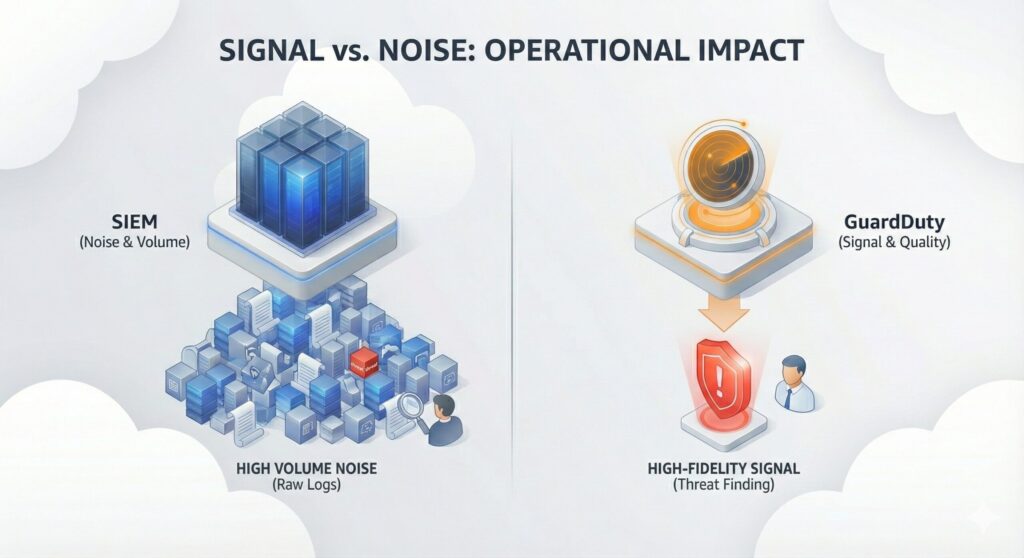
Assuming that AWS GuardDuty and SIEMs are the same can lead to poor architectural choices that carry implications for years to come. GuardDuty’s key benefit is that it reduces operational burden through managed detection and tuning. Whereas SIEM requires ongoing rule management, tuning, and operational oversight. Another major consideration is that GuardDuty emphasizes signal quality over data volume, but SIEM emphasizes comprehensive visibility over noise reduction. Therefore, misclassifying GuardDuty as a SIEM can lead to gaps in logging and compliance coverage for any architecture. Hence, security system designers should treat GuardDuty and SIEM as complementary, enabling layered security architectures.
How GuardDuty Fits Into a Modern Security Stack
We now understand that AWS GuardDuty is not a SIEM, but both complement each other in forming modern security postures. Therefore, it is valuable to show how GuardDuty fits into a modern security stack and integrates with other security services.
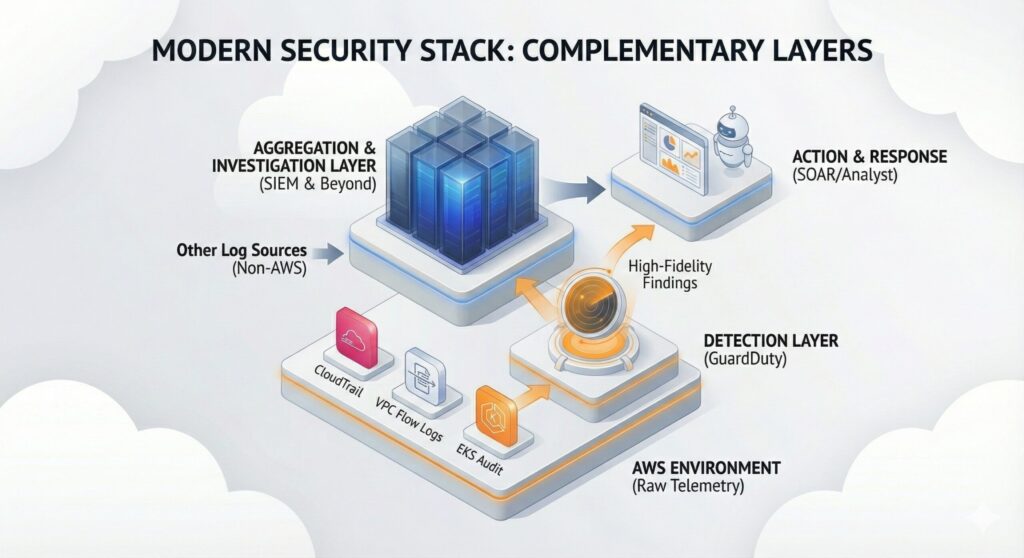
GuardDuty’s Role in Detection and Signal Generation
GuardDuty’s place in any security stack is as an upstream detection and signal-generation layer for downstream services. Its role is now understood to provide continuous analysis of AWS-native telemetry for suspicious behaviour. AWS GuardDuty’s emphasis on high-fidelity signals rather than exhaustive data collection positions it as an upstream service. This is further enhanced where it converts the raw telemetry signal into actionable security findings. Therefore, it provides early identification of threats before downstream investigation stages, such as Amazon Detective. Having AWS GuardDuty complementing the SIEM allows decoupling detection responsibilities from the storage and correlation layers.
Composing GuardDuty with SIEM and Other Security Services
AWS GuardDuty’s value is as a source of findings for any centralized logging and analytics platforms, rather than a tool replacement. Accordingly, SIEMs are highly useful as systems of record for downstream investigation and compliance enforcement, complementing AWS GuardDuty. Further integration with orchestration and response services enables automated actions for any critical findings generated by GuardDuty. These different systems allow the separation of concerns between detection, aggregation, and investigation. Integrating GuardDuty into the security stack with tools like SIEM provides the ability to correlate GuardDuty findings with the broader environment context. Therefore, a layered security architecture allows for the combination of managed detection with enterprise analytics.
Conclusion
Modern cloud security architectures have separation of concerns as a core principle, thereby separating detection, aggregation, and investigation services. Hence, AWS GuardDuty and SIEM serve as distinct but complementary roles within the security stack. Subsequently, whenever engineers treat these tools as interchangeable, they risk creating serious architectural gaps. Their complementary role is emphasized by modern architectural principles that stress the importance of composing managed services rather than relying on single platforms. Following these sound principles of integration and layered design decisions will drive effective security outcomes.
Further Reading
AWS GuardDuty – What is Amazon GuardDuty?
The Modern Security Operations Center, by Joseph Muniz
Blue Team Handbook: Incident Response 3rd Edition: A condensed field guide for the Cyber Security Incident Responder, by Don Murdoch
Affiliate Disclosure: As an Amazon Associate, I earn from qualifying purchases. This means that if you click on one of the Amazon links and make a purchase, I may receive a small commission at no additional cost to you. This helps support the site and allows me to continue creating valuable content.