
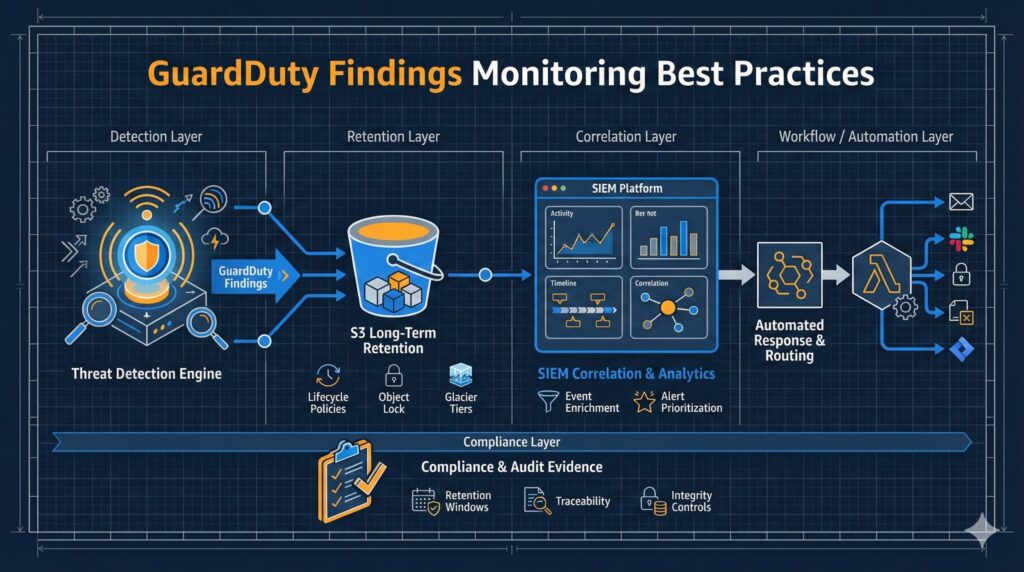
Introduction to GuardDuty Findings: Monitoring Best Practices
GuardDuty findings are central to any security response workflow; therefore, best practices around monitoring are essential. Later sections cover how to export GuardDuty findings to S3, integrate findings with SIEM platforms, and support long-term retention and compliance workflows
What GuardDuty Findings Represent
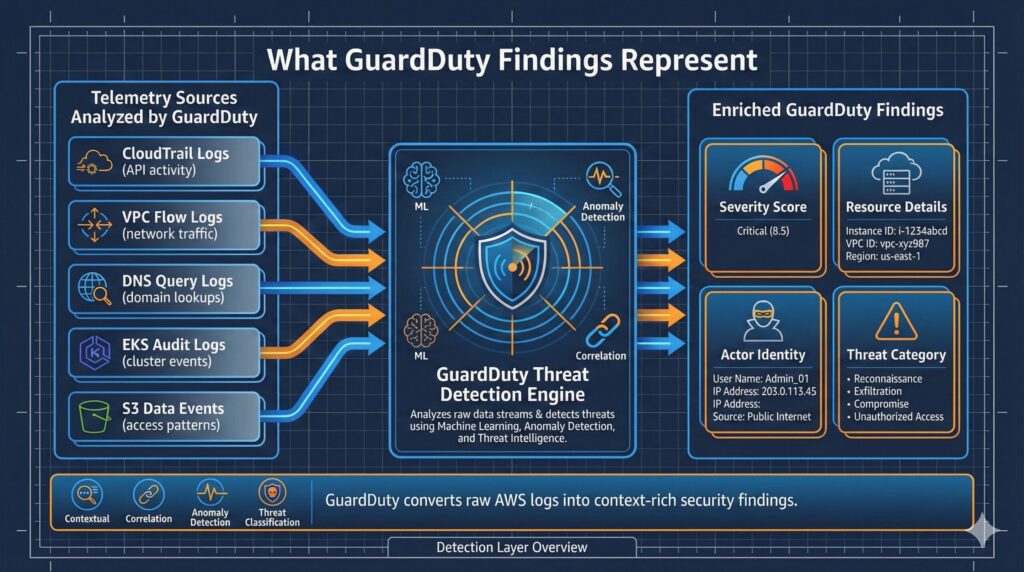
GuardDuty findings are an analysis of diverse logs that provide a rich description of activities in the AWS environment, covered in AWS CloudTrail logging best practices. The logs that GuardDuty analyzes come from sources including CloudTrail, VPC Flow Logs, DNS logs, EKS audit logs, and S3 access patterns. These log sources are fundamental to AWS visibility and align closely with the principles outlined in our AWS logging and monitoring guide, which explains how telemetry shapes cloud security posture. These logs provide GuardDuty indicators of suspicious behavior, anomalous activity, policy violations, or potential compromise. The subsequent finding provides context-rich alerts that include resource details, actor identity, and severity scoring. Consequently, the security workflow should use these signals for downstream monitoring, correlation, investigation, and incident response. These detection capabilities are part of broader architectural considerations discussed in our AWS GuardDuty best practices guide, which outlines how to deploy and tune GuardDuty across accounts and Regions.
Why Monitoring GuardDuty Findings Matters
It is essential to include GuardDuty findings within security workflows responsible for securing AWS environments. Primarily, this ensures the timely detection and escalation of high-severity security events across AWS environments. It also enables integration with SIEM platforms for correlating logs, identities, and network activity. Given the regulatory environment, the findings support long-term evidence retention and audit requirements through S3 and lifecycle policies. These findings subsequently drive automated remediation workflows implemented by CloudWatch, EventBridge, and Security Hub. Effective use of these signals is also a core part of implementing incident response best practices, ensuring threats are escalated and handled in a structured and repeatable manner.
The Role of GuardDuty Findings in AWS Security
Simply put, GuardDuty findings essentially indicate that something potentially is wrong and take action on this. Therefore, GuardDuty findings have a fundamental role in AWS security, making best practices around their monitoring crucial.
GuardDuty Findings as Core Detective Controls
Furthermore, GuardDuty findings serve as foundational signals feeding into AWS-native detective controls and security monitoring platforms for subsequent action. As stated earlier, these findings are derived from the analysis layered across primary log sources. These include CloudTrail, VPC Flow Logs, DNS logs, EKS audit logs, and S3 events for broad coverage. Subsequently, these findings provide continuous detection of anomalous API activity, unusual network flows, and suspicious identity behaviour. Deriving these findings also includes applying ML-driven baselines to the log data to flag deviations from typical workloads or user patterns. Additionally, these findings provide severity scores and resource context, allowing other workflow stages to prioritize and triage them.
How GuardDuty Findings Support Enterprise Security Workflows
GuardDuty findings provide enrichments to the existing logs and metrics with actor details, resource identifiers, and threat context. As noted previously, they enhance findings with severity, confidence, and correlated activity, allowing triage teams and processes to prioritize actions. Findings also serve as upstream signals for SIEM platforms to correlate identity, network, and application telemetry. And to reiterate, they serve as triggers for EventBridge, Lambda, and Security Hub insights. Moreover, they are evidence artifacts supporting forensic reconstruction, compliance reporting, and audit references.
Export to S3 (Long-term Retention)
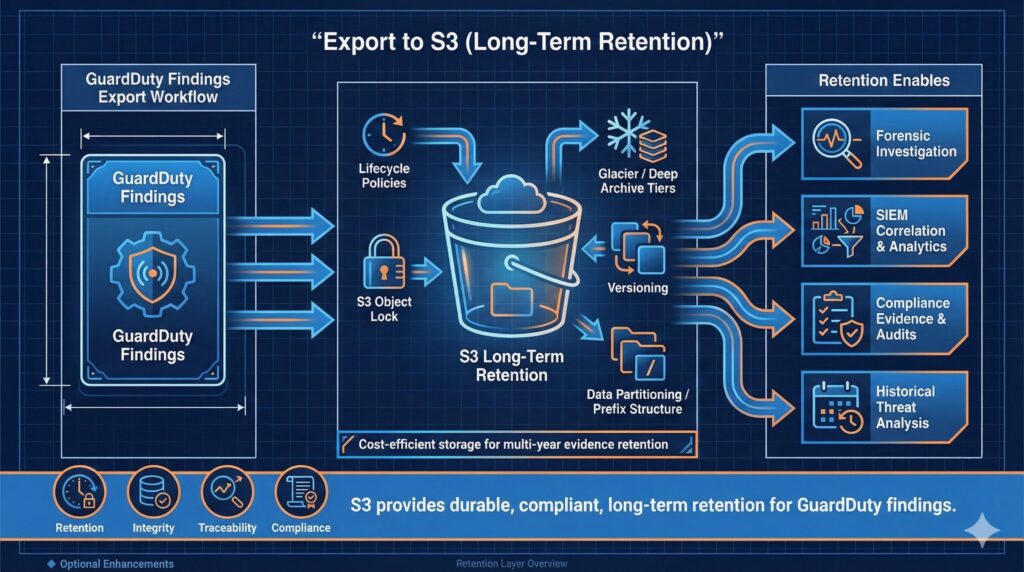
Exporting GuardDuty findings to S3 is a core best practice for monitoring and retaining security-critical information across AWS environments.
Why Exporting GuardDuty Findings to S3 Is Part of Monitoring Best Practices
GuardDuty findings are valuable, but the 90-day retention period is inadequate; this is the primary reason for exporting to S3. This is also crucial for supporting compliance requirements for evidence retention under SOC 2, PCI DSS, and ISO 27001. S3’s powerful and low-cost storage mechanisms support these requirements. S3 storage classes and object locking enable forensic investigation workflows relying on historical findings and event timelines. S3’s low-cost solution provides a central repository for SIEM ingestion, correlation, and enterprise-wide monitoring. Furthermore, it establishes a durable, structured storage for audit readiness, incident review, and post-event analysis.
Designing an Effective S3 Folder and Prefix Structure
While S3 is a powerful and essential storage service for GuardDuty findings, it is also necessary to follow best practices for monitoring environments. Organizing data is half the battle for effective storage. Therefore, engineers should organize GuardDuty findings by AWS Account ID, Region, and detector ID for multi-account accuracy. Prefixes in S3 are a powerful mechanism, and engineers should use date-based prefixes to optimize Athena queries and lifecycle transitions. Designing a good folder structure (although these are also S3 prefixes) will optimize SIEM ingestion pipelines and downstream analytical tools. Equally recommended is to apply consistent naming conventions to support automation and scalable retention policies. Another best practice is data partitioning to balance cost efficiency, query performance, and operational visibility.
Lifecycle and Storage Class Best Practices for GuardDuty Findings and Monitoring
To reiterate, this is what makes S3 such a powerful service for GuardDuty findings storage. It enables transitioning findings through S3 storage classes to balance cost and retention requirements. Cloud administrators can implement lifecycle rules to move older data into Glacier or Deep Archive for long-term preservation. S3 also provides intelligent tiering whenever access patterns are unpredictable or investigation-driven. Organizations managing large volumes of GuardDuty findings encounter many of the same big data challenges seen in broader analytics workloads, particularly around cost efficiency, data lifecycle design, and long-term storage governance. Also, administrators can easily define retention durations within S3 storage classes based on compliance, forensic needs, and organizational governance. S3 also provides object expiration to enable automated cleaning up of expired findings to control storage costs and reduce operational clutter.
Securing Access to Exported GuardDuty Findings
Central to any best practices around monitoring cloud environments with GuardDuty findings is properly securing these in S3 after export. Therefore, engineers must enforce SSE-KMS encryption with customer-managed keys to meet compliance and audit requirements. They should also apply restrictive bucket policies and IAM roles to follow least-privilege principles and limit access to authorized security and analytics teams. Additionally, use S3 Object Lock and retention modes to protect findings from deletion or tampering. Furthermore, security teams must track object-level access and modifications through access logging and CloudTrail events. Related to this is cross-account access, for which security teams must implement controls and monitoring with EventBridge alerts for unauthorized access attempts.
GuardDuty Findings Monitoring: SIEM Integration Best Practices
GuardDuty findings by themselves are insufficient for monitoring the threat environments, and best practices recommend integration with other information sources.
Why Integrating GuardDuty Findings With SIEM Platforms Matters
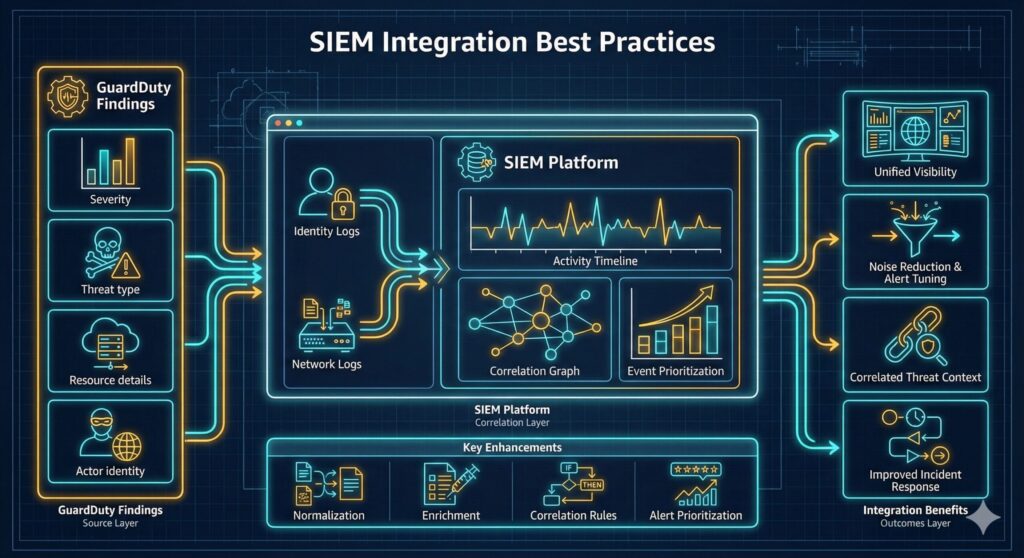
Security teams need unified visibility across the enterprise, necessitating centralized GuardDuty findings alongside other log sources. SIEM integration also enables correlation with other threat data, which is crucial for a deeper investigation, including identity activity, network behavior, and resource interactions. Another benefit is noise reduction by aligning GuardDuty severity levels with SIEM alerting and prioritizing rules. Integration further supports threat detection analytics by enriching SIEM datasets with AWS-native anomaly and event context. It also enables consolidated dashboards, triage queues, and escalation paths, thereby strengthening incident response workflows.
Preparing GuardDuty Findings for SIEM Ingestion
Not only is GuardDuty findings integration with SIEM needed, but following best practices is equally important for effective monitoring. Given that GuardDuty and SIEM have different schemas, we should normalize GuardDuty finding formats. This allows SIEM platforms to process JSON structures from GuardDuty consistently. Furthermore, engineers should map GuardDuty severity, type, and category fields to SIEM-specific event taxonomies. Additionally, to help SIEM better correlate, enrich findings with account metadata, region, tags, and resource identifiers. Also, to support timeline reconstruction and sequencing, ensure timestamp consistency across AWS logs. Effective monitoring also requires detecting gaps in data, which is a process similar to identifying missing or incomplete records in analytics workflows. Moreover, use Lambda and EventBridge rules for additional preprocessing or transformation steps so that GuardDuty findings meet SIEM ingestion requirements.
Using EventBridge and S3 Pipelines to Deliver Findings to SIEM
In addition to preparing GuardDuty findings for SIEM, there is the question of their timely delivery and preventing data loss. Ideally, it is highly valued for triggering near real-time ingestion of SIEM workflows. This is typically done by routing GuardDuty findings through EventBridge rules. Since exporting GuardDuty findings to S3 is a best practice, the S3 bucket is a logical place for delivery to SIEM through either batch or scheduled ingestion. Use Lambda to transform findings between EventBridge and SIEM targets for normalizing fields and reducing payload noise. Therefore, look to coordinate EventBridge and S3-based flows to ensure redundancy, replay capability, and consistent delivery to SIEM systems. Also, whenever SIEM tools require streaming delivery or buffering, leverage Kinesis Firehose or custom pipelines.
Best Practices for SIEM Correlation and Alert Tuning
Further matching between GuardDuty findings and SIEM schemas is achievable around SIEM correlation and alert tuning. Engineers should align GuardDuty severity levels with SIEM alert thresholds to reduce false positives and noise. It is also valuable to correlate GuardDuty findings with identity, network, and application logs to surface meaningful attack patterns. On the SIEM side, engineers should create SIEM rules that group related GuardDuty events to improve triage efficiency and analyst focus. Additionally, map GuardDuty threat categories to established frameworks such as MITRE ATT&CK for a richer investigation context. As in all best practices, continual refinement is mandatory; therefore, continuously tune correlation logic and dashboards based on environment changes, detection gaps, and incident postmortems.
GuardDuty Findings Monitoring – Compliance and Audit Considerations
A core requirement of GuardDuty findings monitoring is supporting regulatory compliance and audit readiness, which shape GuardDuty best practices.
Compliance Requirements That Influence GuardDuty Findings Monitoring
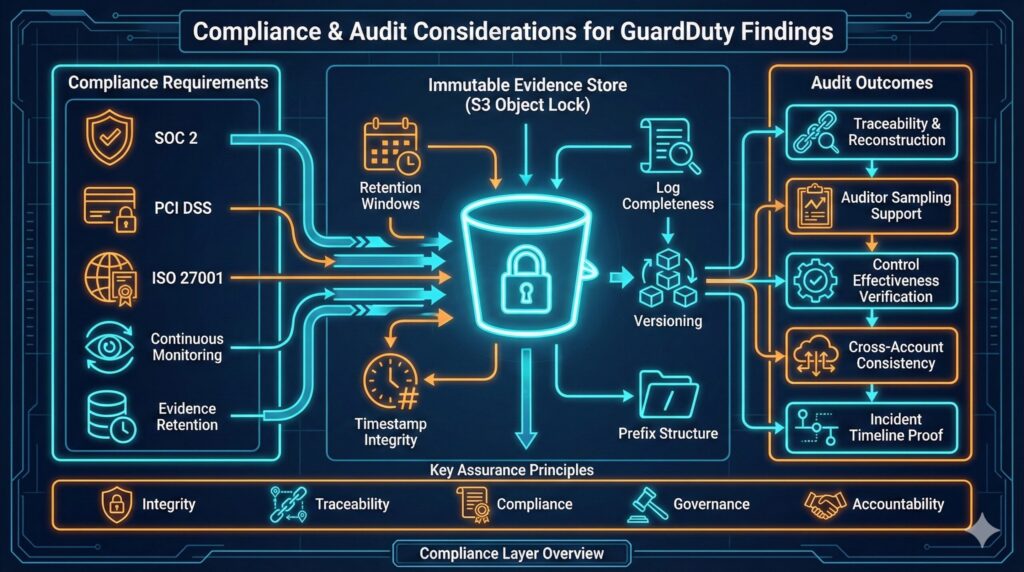
GuardDuty findings monitoring must ensure compliance with centralized threat detection and continuous monitoring, meeting SOC 2, PCI DSS, and ISO 27001. Therefore, security processes must retain GuardDuty findings beyond native service limits to satisfy mandated evidence preservation windows. Additionally, findings retention must ensure log integrity, timestamp accuracy, and event completeness for audit traceability. Regulatory requirements also include correlating security events across systems, identities, and network activity. GuardDuty findings must also demonstrate operational controls around incident detection, escalation timelines, and monitoring effectiveness to auditors. Moreover, findings must provide verifiable proof that security monitoring controls are consistently applied across all AWS accounts and Regions within the organization.
Audit Readiness and Evidence Management Using GuardDuty Findings
The following best practices enable GuardDuty findings monitoring to support audit readiness and evidence management. An obvious choice is using S3 as an immutable evidence repository since it is a native AWS service providing Object Lock, retention modes, and versioning. This demonstrates the organization’s ability to reconstruct security events using historical GuardDuty findings with associated logs. It also provides auditors with structured, timestamped findings that show detection timelines and escalation paths. Additionally, data storage best practices in S3 support audit sampling requests by organizing findings with clear prefixes, tags, and metadata for fast retrieval. Moreover, correlating GuardDuty findings with SIEM records and incident response documentation provides proof of monitoring control effectiveness.
Conclusion to GuardDuty Findings: Monitoring Best Practices
GuardDuty findings are essential to monitoring best practices since they are the foundational signal for detecting threats and guiding investigations. They ensure timely escalation, deeper correlation, and long-term visibility, all of which are essential for resilient cloud security operations.
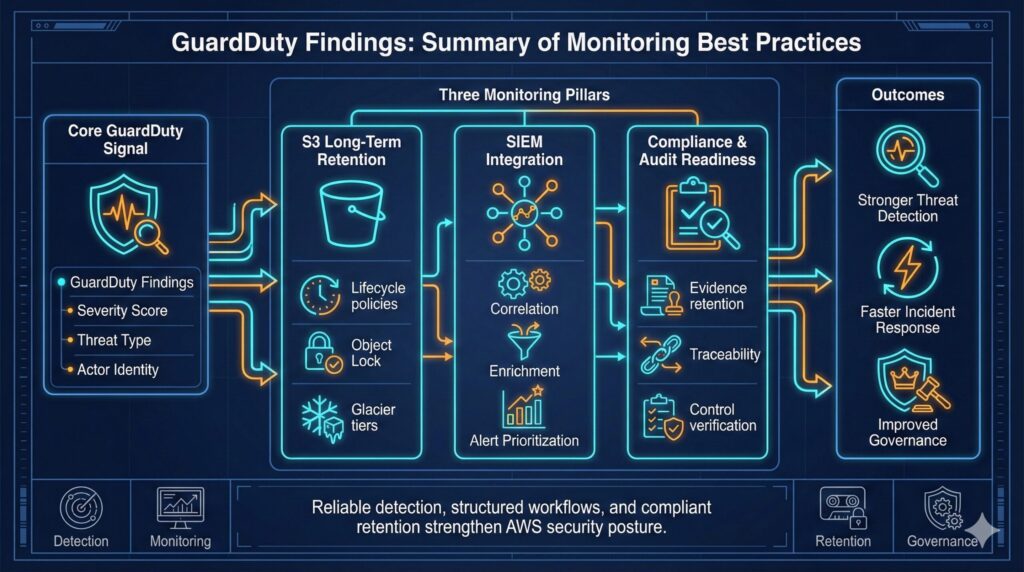
Best practices around GuardDuty findings revolve around three pillars: S3 long-term retention, SIEM integration, and compliance audit readiness. S3 provides cost-effective and versatile storage for GuardDuty findings that support long-term retention. AWS EventBridge and Lambda allow integration with SIEM and data preparation for GuardDuty findings to match the SIEM’s data schemas. GuardDuty findings are also necessary for comprehensive auditing requirements in providing a detailed log of security events.
Therefore, organizations that implement these practices will strengthen detection, response, and governance across their AWS environments.
Further Reading
Affiliate Disclosure: As an Amazon Associate, AI Cloud Data Pulse earns from qualifying purchases. Some links in this article are Amazon affiliate links. If you purchase a product through these links, we may earn a small commission at no additional cost to you. We only recommend resources that we believe provide value to our readers.
AWS Certified Security – Specialty (SCS-C02) Exam Guide by Adam Book and Stuart Scott
Practical Cloud Security: A Guide for Secure Design and Deployment by Chris Dotson
Cloud Security Handbook: Find out how to effectively secure cloud environments using AWS, Azure, and GCP by Eyal Estrin
Incident Response & Computer Forensics, Third Edition by Jason T. Luttgens, Matthew Pepe, and Kevin Mandia
Logging and Log Management: The Authoritative Guide to Understanding the Concepts Surrounding Logging and Log Management, 1st Edition by Kevin Schmidt, Chris Phillips, and Anton Chuvakin
