Introduction — From Guardrails to Guardrail Engineering
AWS security guardrails are needed because enterprises leveraging AWS continually increase their workload footprint in AWS. This increases the number of AWS accounts in their landscape. Also, governance complexity increases as enterprises impose constraints on workloads and ensure consistent security enforcement. Enterprises must establish multi-account administration policies to ensure effective governance and consistent enterprise control. Scaling governance over a growing AWS footprint is a significant challenge.
While defining governance policies across the AWS enterprise is necessary, it is insufficient to enforce them and to continually maintain them. Manually enforcing them will lead to configuration inconsistencies across the workloads and configuration drift over time. This will result in a growing operational overhead due to repetitive administrative effort. Additionally, the risk of human error increases as the environment scales. Hence, the limitations of manual governance become increasingly apparent.
From Manual Governance to Guardrail Engineering
As enterprises scale their AWS environments, they must therefore automate enforcement of governance policies. AWS security guardrails enforce governance constraints across the enterprise and fall into two broad categories: preventive and detective guardrails. These are elaborated in Preventive vs Detective Guardrails in AWS: Build Security Before Breaches Happen. However, enterprises must apply sound engineering principles to guardrails to ensure their consistent deployment and continuous operation.
Application of engineering principles to automated guardrails borrows from other domains, including guardrail lifecycle management. The other important principle is repeatability in guardrail deployment. These principles help ensure continuous security monitoring and automated policy enforcement. Additionally, guardrails should enable event-driven remediation and remediation verification. Guardrail engineering principles should also provide guardrail effectiveness measurement along with continuous governance improvement. Hence, guardrails transform individually configured controls into managed capabilities, enabling enterprise security automation at scale.
What Is Guardrail Engineering?
Automating AWS security guardrails has progressed into a systematic governance control engineering discipline that implements governance requirements as enforceable controls. Implementing security requirements is also a key objective. This enables repeatable control implementation, standardizing guardrail configurations as enterprises scale their workloads. Another key objective is managing the guardrail lifecycle end-to-end beyond initial control deployment. Guardrail engineering helps to achieve consistent enterprise-wide enforcement and scalable multi-account governance.
Engineering the Guardrail Lifecycle
Enterprises express governance requirements as policy definitions across the AWS environment. Enterprises implement these requirements as policy as code to automate enforcement in AWS. Therefore, many software engineering principles are applicable to policy as code, including guardrail definition version control along with validation and testing. This also includes pre-deployment control verification. Automating guardrail deployment allows for repeatable multi-account implementation and consistent cross-environment deployment.
Beyond initial deployment, there is continuous guardrail monitoring to identify policy violations and any configuration drift. An additional layer is automated or controlled remediation of any policy violation or configuration drift. Another important operation is guardrail exception management when there is a legitimate business or technical reason. There is also continual improvement of guardrails due to continuous policy refinement based on feedback and evolving environments.
Guardrails as an Enterprise Capability
Configuring controls individually generates overhead as enterprises scale, becoming unmanageable. Therefore, it is imperative to standardize guardrail patterns along with reusable governance controls similar to the principle of software reuse. Guardrail reuse contributes to consistent workload implementation and repeatable multi-account enforcement. It also reduces duplication of control policies similar to duplicated code in software. Deriving standardized governance baselines allows for controlled business-specific variation of guardrails.
An organization’s central goal is to establish an enterprise governance architecture and a centralized governance model. However, they empower teams with decentralized workload ownership within consistent security boundaries. Therefore, they should allow controlled workload autonomy within enterprise policy consistency. Significantly, they should reduce manual administration to enable scalable multi-account governance. Guardrail engineering is a platform capability that enables enterprise governance and a centralized governance model.
Guardrails as Code
Policy as Code
Implementing governance policies as code supports automation by representing governance requirements as machine-readable policies that AWS policy engines can evaluate and enforce. This reduces error-prone manual policy administration and replaces it with policy definitions as engineering artifacts. Governance automation consistently applies these artifacts to targeted workloads, ensuring a consistent governance representation that supports automated policy enforcement. This makes guardrail implementation repeatable and favors engineered controls over administrative configurations.
Since engineers manage governance policies as code, it is necessary to apply software engineering practices to them. Change management should include policy version control and apply peer review to any policy changes similar to other software engineering artifacts. Governance should establish repeatable policy implementation. Additionally, verification should include automated policy validation and pre-deployment policy testing. Policy management should include documented change history, policy traceability, and auditability. These practices enable controlled policy evolution in response to changing requirements.
AWS Controls That Can Be Engineered
There is a suite of controls that enterprises can engineer as AWS security guardrails to provide repeatable and automated governance enforcement. The most sweeping of these are Service Control Policies (SCPs), which enable organization-wide governance controls through OU-level policy inheritance. SCPs establish the maximum available permissions for affected AWS accounts without granting permissions themselves. IAM policies provide consistent authorization governance through permissions boundaries and standardized identity constraints.
While SCPs define the maximum permissions available within AWS Organizations, IAM policies implement fine-grained authorization for identities and workloads. The architectural relationship between these policy types is discussed in AWS IAM Architecture Best Practices.
Configuration Compliance and Governance
Resource-based policies provide an additional layer of governance enforcement, along with resource-level access constraints. Another layer is AWS Organizations tag policies for managing resources. Configuration management is another critical governance activity that is supported by AWS Config rules. These enable configuration compliance evaluation, configuration drift detection, and continuous configuration assessment. Enterprises can group these rules into AWS Config conformance packs to deploy standardized compliance controls and configuration baselines consistently across AWS environments. Governance can establish resource baselines and ensure consistent resource governance.
AWS Control Tower governance uses automation to control account creation and standardize multi-account governance. This integrates landing zone controls, ensuring that accounts provisioned through the landing zone inherit the required governance constraints and approved baseline configurations. These controls help ensure that accounts are provisioned with prescribed governance baselines and applicable preventive and detective controls. Fundamentally, AWS Control Tower standardizes account baselines and supports consistent account provisioning. This embeds governance during account provisioning and makes landing-zone governance scalable.
AWS Guardrail and Governance Controls at a Glance
| AWS Control | Primary Role | Guardrail Function | Typical Scope |
|---|---|---|---|
| Service Control Policies (SCPs) | Permission governance | Preventive | Organization, OU, account |
| IAM policies | Identity authorization | Preventive | Identities and workloads |
| Resource-based policies | Resource access control | Preventive | Individual resources |
| AWS Organizations tag policies | Tag standardization | Governance | Organization, OU, account |
| AWS Config rules | Configuration compliance | Detective | Resources and accounts |
| AWS Config conformance packs | Standardized compliance controls | Detective | Accounts and Organizations |
| AWS Control Tower controls | Multi-account governance | Preventive, detective, proactive | OUs and accounts |
Policy as Code vs Infrastructure as Code
Deployment technologies allow engineers to codify the infrastructure they want deployed, and there are several mechanisms that support this for AWS. These include AWS CloudFormation templates, Terraform configurations, and CloudFormation StackSets. However, policy as code defines repeatable governance controls, while deployment automation consistently distributes those controls across AWS environments. Together, they support consistent environment configuration and governance enforcement.
Infrastructure as code and policy as code serve different but complementary roles. Infrastructure as code defines and provisions resources, whereas policy as code defines the security and governance constraints under which those resources may operate. Combining both within enterprise automation pipelines enables infrastructure to be deployed consistently within established governance boundaries.
Building a Guardrail Delivery Pipeline
Governance Development Lifecycle
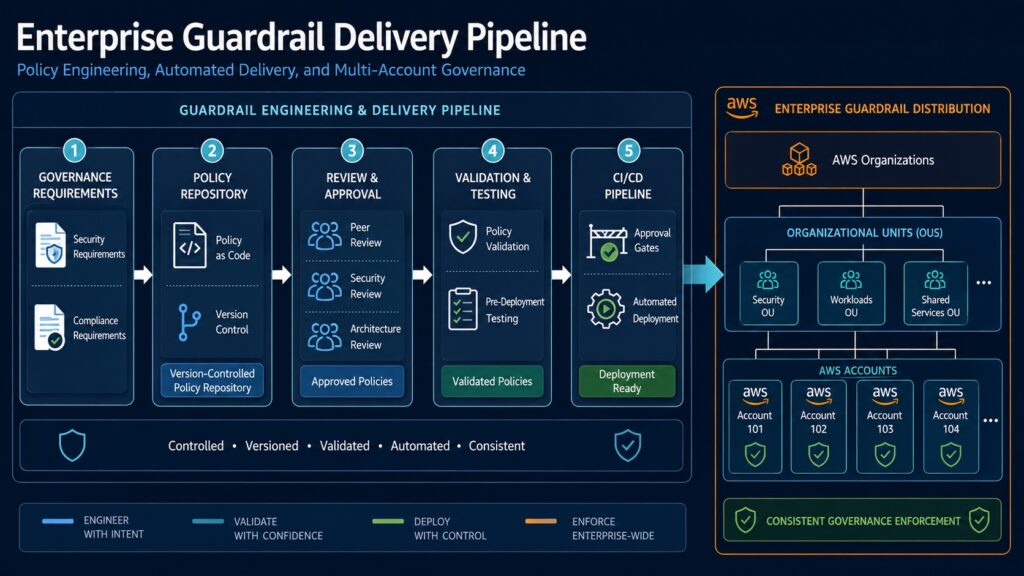
The AWS security guardrail delivery pipeline transforms governance requirements into machine-readable code that enforces governance across the AWS environment. The pipeline takes security and compliance requirements as inputs and translates them into policy definitions. Engineers commit these policy definitions to the central policy repository, which serves as the authoritative source for policy definitions. Governance requirements become deployable artifacts, making policy definition a repeatable process.
The other important stage of the delivery pipeline is guardrail delivery, with verification actions being key steps. These include policy review, automated policy validation, and pre-deployment testing. The next important stage is controlled approval, given the policies’ potential impact across the AWS environment. There is the automated deployment stage, but critically, there is post-deployment monitoring and deployment outcome verification. Finally, operational feedback informs subsequent policy changes. This supports the repeatable guardrail lifecycle and continuous governance engineering.
Version Control and Peer Review
Software engineering principles place a heavy emphasis on version control of artifacts since code is continually changing due to evolving requirements. This is no less true of policies, and engineering best practices favor managing policies in Git-based repositories. These ensure centralized policy definitions and version-controlled changes. They provide policy history and traceability from requirements to implementation. Significantly, they enable recovery with previous known-good versions.
Creating or updating policies follows certain processes aligned with best practices tied to Git-based repositories. Engineers initiate policy changes through pull requests, followed by peer, security, and architecture reviews. This is the standard practice of separating authoring and approval. Additionally, there is change documentation and approval evidence to ensure governance accountability.
Automated Guardrail Deployment
The practice of CI/CD is also applicable to guardrails implemented as policies, automating the integration and delivery of policy artifacts. For verification, the CI/CD pipeline consists of automated validation gates, automated policy testing, and deployment approval gates. The pipeline blocks any failed validations. The CI/CD pipeline automates the deployment of AWS security guardrails, making policy releases repeatable and reducing manual intervention.
Therefore, the CI/CD pipeline distributes these policies across the enterprise through integration with AWS Organizations. The CI/CD pipeline targets the organization at the Organizational Unit (OU) level and the AWS Account level. The policy target within the AWS Organizations hierarchy determines its scope, allowing controls to be applied broadly through OUs or more selectively to individual accounts. Regional guardrails must also account for multi-Region deployment requirements where applicable. Additionally, they are integrated with landing zones for consistent targeted deployment and enterprise-scale guardrail distribution.
The final critical CI/CD stage is providing visibility into deployment success or failure with policy application verification and post-deployment monitoring. It is also critical to detect unintended effects and maintain deployment audit records. Operational feedback should inform policy refinement, with subsequent policy changes committed to the policy repository and processed through the delivery lifecycle. This supports the continuous guardrail lifecycle and closed-loop governance engineering.
Event-Driven Security Remediation
Detecting Policy Violations
Baking security into the architecture with resource isolation and governance preventive policies is critical but not sufficient. It is always possible that actions can make resources non-compliant or that security events can occur. Therefore, the architecture must support continuous detection after deploying AWS security guardrails and continuously monitor configuration compliance and security state. The architecture must implement detective controls as remediation triggers that initiate the response lifecycle.
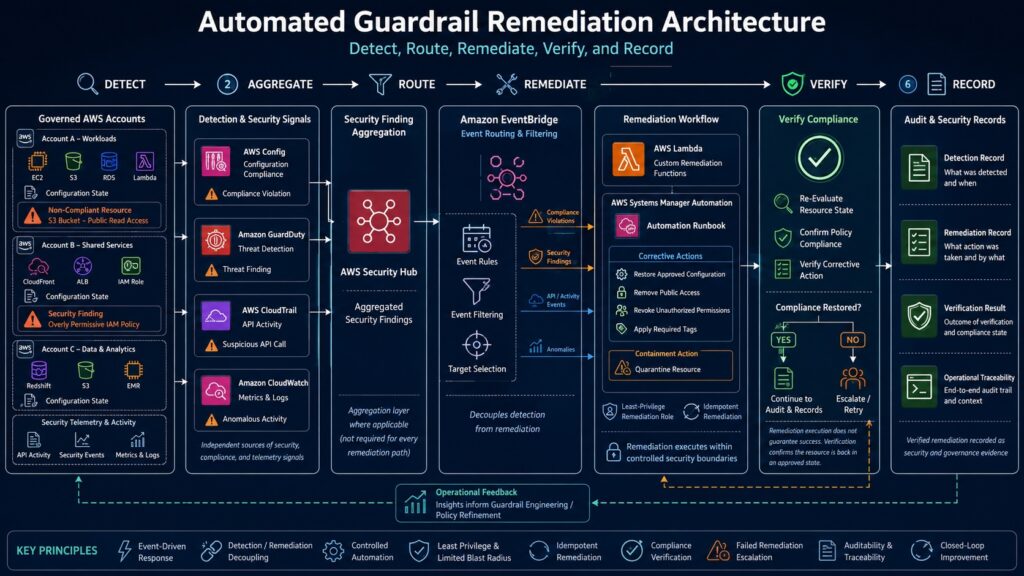
AWS provides a suite of detection services that specialize in specific aspects of the AWS environment. The AWS Config service continuously assesses resource configurations and evaluates them against defined compliance rules. AWS CloudTrail monitors API calls to AWS services, providing an audit trail of activity that can be centrally retained for security analysis and investigation, as discussed in AWS CloudTrail Logs to S3. CloudWatch receives metrics of resource usage and system and application logs. AWS GuardDuty independently analyzes supported AWS data sources and service telemetry for threats. Security Hub can then aggregate GuardDuty findings along with findings from other security services. Together, these services contribute to the broader AWS logging and monitoring architecture that provides the visibility required for continuous security detection and response.
Event-Driven Response
Compliance changes, GuardDuty findings, and other relevant security events can initiate automated response workflows. Amazon EventBridge is a key AWS service that enables these events to trigger response and remediation actions. This forms the basis of an event-driven architecture that decouples detection from remediation. It also supports event rules and filtering, enabling different responses for different event types.
The event-driven architecture establishes a remediation workflow that originates from security event detection or compliance violations. AWS Security Hub can serve as an aggregation stage in this workflow, integrating findings from multiple security sources. Amazon EventBridge provides the event-routing layer, directing relevant events to appropriate remediation targets. Remediation actions are typically implemented using AWS Lambda or AWS Systems Manager Automation.
Automated Remediation
There are corrective actions for misconfigurations, designed to restore resources to an approved configuration state. One key corrective action is to remove unintended public access and revoke unauthorized permissions that compromise resource isolation. These corrective actions help restore the security boundaries discussed in AWS Resource Isolation Security, which limit unauthorized access and reduce the potential blast radius of a compromise. Another remediation action is restoring required tags when resources violate enterprise tagging policies. Significantly, remediation includes disabling or restricting non-compliant resources and returning them to approved states. Certain remediation actions enforce governance policies. These corrective actions restore resources to established governance baselines.
The other major remediation category is containment, with quarantining compromised resources as an important response. It is critical to isolate compromised resources and workloads from production environments to prevent them from causing harm. Good engineering prioritizes remediation actions based on their potential impact and risk. Also, engineering must balance fully automated remediation with approval-controlled actions. Additionally, remediation roles should follow least-privilege principles and limit the blast radius of corrective actions. Finally, remediation should be idempotent so that repeated execution produces a consistent outcome without introducing additional risk.
Verify and Record Remediation
The remediation stage is a critical layer of security and guardrail protection, but it never guarantees success. Consequently, the remediation workflow must include feedback to confirm the correction of misconfigured resources and verify compliance with applicable policies. The remediation workflow must confirm restored compliance and include failed-remediation handling. It must also support escalation when repeated remediation attempts fail.
Beyond defining governance constraints, enterprises must confirm that those constraints are enforced and that corrective actions succeed. This includes recording security events together with their detection, remediation actions, and verification results. These records provide security and audit evidence along with operational traceability. This allows the collection of metrics and effectiveness measurements that close the feedback loop for guardrail engineering.
Scaling AWS Security Guardrails Across AWS Organizations
Organizational Unit-Based Governance
The AWS Organizations hierarchy provides the structure for applying AWS security guardrails across the enterprise as it scales. Organizational Units (OUs) serve as governance boundaries, enabling hierarchical policy inheritance through parent-to-child policy application. OUs can contain other OUs or AWS accounts, which inherit applicable policies through the organizational hierarchy. This enables consistent enforcement across groups of accounts and reduces account-by-account administration.
The organizational hierarchy also separates workloads into different environments, typically production versus non-production. Workloads carry different classifications depending on the environment, and those classifications may require additional security or compliance controls. OUs can also group workloads according to business-unit or governance requirements. Additionally, the hierarchy allows a common enterprise baseline to apply broadly while supporting additional controls for specific OUs, enabling controlled variation without abandoning standardization.
Delegated Administration
The AWS Organizations management account has administrative responsibility for the organization and holds elevated privileges. However, administration of supported AWS services can be delegated to member accounts, reducing the need to perform routine operations from the highly privileged management account. Supported security services can therefore be administered from delegated member accounts, separating organizational management from routine security operations. This reduces operational dependency on the management account while providing central visibility across member accounts.
Security service delegation enables delegated administration for supported AWS security services through a central security account. This allows multi-account security operations for aggregating findings and providing compliance visibility. For example, a central security account can serve as the delegated administrator for Amazon GuardDuty and AWS Security Hub across member accounts. This enables consistent administration across member accounts while enforcing least-privilege administrative boundaries along with separation of duties.
Automated Account Provisioning and Baseline Maintenance
The other important governance scaling activity is controlling how the organization scales when provisioning new accounts. AWS Control Tower and landing-zone architecture support this process by establishing standardized account baselines with required security and governance controls. This standardized multi-account governance architecture is discussed in AWS Secure Landing Zone, which explains how landing zones establish the enterprise foundation upon which guardrails are deployed and managed. This allows guardrails to be applied during account provisioning, establishing a consistent starting state across the enterprise. It also reduces manual account configuration that leads to inconsistencies.
However, it is important to maintain governance after provisioning, which is the starting point rather than the end state. Therefore, governance must enforce continuous configuration assessment to identify configuration drift. Detective controls such as AWS Config can identify configuration drift, while automated remediation can restore affected resources to the approved baseline. Governance must also continuously verify that remediation successfully restores resources to compliance. Hence, AWS security guardrails are continuously managed controls.
Testing AWS Security Guardrails Before Enterprise Deployment
Why Guardrails Need Testing
AWS security guardrails enforce governance policy in constraining unauthorized actions and can block authorized actions when incorrectly implemented. This is compounded since they have broad scope across OUs and accounts. Because guardrails rely heavily on policy logic, errors can deny legitimate API calls and disrupt valid workloads. Hence, governance changes can create enterprise-wide consequences, making security controls a potential outage mechanism.
Guardrails with incorrect policy logic can cause CI/CD deployment pipelines to lose required permissions. They can also make operational tooling unable to perform administrative actions. Additionally, they can break cross-account workflows and cause automation roles to lose permissions. Another risk is unexpected interaction between existing policies and newly introduced controls. There is a tension between security improvement and operational availability. This clearly demonstrates that pre-deployment testing is needed to reduce unintended consequences.
Staged Guardrail Deployment
Following the pattern of software engineering principles, there should be verification of guardrails before broad deployment across the enterprise. As with deploying applications to development environments and sandboxes, a similar practice is needed for guardrail deployment. Guardrails can progress from development and sandbox environments to representative production accounts before broader enterprise rollout. They should only increase scope following successful validation. AWS specifically recommends thoroughly testing the effects of SCPs before attaching them broadly, including using an OU to introduce affected accounts incrementally.
At each stage, engineers should verify policy behavior and confirm that expected workload access continues to function correctly. They should verify that intended violations are successfully blocked while testing deployment pipelines. Furthermore, engineers should validate that cross-account workflows and operational tooling are not impacted by new policy logic. Finally, engineers should establish promotion criteria before extending guardrail scope and continually monitor for unintended consequences.
Rollback and Blast-Radius Control
Engineers need to anticipate that they may need to roll back certain guardrail releases due to poor policy logic causing unintended consequences. Therefore, they need to version guardrail releases, providing a previous known-good version to which they can roll back. They need to establish defined rollback procedures allowing rapid restoration after unintended consequences. Rollback can be automated or approval-controlled according to the risk and scope of the guardrail change. Additionally, they should support this with a deployment history and establish traceability between release and policy version.
Significantly, governance changes have their own blast radius, and policy scope determines the potential impact of a governance change. This should factor in OU-level versus account-level deployment, where broad enterprise policies create a larger blast radius. This further supports the need for controlled rollout, limiting exposure to allow testing before increasing policy scope. This clearly demonstrates that security automation itself should have safeguards. This extends to governance itself being subject to change-risk management
Managing Guardrail Exceptions and Waivers
Why Guardrail Exceptions Exist
Since guardrails scale across the enterprise, they are designed for broad applicability. However, some legitimate workloads are unable to meet standard controls, with legacy workloads being a common example. Another reason is that certain workloads have temporary migration constraints or specialized business requirements. Also, there are regulatory or jurisdiction-specific requirements. The existence of such exceptions does not necessarily indicate poor governance; rather, a zero-exception model is unrealistic at enterprise scale.
Guardrail Exception Lifecycle
When guardrail exceptions are necessary, governance should manage them as controlled governance artifacts. The lifecycle begins with a formal exception request with the specific guardrail or control involved. It also includes the business or technical justification with the affected resources, accounts, or workloads. Governance performs a security risk assessment and recommends compensating controls where appropriate. Approval should identify a named risk owner and document the accepted risk, applicable compensating controls, and authorization for the exception. There is also a separation of duties between parties requesting exceptions and those approving exceptions.
Upon approval, governance controls implementation of exceptions with the narrowest practical scope by targeting the account, resource, or workload. Governance monitors the exception throughout its active period while continuing to enforce unaffected guardrails. Additionally, detective controls monitor for activity outside the approved exception. The implemented exception should remain traceable to its approved request, allowing governance to manage it as a controlled configuration.
Time-Bound Waivers and Expiration
By definition, exceptions should be temporary, with time-bound waivers and defined expiration dates. Each waiver should retain a named owner, documented risk acceptance, and business justification. Significantly, governance must review them periodically and reassess the risk whenever renewal is requested. It should always avoid indefinite policy exclusions.
The overriding objective is to return affected resources or workloads to the standard governance baseline. Automatic or controlled expiration provides the mechanism for ending the exception. Expiration should trigger the planned removal of the exception and reapplication of the standard guardrail. Governance should continually verify compliance and escalate expired but unresolved exceptions. It should also include exception metrics and reporting that provide feedback for guardrail design. Additionally, having recurring exceptions may indicate problems with the baseline.
Measuring AWS Security Guardrail Effectiveness
Guardrail Coverage
Governance must assess the coverage of AWS security guardrails across the enterprise environment, and it should assess the reach of guardrails. Metrics here should include the percentage of AWS accounts covered and OU coverage. They should also include policy deployment coverage and regional coverage and expose any coverage gaps. Governance should use these metrics to compare expected guardrail coverage with actual coverage and provide visibility into unmanaged resources or accounts.
Security Effectiveness
Measuring effectiveness is continuous after deployment and measures violations that guardrails prevented and violations detected by detective controls. Metrics include the number of violations that controls either prevent or detect and the severity of these violations. Governance should collect the frequency of these violations and trends over time. Additionally, governance should evaluate preventive and detective outcomes and collect evidence that controls mitigate their intended risks.
Beyond controls, governance must assess remediation, including recurring violations and the number of remediation attempts. They should also collect successful and failed remediation rates to evaluate the effectiveness of the remediation architecture. This includes verifying whether remediation successfully restored compliance. Governance should also monitor repeated remediation of the same resource, where recurring patterns often indicate underlying issues. These metrics serve as feedback into guardrail refinement.
Operational Effectiveness
Additional performance metrics cover remediation performance, including the mean time to remediation to reduce the duration of security or compliance exposure. This also includes the percentage of violations that were automatically remediated and those that required manual intervention. Other key metrics are failed remediation workflows and remediation retry frequency, along with escalation volume. Ultimately, the critical factor is the time between detection and restored compliance.
The other important metrics category is the number of guardrail exceptions or waivers and their renewal rate compared with expired exceptions. This also includes recurring exception patterns and the level of manual intervention required, which may reveal opportunities to improve guardrail architecture. Governance should measure operational effort and identify guardrails causing deployment failures and delivery team friction. Overall, they should use the metrics to identify controls or workflows that may require redesign.
Architecture and Governance Outcomes
Governance should assess these metrics together rather than examining them independently for a complete picture of guardrail effectiveness. They should evaluate whether guardrails reduce security risk and provide governance consistency. However, they must also assess whether guardrails unnecessarily constrain operational autonomy or create excessive friction for delivery teams. Governance should also identify false or unnecessary enforcement while preserving operational autonomy within established governance boundaries. Ultimately, governance should ensure continuous improvement using evidence-based guardrail refinement.
Guardrail Engineering Anti-Patterns
Policy Engineering and Deployment Anti-Patterns
Manually deploying policies through individual guardrail configuration and account-by-account policy changes leads to increased administrative overhead. This can create configuration inconsistencies, operational and security gaps, and weak change traceability. Manual deployment also makes configurations harder to reproduce during troubleshooting and increases the risk of configuration drift.
Another anti-pattern is deploying high-impact guardrails such as SCPs without adequate verification, particularly because these policies can have broad organizational scope. Insufficiently tested policy changes may contain incorrect logic that denies legitimate actions, disrupts operational tooling, or causes CI/CD pipeline failures. Best practices require testing before broad policy attachment and staged deployment before expanding guardrail scope. Rollback capability should also be available when serious unintended effects occur.
Over-Governance and Exception Anti-Patterns
Overly restrictive preventive guardrails can block legitimate workload operations. This increases developer and delivery-team friction, heightens frustration, and can encourage teams to seek non-compliant workarounds. Additionally, excessive controls can create unnecessary approval dependencies. Governance must continually balance security with operational autonomy and implement controls proportional to actual risk.
Whereas exceptions are necessary in many legitimate cases, there is the risk that these temporary waivers become permanent. Without effective lifecycle management, temporary waivers may lack expiration dates or eventually become unowned. Repeated renewals without risk reassessment can gradually erode the governance baseline and accumulate unmanaged risk. Return to standard controls must be the objective of any exceptions granted.
Applying the same guardrails uniformly across every AWS account ignores differences in workload context and governance requirements. These contexts include production versus non-production differences, business-unit requirements, and regulatory requirements. Proper workload classification helps avoid unnecessary control variation by establishing a common enterprise baseline supplemented with targeted controls where requirements differ. This provides the basis for OU-based governance with controlled variation.
Operational Automation Anti-Patterns
Automated remediation is an important aspect of governance enforcement, but remediation without verification can create additional risk. A remediation action can fail to restore compliance or introduce unintended configuration changes, making post-remediation evaluation essential. The remediation workflow must therefore verify restored compliance and include failed-remediation handling, escalation, and audit evidence.
Governance must ensure that automated guardrails are traceable and have a named control owner. Named owners should remain accountable for policy changes and the operation of automated controls. Remediation workflows also require accountable owners for handling failed automation and escalation. Exceptions also require ownership throughout their lifecycle to prevent temporary waivers from becoming permanent and eroding the governance baseline. Implementing automation must not replace or eliminate governance accountability.
Enterprise Guardrail Engineering Operating Model
The Guardrail Lifecycle
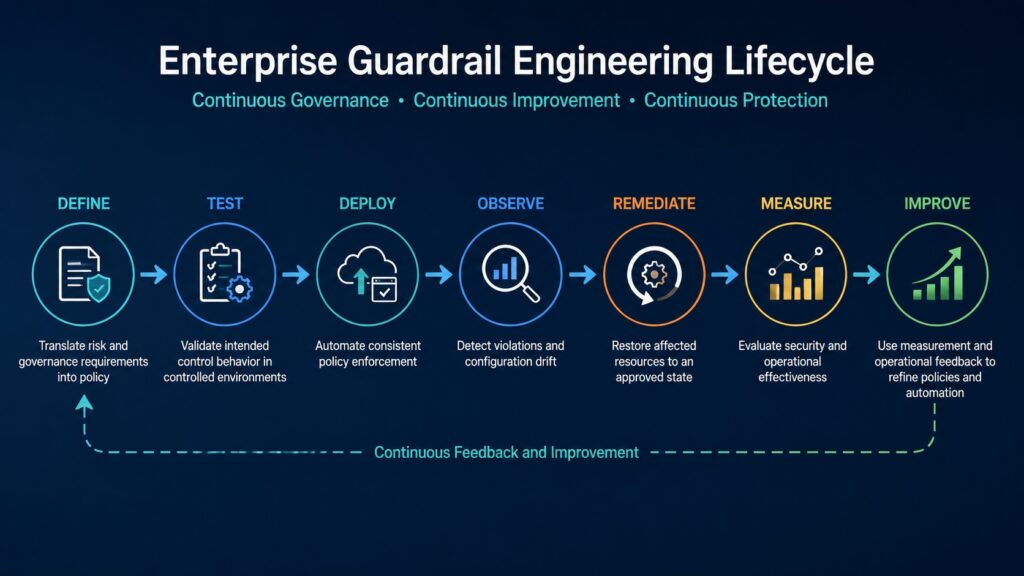
Engineering AWS security guardrails has emerged as a subdiscipline within enterprise architecture, operating as a continuous process rather than a project-based activity. Governance requirements initiate the guardrail lifecycle, and controls evolve with changing security and business requirements. Guardrail deployment is one stage of the lifecycle, with operational feedback feeding subsequent changes. The guardrail lifecycle spans engineering and operations, making it repeatable across the enterprise.
The guardrail lifecycle comprises seven stages. Define translates risk and governance requirements into policy, while Test validates intended control behavior in controlled environments. Deploy automates consistent policy enforcement, and Observe detects violations and configuration drift. Remediate restores affected resources to an approved state, while Measure evaluates security and operational effectiveness. Finally, Improve uses measurement and operational feedback to refine policies and automation.
Enterprise Responsibilities
People remain accountable for governance outcomes even when AWS controls automate policy enforcement. Security and governance teams are responsible for defining governance requirements, while architecture establishes the guardrail patterns and boundaries. Engineering translates requirements into policy code, while peer review and approval provide independent validation before deployment. Platform, DevOps, or security engineering teams can operate the CI/CD mechanisms used for guardrail delivery. Different personnel own different lifecycle responsibilities to support separation of duties, with traceability from requirement to implementation.
Operational responsibilities continue after guardrail deployment, with security operations monitoring guardrail outcomes and responsible teams managing detection and remediation. Failed remediation requires defined escalation paths, while exception management requires accountable ownership throughout the exception lifecycle. Compliance verification, metrics collection, and operational feedback also require assigned responsibilities. Separation of duties should prevent incompatible responsibilities from concentrating under the same authority while preserving clear accountability. Ultimately, every stage retains named accountability even when much of the guardrail lifecycle is automated.
Continuous Governance Improvement
The Improve stage uses measurement and operational feedback to refine policies and automation. The measurement framework includes metrics such as violation trends, remediation effectiveness, and coverage gaps that evaluate guardrail performance. Other metrics evaluate whether guardrails create excessive operational friction, including recurring exceptions, deployment failures, and delivery-team friction. These metrics provide operational feedback for evidence-based policy refinement, allowing the guardrail lifecycle to restart as requirements evolve.
Guardrail engineering extends beyond implementing individual security controls by establishing a repeatable enterprise governance capability. This supports centralized governance through the organizational hierarchy while preserving decentralized workload ownership. Additionally, they enable security consistency at the enterprise scale through automated deployment and monitoring. This enables controlled operational autonomy within established governance boundaries through continuously managed AWS security guardrails. Continuous guardrail engineering allows governance to adapt as security, operational, and business requirements evolve.
Conclusion — Security Automation as an Enterprise Capability
Security Automation at Enterprise Scale
Enterprise AWS environments are continually changing and scaling, making manual security controls difficult to implement and maintain consistently. Enterprise architecture therefore favors progressing from manual controls to automation. These automated controls have evolved into engineered AWS security guardrails, with guardrail engineering supporting continuous governance. This makes security automation an enterprise capability rather than isolated tooling.
There is a suite of AWS services that comprise components of the governance architecture. AWS Organizations SCPs establish preventive permission boundaries across the organizational hierarchy. Within landing-zone environments, AWS Control Tower provides standardized controls. AWS Config evaluates resource configurations against compliance rules, while Amazon GuardDuty detects threats and AWS Security Hub aggregates and evaluates security findings. Together, these services contribute to a coherent security architecture.
Guardrail Engineering as a Continuous Capability
Guardrail engineering adopts many software engineering practices, implementing governance policies as code. These practices include policy version control, peer review, and pre-deployment testing and validation. Next is automated deployment to ensure consistency and event-driven remediation to reduce manual intervention. Verification, exception management, and effectiveness measurement provide continuous feedback and improvement. The core characteristic is repeatability.
A core goal of guardrail engineering is the consistent enforcement of governance boundaries at enterprise scale. Additionally, guardrail engineering supports governance adaptation in response to workload and organizational change while maintaining controlled operational autonomy. Security governance must also adapt as requirements evolve, and guardrail engineering ensures that guardrails remain continuously managed capabilities. AWS security guardrails establish governance boundaries. Guardrail engineering ensures those boundaries remain consistently enforced as the enterprise changes and scales.
Further Reading
Affiliate Disclosure: Some links on this page are affiliate links. As an Amazon Associate, AI Cloud Data Pulse earns from qualifying purchases. We also participate in the Pluralsight affiliate program and may earn a commission if you subscribe or purchase through our links, at no additional cost to you. We only recommend courses and resources that provide genuine value to our readers.
Recommend Books
Security as Code: DevSecOps Patterns with AWS
by BK Sarthak Das, Virginia Chu
AWS Security Cookbook: Practical solutions for securing AWS cloud infrastructure with essential services and best practices
by Heartin Kanikathottu
Practical Cloud Security: A Guide for Secure Design and Deployment
by Chris Dotson
Online Learning
For readers who prefer structured video training, Pluralsight provides courses covering AWS security, cloud governance, DevSecOps, and security automation.