Introduction
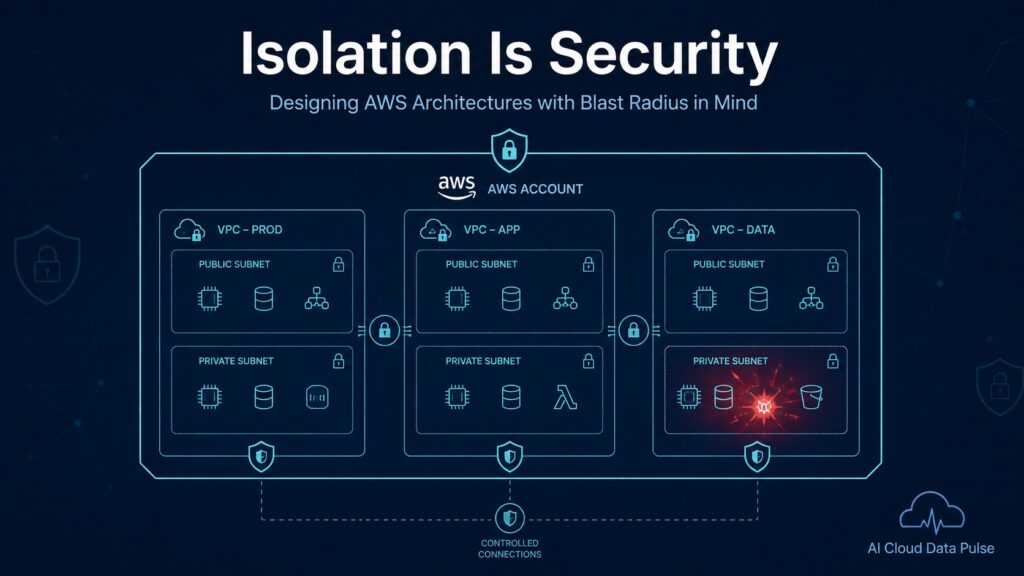
AWS resource isolation security establishes AWS fault isolation boundaries that separate workloads into control boundaries and limit interaction between these boundaries. Its goal is to isolate failures and compromises by preventing uncontrolled lateral movement. This is needed since permissions alone will not remove reachability, and exposed resources increase the attack surface. Hence, segmentation complements IAM controls by reducing who can access resources through isolation. Therefore, architecture should control exposure through segmentation and trust boundaries. For a broader discussion on why security begins with architectural boundaries rather than permissions alone, see AWS Infrastructure Security: Why Architecture Comes First.
AWS implements network segmentation through Virtual Private Clouds (VPCs) and trust boundaries through AWS Accounts. VPCs divide infrastructure into controlled zones using network-level isolation boundaries that control routing and connectivity. VPCs further segment the network into subnets with route tables and provide layered defense for traffic flow using Security Groups and NACLs.
These isolation principles also apply when extending AWS environments into on-premises networks. Hybrid connectivity introduces additional trust assumptions and exposure paths that architects must evaluate carefully. For a detailed discussion, see AWS VPN vs Direct Connect Security: The Security Trade-offs That Actually Matter.
AWS accounts serve as the strongest isolation boundary in AWS and separate IAM control planes between trust boundaries. Understanding how identities, roles, and permissions operate within those trust boundaries is equally important for designing secure AWS environments. For a deeper discussion, see AWS IAM Architecture: Designing Identity Boundaries at Scale. Furthermore, they enable SCP enforcement and establish guardrails for AWS Accounts.
What Is AWS Resource Isolation Security?
Isolation as a Security Control
Isolating AWS resources is the foundation for architected security since it reduces reachability from other workloads within and outside AWS. The ability of workloads to connect to AWS resources is a security concern, as increased exposure increases the attack surface. When a workload needs to access a resource, reachability should exist before IAM evaluation.
When applying the principle of AWS resource isolation, the architecture defines the exposure paths for each workload. Architecture implements resource isolation through network segmentation and trust boundaries. Network segmentation constrains interactions, since workloads can reach resources only through predefined network paths. Trust boundaries limit propagation since workloads outside of boundaries require special permissions.
From Resources to Boundaries
Architecting security through resource isolation prevents workloads from operating independently and freely accessing other resources. Establishing boundaries forces systems to interact through these boundaries, allowing control of their interactions, especially when a workload is compromised. Hence, these boundaries govern communication and trust between resources, allowing security controls to better respond to attack propagation.
Blast radius is the range of attack propagation from compromised workloads, and weak boundaries expand it. Additionally, architecture that implements poor segmentation enables lateral movement of message propagation that reaches other resources far more easily. This increases the attack surface of these resources. Therefore, implementing strong boundaries and segmentation will better contain failures and compromises.
Understanding AWS Fault Isolation Boundaries
What Are Fault Isolation Boundaries?
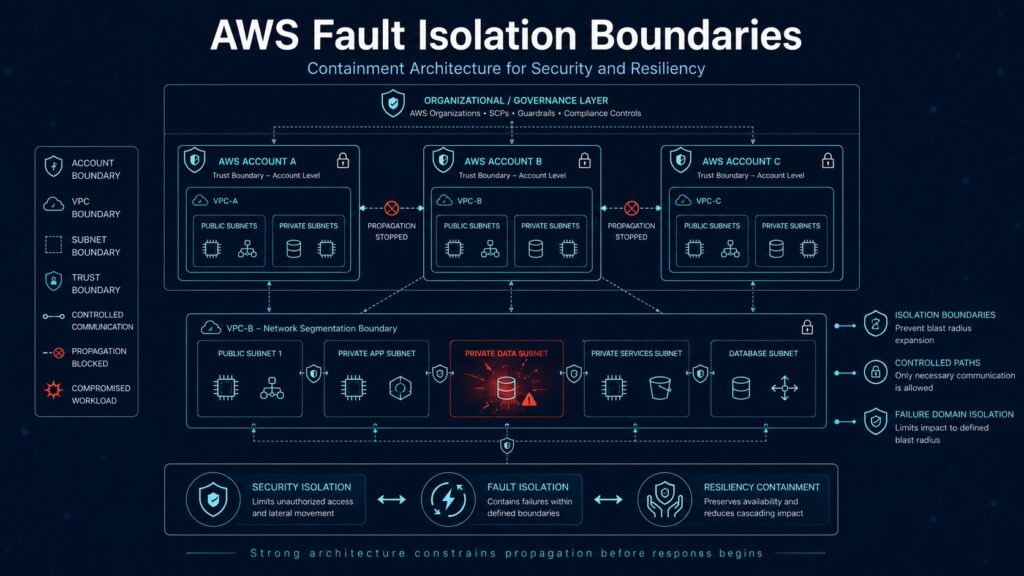
An AWS Fault Isolation Boundary is an architectural boundary that prevents faults, disruptions, or compromises from reaching resources in other boundaries. It stops these faults from propagating across the AWS ecosystem and compromising or disrupting other workloads or services. They act as containment mechanisms where failures stop within them, and their implementations include AWS Accounts and Virtual Private Clouds (VPCs).
There are also other fault boundary implementations within AWS, and they do not provide equal containment but have varying isolation strengths. AWS Accounts are the strongest isolation boundary since they separate IAM control planes, preventing access from entities outside the account. However, VPCs provide network segmentation, offering layered defense by limiting the paths for network access in the event of failures or compromises.
Fault Isolation vs Security Isolation
There is also an overlap between fault and security isolation, where similar architectural mechanisms support both. They have different objectives where fault isolation protects availability, and security isolation limits compromise spread. However, they often propagate through the same architectural paths. Hence, this strengthens the connection between resilience engineering and security architecture.
Therefore, the architecture unifies these two mechanisms, building a secure and resilient ecosystem. VPCs implement network segmentation that supports both resilience and security by limiting the network propagation paths for faults and compromises. AWS Accounts implement permission boundaries that help contain faults and compromises from propagating to other workloads and systems. Additionally, having strong containment improves recoverability.
Account Isolation vs VPC Isolation
Why Accounts Are the Strongest Boundary
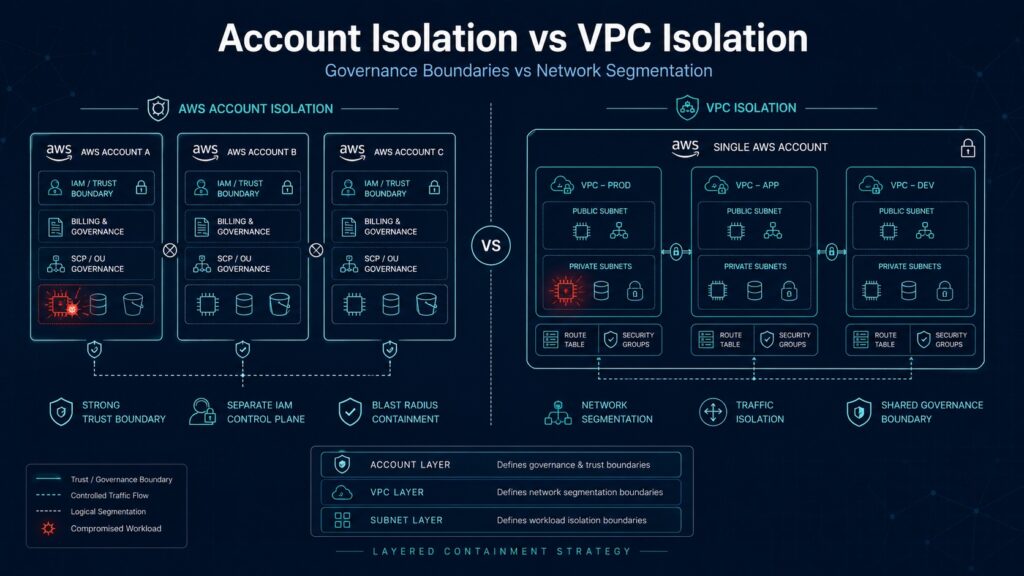
AWS Accounts provide the strongest resource isolation for security, as they have separate IAM control planes that prevent access outside their boundaries. They also establish billing and service limits that help to contain operational, financial, and security impact within their boundaries.
AWS Accounts’ critical role is to contain the blast radius within their boundaries and not impact other resources. Additionally, they have SCPs that establish guardrails that limit entities’ behavior within Account boundaries. For a deeper discussion on governance guardrails and organizational segmentation, see AWS Organizations and SCPs. This extends to organization units (OUs), with guardrails on account and OU groupings to establish governance across the AWS ecosystem. At enterprise scale, these account boundaries, OUs, and governance controls form the foundation of an AWS secure landing zone, where workloads are organized into standardized security and operational boundaries.
Where VPC Isolation Fits
AWS VPCs support resource isolation security by segmenting the networks, usually matching Account trust boundaries. They establish traffic flow by limiting the paths through which access can propagate between segments using route tables and their controls. These segments are further divided into subnets, providing fine-grained segmentation and tighter traffic control. They control traffic on these paths using Security Groups and NACLs that allow traffic to specified sources and destinations. For a detailed comparison of subnet and instance-level traffic controls, see Security Groups vs NACLs. However, they do not govern which entities are permitted to access resources, such as trust boundaries.
Isolation boundaries also extend into AWS compute models. EC2 provides isolation at the virtual machine level, ECS isolates workloads at the task and container level, and EKS introduces pod and namespace isolation within Kubernetes orchestration. For a deeper comparison of how compute abstraction changes security responsibilities and isolation boundaries, see EC2 vs ECS vs EKS: Why AWS Compute Security Isn’t the Same.
Choosing the Right Boundary
The architect’s job is to partition resources into trust boundaries that maximize implicit security but minimize bottlenecks. Practical resource grouping centers on production vs. development and on highly regulated workloads. Isolating workloads also makes sense if they are internet-facing or exposed to high risk, isolating attacks from the rest of the ecosystem.
Within the ecosystem, VPC isolation is sufficient when the risk levels between workloads are similar, leading to operational simplicity. Additionally, VPCs provide internal segmentation through subnets, limiting access paths between resources and controlling traffic. They also provide a layered containment strategy with AWS Accounts establishing defense in depth.
Segmentation as an Operational Control
Segmentation Reduces Blast Radius
AWS ecosystems require resource isolation for security, since unrestricted communication between workloads increases operational and security risks. Segmentation reduces unnecessary connectivity, thereby limiting lateral movement and constraining communication. It forces workloads to communicate through controlled paths and constrains attack propagation. It also reduces the exposure of workloads, limiting the attack surface. Different compute models also affect how segmentation and containment operate within AWS. EC2, ECS, and EKS each implement different workload isolation boundaries that influence blast radius and lateral movement risks.
Segmentation also supports AWS fault isolation boundaries by constraining the failure scope within the AWS ecosystem. It isolates failures and compromises when a network segment experiences a failure or compromise; the propagation is limited to controlled paths. This minimizes implicit trust between networks and aligns with zero-trust principles. Therefore, segmentation improves both resiliency and security posture.
Practical Segmentation Patterns
An important segmentation pattern is to segment different environments into their own networks, traditionally development, test, and production. Each environment has its own risk levels, stability requirements, access patterns, and operational controls. Production environments are far more sensitive to mistakes than development environments, and isolating them prevents developer mistakes from reaching production.
Other segmentation patterns include tier-based segmentation, where the web application, business application, and database are separated. These have varying levels of trust, and segmentation prevents a compromised web application from attacking the database. They are typically partitioned by subnets within the VPC, with Security Groups and NACLs controlling traffic. Therefore, segmentation aligns with workload trust levels and communication requirements.
The Shared Services Anti-Pattern
Centralization vs Isolation
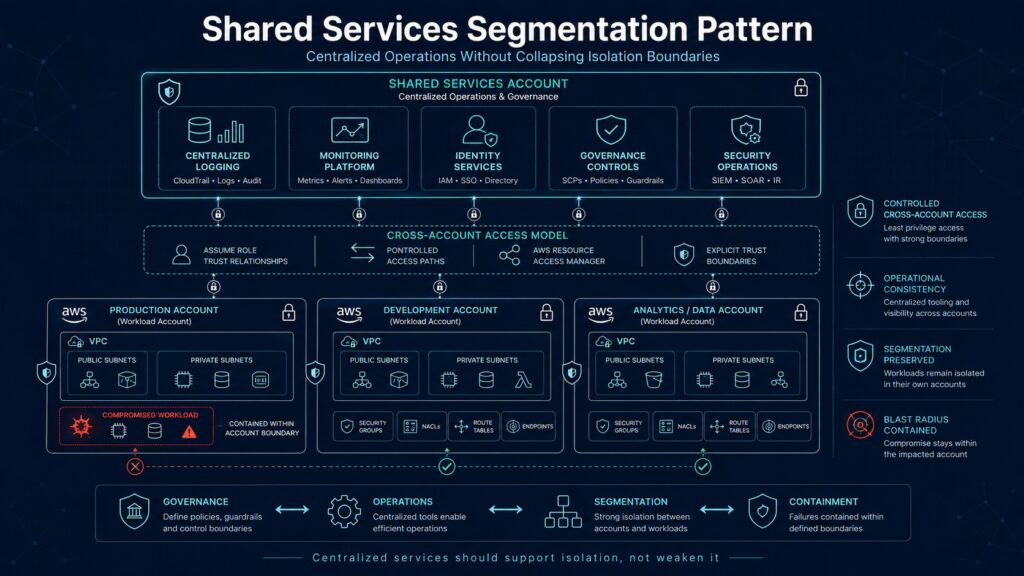
Every multi-boundary environment typically has shared services within centralized VPCs that serve all workloads to simplify operational control. Having these services aggregated within the same network segments and trust boundaries increases their interconnectivity and implicit trust. Achieving this centralization for operational convenience can weaken their isolation.
The implications of shared services with a common network segment and trust boundary increase the blast radius of compromised workloads. There are lateral movement risks where compromises and failures can easily propagate across workloads. These architectures are over-connected so that excessive centralization can undermine containment strategies.
When Shared Services Make Sense
However, there are many legitimate shared services for which centralization is essential for operational control of the AWS ecosystem. These services include centralized logging, identity services, monitoring platforms, and governance tooling. It is necessary to centralize these services to achieve operational consistency across the whole environment. For broader monitoring and observability strategies in AWS environments, see Best Monitoring Tools for AWS. Monitoring architectures also influence trust boundaries and segmentation strategies, as discussed in Prometheus vs CloudWatch.
Architects should enforce tighter security measures around these centralized services to address their weakened isolation. These include tightly controlled access, least privilege, cross-account access patterns, and avoiding flat trust models. They should also preserve segmentation between shared services to support their isolation and not weaken it.
Cross-Account Access Done Safely
Using AWS Resource Access Manager
There are many scenarios and use cases where workloads need to access resources in other trust boundaries or AWS accounts. Architects need to enforce controlled resource sharing while preserving account isolation. The AWS Resource Access Manager (RAM) enables cross-account resource sharing without collapsing trust boundaries.
Resource sharing should avoid broad network exposure and flat connectivity models that undermine resource isolation. Additionally, it should ensure that direct access paths are limited and resource visibility is controlled. Architects must ensure that segmentation is preserved to minimize unnecessary reachability when sharing.
IAM Roles and Least Privilege
Another pattern that enables cross-trust-boundary (cross-account) resource sharing is the IAM AssumeRole pattern, which provides temporary access. Workload requiring access is granted a role with a limited set of permissions within the other AWS account, enforcing least privilege.
This makes trust relationships explicit and keeps permissions scoped using role-based delegation.
Least privilege enforcement is key to maintaining resource containment within trust boundaries. Architects should avoid wildcard permissions and minimize privilege propagation when developing cross-account access policies. This is to limit the impact of compromise and preserve isolation integrity. Therefore, cross-account access supports collaboration without weakening containment.
Designing for Blast Radius Reduction
Think in Failure Domains
Architects, when designing for blast radius reduction, should always assume that compromise is possible with all workloads. Therefore, they should evaluate failure domains, understand workload dependencies, and identify exposure paths. They should work with the mindset of anticipating compromise rather than assuming perfect prevention.
Architects need to identify what spreads vs what stops when evaluating blast radius. They should also identify the propagation boundaries, along with containment zones. Architects should primarily aim to limit cascading failures and compromise when designing trust boundaries to constrain propagation.
Architecture as Prevention
Architectures will never prevent all events, but they should minimize them and minimize the need to respond to events. Hence, isolation is preferred before detection and response. Segmentation and reduced exposure limits attack opportunities before monitoring is needed.
Therefore, architectures should support resilient security design to enable rapid recovery from a security event. Containment-first thinking and layered boundaries ensure compromises are isolated prior to any response. Hence, governance and segmentation together limit damage before incident response begins.
Conclusion
AWS resource isolation security is architectural and is not an option. It contains compromises and failures and prevents them from spreading to other workloads. These are implemented as Accounts and VPCs within AWS and serve different containment roles. Network segmentation implemented by VPCs reduces the blast radius, while AWS fault isolation boundaries constrain compromise and failure propagation. Together, they enforce a layered containment strategy isolating resources from compromised workloads.
VPC network segmentation limits the exposure paths that compromise and failures can reach other resources in the network. AWS Account trust boundaries limit the access that compromised workloads have to resources within other trust boundaries. These boundaries can be further strengthened through AWS Organizations Service Control Policies (SCPs), which enforce governance guardrails across multiple accounts. This prevention-oriented design aids resiliency since responses can quickly contain security events, minimizing damage and enabling faster recovery. Overall, good architecture limits damage before it even starts.
Further Learning
Practical Cloud Security: A Guide for Secure Design and Deployment by Chris Dotson
For readers wanting deeper hands-on exposure to AWS security architecture, IAM trust boundaries, segmentation strategies, and multi-account governance, Pluralsight offers advanced AWS security and cloud architecture learning paths that complement the concepts discussed in this article.
Disclosure: As an Amazon Associate and Pluralsight affiliate, AI Cloud Data Pulse may earn commissions from qualifying purchases made through links in this article. These recommendations are provided because they are relevant to the topics discussed and may help readers deepen their understanding of AWS security and cloud architecture.