
Introduction
Feature importance in machine learning has become increasingly important as organizations seek to better understand how machine learning (ML) models make predictions. We should remember that no matter how sophisticated machine learning models become, they can still produce incorrect predictions. An important example is large language models (LLMs) and other frontier models that may hallucinate by generating inaccurate information. Consequently, ML engineers use a range of evaluation metrics to measure, tune, and refine model performance.
Several common examples include precision and recall, which help evaluate classification model performance. They have demonstrated that accuracy alone is insufficient for evaluating ML performance. Additional evaluation approaches, such as ROC and Precision-Recall analysis, provide deeper insight into classifier behavior across different decision thresholds. Readers seeking a broader introduction to classification metrics can explore Precision vs Recall Explained with Real-World Examples, while a detailed comparison of threshold-based evaluation is covered in ROC Curve vs Precision-Recall Curve Explained for ML Models.
However, relying solely on performance metrics is often insufficient for understanding the domains in which ML models operate. Stakeholders are demanding that organizations disclose how their ML models are evaluated and the factors influencing their predictions. As a result, feature importance in machine learning has become an increasingly important concept for understanding and explaining model behavior.
Metrics indicate a model’s performance and are often used to refine it, but metrics alone will not improve performance. ML research has found that it is also essential to uncover the factors that are driving a model’s predictions. These factors are the features of the domain in which the ML operates. This is because some features influence ML prediction more than others. A simple example is that house location has far more influence on house price than its paint color.
Organizations understanding the key features influencing an ML model’s predictions can better explain ML’s performance to stakeholders. Also, decision-makers can focus more on the important features when making decisions based on ML predictions. Additionally, ML engineers are better able to refine their models. This article will explore how feature importance influences ML model behavior and how to calculate feature importance. It also shows how to utilize feature importance with ML models.
What Is Feature Importance in Machine Learning?
Definition of Feature Importance
The definition states that feature importance is a measure of how much an input feature contributes to a machine learning model’s predictions. In other words, it is a measure of how each input feature influences the classification that an ML model makes. This measure is relative to the other input features that the model uses to make a classification. The key takeaway is that input features do not have equal influence on the ML outcome. This impacts ML performance measurement and decision-making based on ML outcomes.
Feature Importance Scores
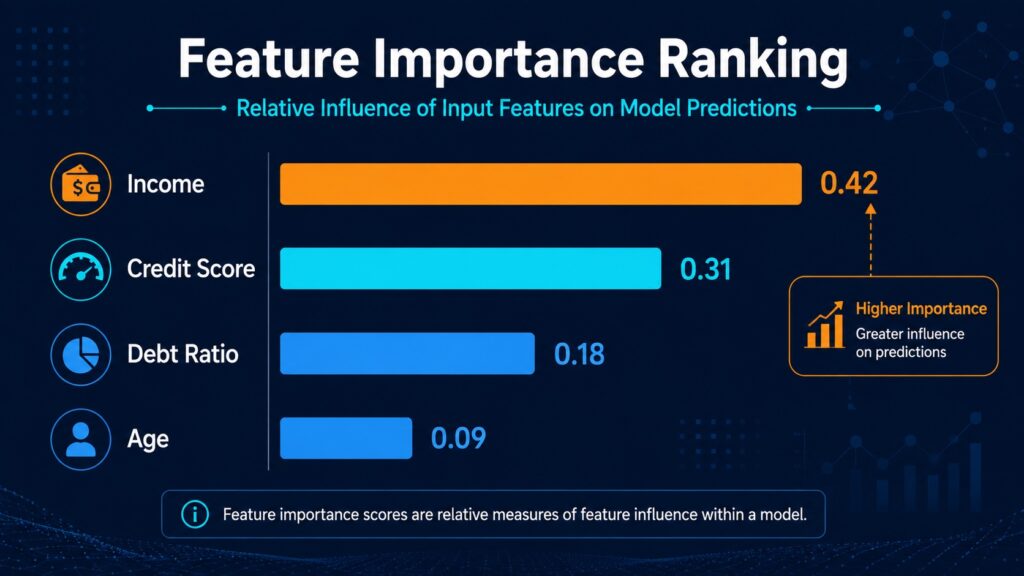
Hence, it is necessary to uncover the relative importance of input features and map their influence on overall model behavior. This starts with calculating the relative importance score of each input feature using one or more common methods. After this, the input features are ranked according to their feature importance scores. Using their relative influence, each input feature is assessed on its contribution to model predictions. This shows the influence each input feature has on the overall model behavior when evaluating it using performance metrics.
Feature Importance in Fraud Detection
It is beneficial to understand the significance of feature importance in machine learning for real-world applications. Fraud detection is an important example to consider. Here, feature importance helps identify which transaction characteristics have the most influence whenever the model flags it as fraudulent. In fraud detection, the amount typically has high feature importance, whereas device type often has low importance. ML engineers can better interpret model decisions using feature importance, such as for fraud, using transaction amounts. By understanding prediction drivers, engineers can better explain prediction outcomes to stakeholders, making decisions on these outcomes.
Why Feature Importance in Machine Learning Matters
Feature importance in machine learning extends insight into ML models beyond what performance metrics can provide. Metrics such as AUC and F1 Score quantify overall model performance, while ROC and Precision-Recall curves evaluate classifier behavior across different decision thresholds. For a detailed comparison of these threshold-based evaluation methods, see ROC Curve vs Precision-Recall Curve Explained for ML Models. In contrast, feature importance explains why predictions occur by identifying which input features have the greatest influence on model decisions. The relative importance of an ML model’s input features typically reflects their influence on the real-world domain in which the model operates. It helps explain prediction outcomes, especially to stakeholders affected by the model’s classifications, and enables better-informed decision-making based on ML guidance.
Better Model Interpretation
Feature importance often reflects important relationships within the domain represented by the training data. It clearly indicates the feature influence on the prediction outcome by showing which features have the greatest contribution to the outcome. Feature importance provides visibility into model behavior by indicating which features the model relies upon. It identifies the key prediction drivers by indicating whether important features align with domain knowledge. It helps stakeholders evaluate whether the model’s behavior is reasonable and aligned with domain knowledge.
Improved Business Insights
Businesses that use ML predictions to make decisions can use feature importance to align decisions with ML predictions. It allows businesses to identify key business drivers that typically map to the features with greater importance scores. Businesses can perform resource prioritization based on these key business drivers that contribute to strategic planning. An example is predicting which customers are likely to leave (customer churn). By deriving feature importance, the business can identify the factors causing a customer to leave, such as the number of support tickets.
Detecting Noise and Irrelevant Features
ML engineers also benefit from understanding feature importance applied to the models they build. Input features with relatively low importance can often impede good ML model design. Many features are irrelevant or redundant, and engineers should consider them during feature selection for the model. By removing these features, they can reduce unnecessary complexity with the ML model and simplify it. Also, removing unnecessary features will reduce the computational overhead required and improve model efficiency. Hence, by optimizing feature sets, engineers can optimize model performance.
Supporting Explainable AI
The black-box nature of AI is a source of anxiety for many stakeholders. Therefore, any opportunity to provide transparency behind ML classification can help to build trust with stakeholders. Feature importance helps explain how models arrive at their classifications. Explainable AI aims to make model decisions more transparent and understandable to stakeholders. Stakeholder concerns often translate into governance requirements and, increasingly, regulatory expectations that reflect public concerns. This also places obligations on businesses to adopt responsible AI practices that include explaining the foundations of their AI systems. These transparency requirements increasingly align with AI governance frameworks such as the NIST AI Risk Management Framework. Additionally, organizations are required to practice AI risk management and adopt AI governance support.
How Feature Importance in Machine Learning Works
Evaluating Feature Contribution
Determining feature importance in machine learning begins with evaluating feature contribution, which measures the extent to which a feature improves predictions. An example is that income contributes significantly to loan approval predictions, but Customer ID contributes very little. Typically, feature contribution is mapped to a numeric value. The subsequent step is to compare the input variables based on their feature contribution to assess their contribution relative to one another. These features are then ranked according to their contribution to predictions, typically for loan approvals, income ranks highest. Finally, unequal feature influence is recognizing that some features have a greater influence on predictions than others.
Feature importance is used as a diagnostic tool when looking to better optimize prediction by improving feature selection and engineering. This includes removing less relevant features, adding more relevant features, or investigating missing important variables. Improving feature selection and feature engineering can reduce prediction error and thereby reduce prediction uncertainty. Typically, there are high-contribution features that are more relevant, and engineers should include them in the model. Conversely, there are low-contribution features that are less relevant, removing these can improve model prediction.
Feature Importance in Linear Models
AI research has introduced a diverse range of ML models, each typically optimized for different problem domains. These model types use different algorithms, resulting in different methods for calculating feature importance for their input features. Given the diversity of feature importance calculation methods, there is no single universal feature importance metric. Evaluating feature importance is model architecture-specific, and feature analysis is model-specific as well.
Linear regression is a common ML model in which engineers approximate the relationship between input features and the predicted value as linear. Input feature importance is typically mapped to the coefficients associated with each input feature. The coefficient is the feature-to-target relationship, and its magnitude signifies the strength of that relationship. Feature inputs with higher coefficients have a stronger influence, whereas those with lower coefficients have a lower influence.
Feature Importance in Tree-Based Models
Decision trees and random forests can make predictions where the relationship between input features and predicted value is non-linear. The decision tree algorithm divides the data on the value of an input feature, repeatedly selecting the feature that provides the greatest improvement in prediction accuracy at each split. An input feature’s split gain is the improvement in prediction when that feature is used to divide the data. The random forest aggregation averages the prediction across many trees. In this case, feature importance varies across trees and is therefore aggregated.
Gradient boosting models are an extension of decision trees, but differ from random forests in that they evaluate trees in sequence. Random forests calculate averages and operate in parallel. Gradient trees perform iterative error reduction and learn from prediction errors. Therefore, feature importance is based on the extent to which a feature contributes to reducing prediction errors across multiple boosting rounds. Features that consistently improve predictions across multiple boosting rounds receive higher feature importance scores.
One limitation of impurity-based feature importance is that features with many unique values can sometimes receive artificially high importance scores. This bias can make variables such as identifiers, timestamps, or high-cardinality categorical features appear more influential than they truly are. Permutation importance helps address this issue by measuring the impact of shuffling feature values on model performance.

Common Methods for Calculating Feature Importance
Feature importance in machine learning identifies the input features having the most influence on the model prediction. This is typically unknown until after training the model and calculating the contribution of each feature to the model’s predictions. However, there are several approaches to calculating the importance of input features, which typically depend on the model type. There is no universal importance metric, but there are several common techniques for calculating feature importance. These allow measurement of the contribution of each input feature.
Impurity-Based Feature Importance
Many relationships in real-world domains are non-linear, with many of these based on thresholds. A useful example is that a transaction becomes suspicious when its amount crosses a certain threshold. Models that predict these relationships are typically tree-based models with the decision tree as the basic building block. Variants include the single decision tree, random forests, and XGBoost. Random forests and XGBoost have multiple decision trees and perform calculations in parallel or in sequence, respectively.
Decision trees test thresholds on each input feature. Features whose thresholds improve the decision tree’s predictive ability have a higher split gain. Hence, they contribute more to the model’s prediction. Such features reduce impurity and therefore receive higher feature importance scores. Credit score for loan approvals significantly reduces impurity since the group with a credit score over 700 is mostly approved. Those with credit scores under 700 are mostly rejected.
Permutation Feature Importance
Unlike linear or tree-based models, other more complex models do not easily give up information on input feature importance. Even linear or tree-based models with a significantly large number of input features make feature importance calculation difficult. Hence, feature importance calculations that are not model-specific are important techniques. This includes permutation feature importance, which shuffles each feature to determine its importance.
The algorithm for determining a feature’s importance is to randomly shuffle its values within an input dataset. However, the values of the other feature are unchanged. The change in the model’s prediction from that before shuffling the feature indicates the feature’s importance. A significant change indicates the feature is important, while an insignificant change indicates that it is unimportant. Testing each feature this way indicates the relative importance of each feature based on the change in prediction after shuffling.
This allows easy interpretation of complex models without calculating feature importance from the model itself.
Scikit-Learn also provides model-agnostic permutation importance implementations for evaluating feature importance across different model types.
Coefficient-Based Importance
There are many real-world domains that closely resemble linear relationships, allowing linear-based models to make reliable predictions. The most common examples are linear regression and logistic regression models that consist of a set of regression coefficients. The models make predictions simply by multiplying each input feature by its corresponding regression coefficient and summing all the products. In these domains, this is a practical solution without the additional processing that more complex models require.
Feature influence is relatively simple to compute, since it is directly related to the magnitudes of the corresponding regression coefficients. This applies whether the relationship is positive or negative, depending on the sign of the regression coefficient. A common example is loan approval, where income typically has a higher regression coefficient, implying greater feature importance. In contrast, age typically has a lower regression coefficient and thereby lower feature importance.
SHAP Values and Explainability
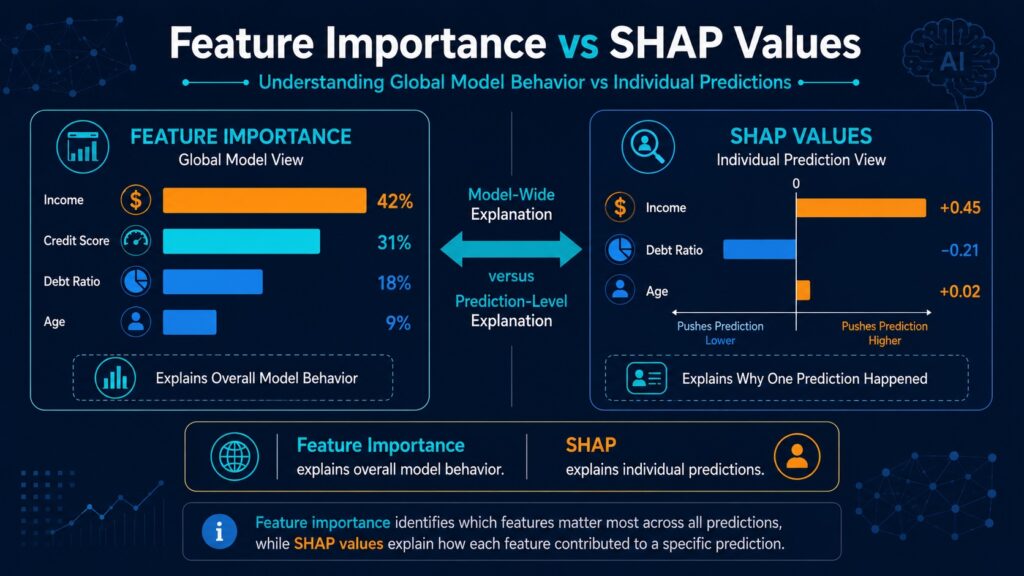
Associated with feature importance are SHAP values that explain how input features contribute to a specific prediction. A simple example is loan approval, where feature importance shows that income is the most significant feature, whereas age is the least significant. For the case of high income with high approval probability, then the SHAP value for income is a high positive value. The SHAP value for age is also positive, but much lower than for income. When income is low, resulting in a low approval probability, then income SHAP is typically negative but still has a high magnitude. Age SHAP could be positive or negative, but it still has a low value.
Feature importance is valuable for improving model performance, but SHAP values help explain how the model arrived at its prediction. This is important for model transparency and gaining stakeholder trust. As AI undergoes greater scrutiny, there are growing demands for AI governance, and SHAP values help address them. Exploring SHAP in more detail is beyond the scope of this article. Readers interested in explainability techniques can explore the official SHAP documentation.
Common Methods Conclusion
From surveying some of the more established methods for calculating feature importance, there is no single method that is better than the others. Similar to how different models are applicable to different domains, the same is true for different importance methods. Different importance methods are applicable to different domains and their corresponding models. Hence, engineers should interpret feature importance in machine learning within its model and business context.
Practical Example Using Scikit-Learn
Practical examples help solidify understanding of feature importance concepts, and the Scikit-Learn library supports several feature-importance methods. It also implements tree-based machine learning models, including RandomForestClassifier, and provides tools for training and evaluating models. RandomForestClassifier has built-in feature importance and directly exposes importance scores after training. This example will use this model for the demonstration. The Iris dataset is used since it is small and easy to understand, and its features have different predictive power. This will show feature importance calculation as well as how to use feature importance to interpret model behavior. For additional implementation examples, see the Scikit-Learn documentation on feature importance
from sklearn.datasets import load_iris
from sklearn.model_selection import train_test_split
from sklearn.ensemble import RandomForestClassifier

# Load the Iris dataset
iris = load_iris()
X = iris.data
y = iris.target

# Split into training and test datasets
X_train, X_test, y_train, y_test = train_test_split(
    X, y, test_size=0.2, random_state=42
)

# Train the Random Forest model
model = RandomForestClassifier(
    n_estimators=100,
    random_state=42
)

model.fit(X_train, y_train)
This code block is the first stage of the overall example of training a model and using feature importance for model refinement. This begins by loading the Iris dataset, which is used to demonstrate feature importance, and then splitting it into training and testing datasets. The selected model is RandomForestClassifier because it provides built-in feature importance scores. The model is initialized with the number of decision trees in the random forest (n_estimators) and a fixed random seed (random_state) to ensure reproducible results. Finally, the fit() method is invoked to train the model using the training dataset.
Extracting Feature Importance Scores
Once training is complete, the model has learned feature-to-target relationships. This is through the construction of the decision trees, where it evaluates the feature split. For each decision tree in the forest, the model calculates the split gain of each feature to determine its contribution to prediction accuracy. The split gain is calculated by assessing the impurity reduction. The split gain for each feature is aggregated across all decision trees in the forest. The model then generates the importance score, which indicates the relative feature contribution. It then ranks the features and enables feature importance extraction.
feature_importances = model.feature_importances_

for feature, importance in zip(
    iris.feature_names,
    feature_importances
):
    print(f"{feature}: {importance:.3f}")
Interpreting Feature Importance Scores
The raw values derived from split gain are difficult to interpret in isolation and must be compared side by side. When comparing them together, they show the relative importance between features. The crucial next step is ranking features according to these scores. The importance score comparison shows the most influential features and the least influential features. This indicates which features contribute most to model predictions and which have relatively little influence. In the Iris dataset, species are distinguished by their petal characteristics, so petal length and petal width typically rank the highest in importance. Sepal measurements overlap much more between species and typically rank lowest in importance.
Engineering Value of Feature Importance
There are several ways in which feature importance is valuable for engineering ML models. Feature importance primarily supports feature selection, which is an important stage of ML model development. Certain features in a domain are more significant than others, and identifying them helps the model better capture the relationships within the domain. It identifies redundant and low-value features that engineers should consider removing. Engineers can simplify the model and improve its efficiency due to less processing required to produce an outcome.
Feature importance is also valuable in explaining the model, especially as AI systems face more scrutiny. Feature importance supports explainability, while SHAP provides more detailed explanations of individual predictions.
Challenges and Limitations of Feature Importance
ML model development includes a range of techniques for refining and improving ML models, with feature importance being one of them. Like any analytical technique, feature importance has strengths and limitations, with interpretation highly dependent upon context. These contexts include model-specific behavior and domain-specific behavior. Engineers should view it as a decision-support tool and be aware that they could derive potentially misleading conclusions from it. Therefore, they should use complementary evaluation methods and apply domain expertise and careful result interpretation.
Correlated Features
Input feature datasets and feature selection are an integral part of ML models, as are the models themselves. Highly correlated features add little value to prediction and increase processing requirements similar to redundant and low-value features. They can also dilute or even split the importance, masking the importance of either feature. An example is house price prediction, where house size and number of rooms are typically highly correlated. This makes it difficult to reliably interpret the results, and engineers should apply a suite of diagnostic techniques.
Misleading Importance Scores
Different domains often require different ML models, resulting in a range of model architectures and levels of complexity. Correspondingly, feature important methods are typically specific to different ML models. Hence, feature importance calculation methods vary according to the ML model architecture. Calculating feature importance scores for Random Forest differs from that of logistic regression. Hence, interpretation is dependent upon context, and there are no yardstick feature-importance scores. Feature importance scores are relative rather than absolute, which can lead to misleading conclusions if interpreted incorrectly.
Model Bias
There are many domains in which features are significant for historical reasons, due to decision-makers’ bias against certain groups within the population. This results in ML models trained on this data reflecting those biases. This can raise concerns regarding fairness, governance, and anti-discrimination requirements. Features associated with model bias can still receive high feature importance scores, increasing the likelihood that they are retained during feature selection. While having high feature importance, they do not lead to correctness or perceived fairness.
Importance Does Not Equal Causation
Feature selection for ML models shares many of the characteristics of empirical research methods. A key fallacy is assuming a causal relationship between two variables based on observing a high correlation between them. This leads to the assumption that a particular feature with a high feature importance measure influences the predicted value. A classic example is the strong correlation between ice cream sales and temperature. While both increase together, higher ice cream sales do not cause higher temperatures. Instead, temperature influences ice cream sales. Therefore, it is essential to have a qualitative understanding of the domain when applying feature importance to feature selection.
Best Practices for Using Feature Importance
Feature importance is a valuable tool for ML model refinement and improvement, but it still has several significant limitations. Therefore, in harnessing the value of feature importance, engineers should adopt best practices to address these limitations. It is a powerful decision-support tool that engineers need to use responsibly and to interpret scores carefully. They should integrate domain knowledge with both quantitative and qualitative analysis and utilize complementary evaluation methods.
Combine Feature Importance with Domain Knowledge
While feature importance provides useful quantitative insights, it is important to use domain expertise to explain the meaning behind these numbers. Therefore, apply context to the derived feature-importance measure by drawing on business understanding and industry knowledge. Map out real-world relationships to understand why certain features drive the model’s prediction and check for correlation vs causation. Perform informed feature selection, not relying on numbers, remembering that importance scores are no substitute for expertise.
Validate Using Multiple Methods
Given the limitations of feature importance methods, it is useful to apply several different methods. This allows cross-validation and independent verification to establish greater confidence in the findings or refine them. Regression and decision tree models have feature-importance techniques specific to their respective models. Permutation feature importance and SHAP value analysis are model-agnostic and valuable for validating model-specific feature importance. Engineers can place greater confidence in feature importance when there is consensus between results, allowing them to draw more reliable conclusions.
Monitor Feature Drift and Retrain Models
Many domains modeled by ML are not static but continually changing due to evolving business conditions. Fraud is one clear example in which criminals continually adapt. This results in feature drift due to shifting feature relationships, causing declining feature importance. In turn, this causes model degradation, as the model’s prediction accuracy decreases. Therefore, apply a lifecycle approach to ML models by performing ongoing model monitoring and reassessing feature importance. It is necessary to update training data and perform periodic retraining to support continuous model improvement.
Final Thoughts
Feature importance is a core ML concept that helps engineers understand model behavior by identifying model prediction drivers. A feature’s importance is relative to other feature importances, but they assist in interpreting the model beyond performance metrics. Analyzing feature contributions helps explain model predictions and understand prediction outcomes. Together with evaluation metrics such as AUC, F1 score, ROC, and Precision-Recall curves, feature importance provides a more complete understanding of both model performance and model behavior. Learn more about threshold-based classifier evaluation in our article on ROC Curve vs Precision-Recall Curve Explained for ML Models.
Understanding models is valuable in their refinement, but feature importance also serves a crucial role in explaining models to stakeholders. By enabling stakeholders to understand prediction decisions, it helps build their confidence and establish business trust in these models. Businesses using AI are increasingly subject to regulatory expectations and are increasingly required to adhere to responsible AI practices.
Feature selection applied to ML models has practical engineering value. It identifies high-value features and allows engineers to remove redundant features. This allows engineers to refine models and improve their prediction quality. However, continually changing domains stipulate applying continuous evaluation to models through ongoing monitoring and periodic retraining. Furthermore, quantitative feature importance is insufficient for model refinement, and engineers must apply contextual understanding to feature importance scores.
Further Learning Resources
Related Training: Learn Scikit-Learn, feature engineering, and model interpretability with Pluralsight.
Disclosure: This article contains affiliate links. If you purchase a product or service through these links, AI Cloud Data Pulse may earn a commission at no additional cost to you. We only recommend resources that are relevant to the topics discussed and that we believe may provide value to readers.