Introduction: Why Precision vs Recall Matters
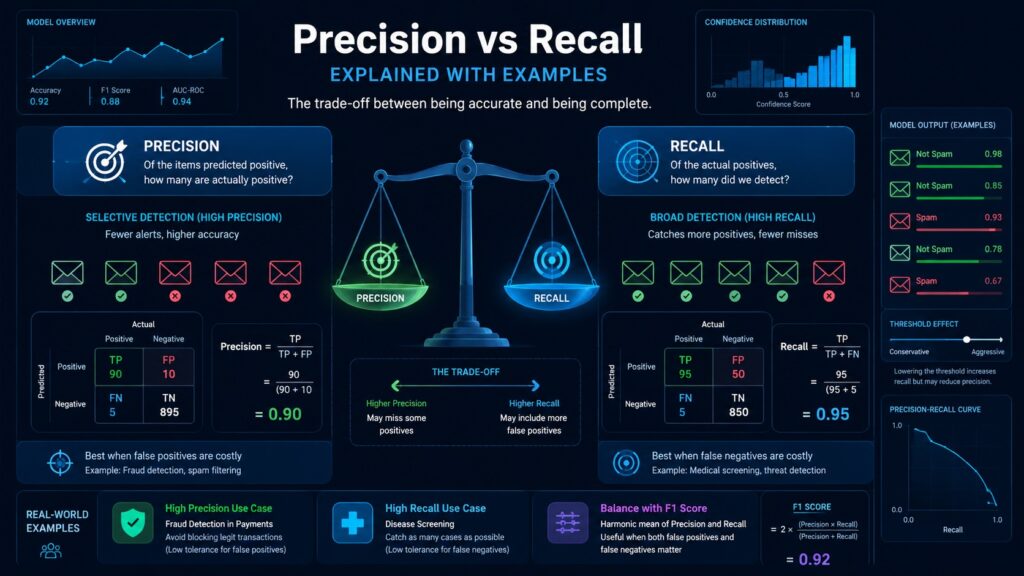
Machine Learning (ML) is non-deterministic, and its predictions are statistically based, where its answers are not always correct. Data scientists and ML engineers’ objective is to find the optimal ML model that balances conflicting requirements in its performance. This article illustrates this by exploring two critical parameters of ML performance, precision vs recall, explained with examples. Precision measures the accuracy of the ML model᾽s positive predictions, where increasing precision results in fewer false alarms. In contrast, recall measures the model’s ability to identify all actual positive cases, with higher recall indicating fewer missed cases. Therefore, increasing one of these parameters reduces the other one, and ML engineers have to select the optimal balance. This has implications for real-world applications where different use cases typically favor one over the other.
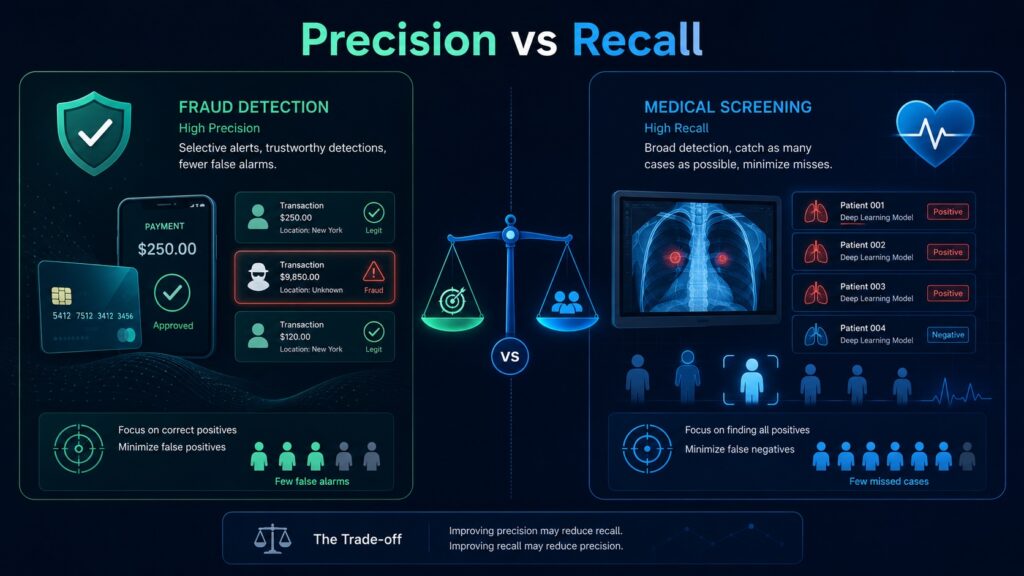
Medical screening favors recall to avoid missing a real disease. Fraud screening favors precision to reduce customer frustration since some financial loss is often recoverable.
What Is Precision in Machine Learning?
Precision is a critical ML performance parameter that measures the correctness of positive predictions compared to false alarms. In the context of precision vs recall, explained with examples, it focuses only on predicted positive results and evaluates the reliability of those predictions. Therefore, it measures the proportion of positive predictions that are actually correct. High precision indicates that most of the positive predictions are correct, whereas low precision indicates that there are many incorrect positives or false alarms. Precision emphasizes quality over quantity, with fewer positive predictions but more accurate ones. Precision is also a measure of trust in the model’s predictions.
This becomes clearer when precision vs recall is explained with examples from real-world systems. It follows that precision indicates the sensitivity to false positives, which are incorrect positive predictions, often referred to as false alarms. False positives, along with true positives, false negatives, and true negatives, are the four prediction outcomes represented in a confusion matrix. Therefore, many incorrect positives lead to lower precision, whereas reducing false positives improves it. These examples highlight why precision matters in practical applications. Precision is critical because too many false alarms undermine trust in the model. Additionally, alert fatigue sets in as users start ignoring alerts altogether. A well-known example of this is fraud detection systems that flag transactions as fraudulent, where false positives can block legitimate transactions. This causes customers to experience friction with their banking experience, leading to frustration. Therefore, having high precision ensures that alerts are credible and actionable.
What Is Recall in Machine Learning?
Recall is also a critical ML performance parameter that measures the model’s ability to identify actual positive cases while minimizing missed cases. In the context of precision vs recall, explained with examples, it focuses on how many true positive cases the model successfully detects. Therefore, it measures the proportion of actual positive cases that the model correctly identifies. High recall indicates that most of the positive cases were correctly identified, whereas low recall indicates that it missed many real positive cases. Recall emphasizes coverage over selectivity and prioritizes broad detection, even in the presence of false alarms. Recall measures how dependable the model is at detecting real cases.
Recall’s importance is clearer when precision vs recall is explained with examples from real-world systems. It follows that recall is sensitive to false negatives, which are positive cases that the model misses. Therefore, many false negatives lead to lower recall, whereas reducing false negatives improves it. These examples highlight the fact that missing real cases can lead to serious consequences, especially when the cost of a missed case may outweigh the cost of a false alarm. Medical screening is a clear example of the need to prioritize high recall. False positives might require additional testing, but are usually manageable. However, missing a diagnosis of a real disease can delay treatment, leading to very serious consequences. Hence, high recall helps to ensure that fewer important cases are overlooked.
Precision vs Recall: Core Differences
Both Precision and Recall are two critical ML performance measures, but they measure different aspects of ML performance by focusing on different outcomes. Precision focuses on prediction accuracy, while recall focuses on detecting all actual positive cases. Another contrast is their sensitivity, where precision is sensitive to incorrect positive predictions or false alarms. Meanwhile, recall is sensitive to the model missing real positive cases, known as false negatives. Another key difference between precision vs recall is accuracy vs coverage mindset. Precision prioritizes the accuracy and reliability of predictions, while recall prioritizes coverage and completeness of detection. The other key difference is selectiveness vs broad detection, where precision makes the model more selective, reducing unnecessary alerts. However, recall makes the model less selective, reducing the risk of overlooking positive cases.
| Aspect | Precision | Recall |
|---|---|---|
| Focus | Correct positive predictions | Finding all actual positive cases |
| Main Concern | False positives | False negatives |
| Priority | Accuracy and reliability | Coverage and completeness |
| High Value Means | Fewer false alarms | Fewer missed cases |
| Best For | Fraud detection | Medical screening |
| Model Behavior | More selective | Broader detection |
The Trade-Off Between Precision and Recall
More importantly, precision and recall typically have an inverse relationship where increasing precision often reduces recall. Correspondingly, increasing recall often reduces precision. The implication is that improving one metric may often result in a trade-off in the other metric. Therefore, optimizing for precision will make the model more selective, while optimizing for recall will make the model broader in detection.
Also, tuning the model with probability thresholds will directly affect the balance between precision and recall. Raising the threshold increases selectivity, while lowering it increases detection coverage. These threshold adjustments also change a classifier’s performance across different operating points. Rather than evaluating a single threshold, ML engineers often visualize performance across all possible thresholds using ROC and Precision-Recall curves. For a deeper explanation of when each visualization is most appropriate, see our guide on ROC Curve vs Precision-Recall Curve Explained for ML Models. Translating this in the real world means that reducing false alarms may increase missed cases. Conversely, reducing missed cases may increase false alarms. Therefore, the business impact of errors drives metric priorities, and there is no universal optimal balance between precision and recall. Hence, ML engineers must align model tuning with business objectives.
Real-World Examples of Precision vs Recall
Fraud Detection: Why Precision Matters
Fraud detection is a common use case among financial institutions with the goal of ensuring flagged transactions are genuinely suspicious. Hence, the business priority is precision over recall since the objective is to reduce unnecessary fraud alerts. This helps build confidence in the fraud detection system, reducing the number of legitimate transactions flagged as fraud. Otherwise, customers may experience blocked cards or declined payments more frequently due to excessive false alarms, generating frustration and inconvenience. This can potentially damage customer trust and the customer experience. Additionally, false alarms mean more resources spent on investigation and reduce confidence in the system. Significantly, alert fatigue may arise, resulting in teams ignoring important warnings. Therefore, high precision helps to ensure that alerts remain credible and actionable. This use case will allow the model to miss some fraudulent transactions, reducing false alarms and balancing fraud prevention with customer experience.
Medical Screening: Why Recall Matters
Medical diagnosis often prioritizes recall since its goal is to identify as many real diseases as possible. Reducing the risk of overlooked diagnoses is invariably a priority, given the life-or-death consequences, making high recall a necessity. Having false negatives means that the model misses a real disease case, which can delay treatment and medical intervention. This leads to serious illnesses worsening whenever detection occurs too late, which can be life-threatening, like cancer. However, early detection improves the chances of effective treatment, where medical screening systems aim to capture all possible positive cases. For any false positives, additional testing can verify whether they are real cases, but detecting more cases will help reduce patient risk. Hence, recall-focused systems prioritize broad detection coverage and are less selective to avoid missing real cases that have serious implications. For medical systems, patient safety is more important than minimizing alerts.
When to Use Precision vs Recall in Machine Learning
When to Prioritize Precision
Typically, prioritize precision when false positives are costly and potentially disrupt normal business operations. Also, prioritize precision when the cost of investigating false alarms becomes significant and excessive false alarms reduce trust in the system. There are several scenarios where false alarms are disruptive, including false positives interrupting legitimate user activity. Related to this is when blocking valid transactions causes unnecessary friction. Additionally, excessive alerts overwhelm operational teams, leading to alert fatigue and operator inattention. Subsequently, false alarms degrade customer trust and satisfaction while support teams spend more time handling false alerts. Examples where precision is preferred are fraud detection systems and spam filters to avoid blocking legitimate emails.
When to Prioritize Recall
Typically, prioritize recall when false negatives are costly because they lead to situations where missed cases are dangerous. This is when missing real positive cases may lead to serious consequences and escalate prior to any corrective action. Missed detections are dangerous when delayed identification can increase operational or human risk, and early detection is critical. Medical screening is one example in which systems prioritize recall to reduce missed diseases that can have severe consequences. Cybersecurity is another critical example of prioritizing recall for early threat detection, where additional investigation is acceptable to reduce missed threats.
Balancing Precision and Recall in Practice
In explaining precision vs recall with examples, it is clear that there is no single ideal balance. The optimal balance depends on the specific business use case, where different industries prioritize prediction errors differently. Prioritizing either precision or recall often depends upon either raising or lowering probability thresholds, where small changes can significantly alter model behavior. Therefore, model tuning should align with operational requirements, with business impact determining which prediction errors are acceptable. Customer experience, safety, and cost all influence priorities and impact the trade-offs of model behavior. Therefore, ML engineers must balance competing performance requirements through context-driven decision-making.
How Precision and Recall Relate to F1 Score
While many business use cases make a trade-off between precision and recall, there are still many use cases where both are important. The F1 score combines precision and recall into a single metric that evaluates how well the model balances them. Strong precision and recall yield high F1 scores, whereas poor performance in either metric lowers the F1 score. This is useful when managing trade-offs between these metrics and for imbalanced datasets. ML engineers use F1 score alongside other metrics to provide a comprehensive assessment of model performance.
While the F1 score summarizes the balance between precision and recall at a single classification threshold, ROC and Precision-Recall curves evaluate model performance across all possible thresholds. Understanding both perspectives helps engineers select the most appropriate evaluation metric for their application. Learn more in our article on ROC Curve vs Precision-Recall Curve Explained for ML Models. These evaluation metrics are readily available in modern machine learning frameworks, with Scikit-learn providing built-in support for calculating precision, recall, and F1 score during model evaluation.
F1 is useful for use cases where precision and recall are equally important. It provides a balanced view of model performance where models must avoid both false alarms and missed cases. This is illustrated in cybersecurity, which generally leans into recall. However, if it becomes too aggressive with recall, operators are flooded with alerts, leading to fatigue. Therefore, F1 is important to ensure a balance between recall and precision, reducing flooding with false alarms. F1 is also valuable for imbalanced datasets, as it provides better insight than accuracy alone. For a deeper comparison of broader ML evaluation metrics, see F1 Score vs AUC.
Common Mistakes When Using Precision and Recall
Real-world use cases often yield imbalanced datasets, with significantly more negative cases than positive cases. However, the ML model’s measured accuracy remains high even when it misses important positive cases and hides its poor performance. Precision and recall complement accuracy, providing deeper insight into model performance by evaluating detection quality and coverage. For a deeper discussion on handling uneven datasets, see Tame Imbalanced Data with Smart Classification Tips. Fraud detection illustrates this, where datasets typically contain few fraudulent transactions. Cybersecurity is another example with rare attack events, and medical diagnosis datasets often contain limited disease cases.
Focusing too heavily on one metric can also reduce overall model effectiveness. Too much focus on precision often leads to missing important cases, whereas focusing on recall may result in excessive false alarms. Reduced detection coverage or overwhelming teams with alerts can reduce trust in the system, even with strong model scores. Optimizing these metrics should support practical business outcomes that tolerate prediction errors differently. It follows that engineers should evaluate precision and recall together, even when the use case favors one over the other. Hence, effective model evaluation requires context-driven decision making.
Conclusion: Choosing the Right Metric for Your Model
Explaining precision vs recall with examples has clearly shown that no ML performance metric is ideal for every use case. Rather, ML engineers should evaluate metrics within the context of the business use case since different applications prioritize different outcomes. Simply put, precision is important when false alarms are costly, but recall is important when missed cases are dangerous. ML engineers need to make trade-offs when optimizing ML systems through threshold tuning. However, they must manage both detection quality and coverage, which often involves the F1 metric. Therefore, choosing the right ML metric requires balancing technical performance with real-world operational impact.
While considering precision vs recall, engineers must remember that precision and recall make only part of the complete ML evaluation strategy. They often need to combine multiple metrics to assess model performance since they provide different perspectives on model behavior. However, performance metrics explain how well a model performs rather than which inputs are driving its predictions. Feature importance in machine learning complements model evaluation by identifying the features that have the greatest influence on model behavior. AUC and F1 scores add further dimension to model performance and are explored further in F1 Score vs AUC. Trade-offs are further evaluated using ROC and Precision-Recall curves, which illustrate classifier performance across different decision thresholds. Together with F1 score and AUC, these metrics provide a more complete picture of model performance. For a detailed comparison of these evaluation curves, see our article on ROC Curve vs Precision-Recall Curve Explained for ML Models.
Further Reading and Resources
- Hands-On Machine Learning with Scikit-Learn, Keras, and TensorFlow: Concepts, Tools, and Techniques to Build Intelligent Systems 3rd Edition
by Aurélien Géron - Interpretable Machine Learning: A Guide For Making Black Box Models Explainable
by Christoph Molnar
Structured Learning: For readers who prefer guided courses, Pluralsight offers training on machine learning fundamentals, model evaluation, Python, and applied data science workflows. This can be a useful complement to books when building hands-on ML evaluation skills.
Disclosure: This article may contain affiliate links. If you purchase through these links, AI Cloud Data Pulse may earn a commission at no additional cost to you. These recommendations are based on relevance and educational value for readers interested in AI, machine learning, cloud computing, and data engineering.