Introduction
Sample Data vs Population
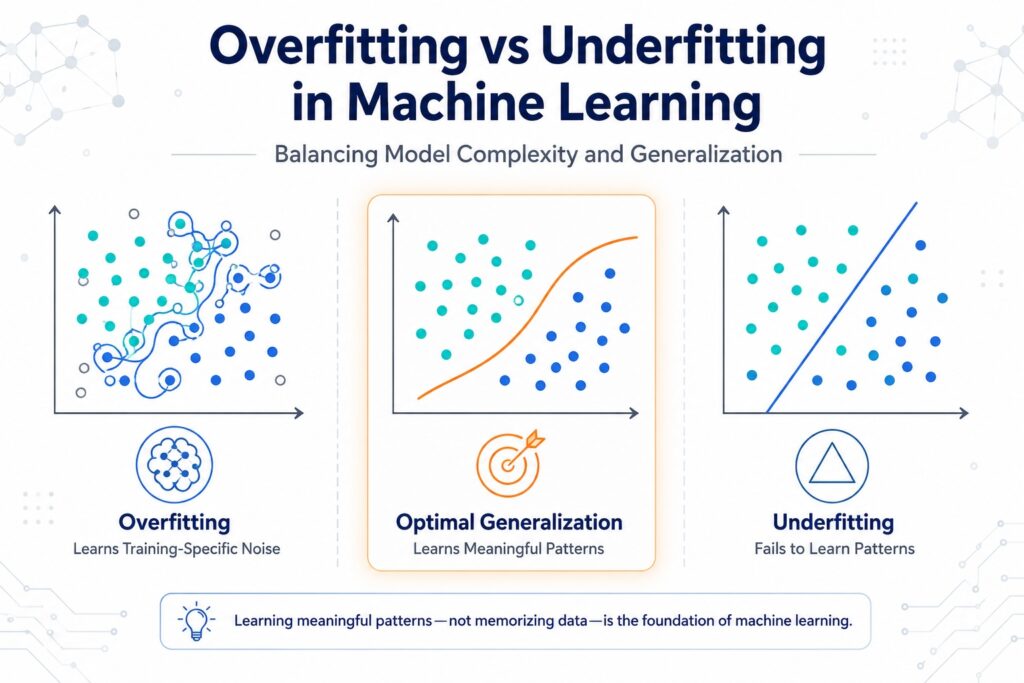
Overfitting vs Underfitting in Machine Learning parallels inferential statistics in mapping the characteristics of a sample to the whole population. Here, overfitting is when the model matches the sample or training data and infers characteristics unique to that dataset to the wider population. Underfitting is when the model fails to build the underlying patterns, and its inference of the wider population is largely inaccurate. Model training needs to fit the wider population and not just the training data.
Learning vs Generalization
Since machine learning is based on sample training data from the population, there is a balance between learning and generalization. Model performance is assessed beyond training data, where it needs to infer new and unseen observations in the wider population. Overfitting is where the model matches the training data too closely and infers training-specific noise to the wider population. Underfitting is when the model does not capture underlying patterns and is poor at inferring both the training data and the wider population. Therefore, the model should infer meaningful patterns without training-data-specific dependency.
Why Generalization Matters
When model inference too closely matches the training data, it generalizes poorly to new, real-world data. Hence, training performance does not necessarily guarantee production performance. Fraud detection is an important example where poor generalization results in missed fraud or false alarms. Another critical example is credit risk, which results in inaccurate borrower risk assessment or, more controversially, discrimination. The most concerning is healthcare, where poor generalization leads to unreliable diagnostics, potentially leading to life-threatening situations. Therefore, Machine Learning engineering encompasses managing overfitting vs underfitting.
Quick Answer: Overfitting vs Underfitting
Overfitting
◆ Model learns the training data too closely
◆ High training performance but weaker validation performance
◆ Low bias and high variance
Underfitting
◆ Model fails to learn important underlying patterns
◆ Poor training and validation performance
◆ High bias and low variance
Goal
◆ Balance model complexity with generalization
◆ Optimize performance on new, unseen data
What Is Overfitting in Machine Learning?
Training ML models has similar parallels to inferential or sampling statistics. The model is meant to make inferences on the population based on sample data used to train the model. Overfitting is when the model can precisely infer the training data, where sample-specific characteristics are treated as population patterns. However, this often reduces model generalization, with poor performance on unseen observations.
There are several causes of this, including relationships appearing meaningful in the training sample but not holding in the wider population. Additionally, training data often has noise that the model is trained with during overfitting but is not part of the wider population. Another cause of overfitting is model complexity. While overfitting can capture subtle relationships, it can also capture irrelevant noise.
Signs of Overfitting
Training performance alone is insufficient to indicate overfitting, and ML development often includes validation or test performance. Hence, performance gaps between training and validation or test are the primary warning signal that there is overfitting in the model. Similar performance between training and validation or test indicates stronger generalization, whereas diverging performance indicates potential overfitting.
- High training accuracy
- Poor validation or test performance
- Large training-validation performance gap
- Memorization of individual training examples
- Unstable predictions on unseen data
- Sensitivity to small input variations
Causes of Overfitting
Overfitting can be caused by the model architecture or the data used to train the model. Whenever the model’s capacity is beyond the available training evidence, then it is likely to overfit the training data. Training data that does not properly represent the population results in the model making poor predictions on the wider population. Also, too many input features or irrelevant or weakly predictive features can result in overfitting.
A real-world example of a student memorizing practice-question answers is a good illustration of overfitting. The student performs well on familiar questions because they have learned answers instead of underlying principles. However, the student encounters difficulties with differently structured questions. Therefore, training data is analogous to practice questions, whereas unseen data is analogous to new exam questions.
What Is Underfitting in Machine Learning?
ML models infer characteristics of the overall population from training data. Underfitting fails to capture data patterns within the population since they are inadequately represented in the ML model. The model fails to learn the relationships in the training data because its complexity is insufficient to represent the underlying structure of the data.
Underfitting results in poor performance with both the training data and test or validation data. This is due to its failure to learn meaningful patterns, along with its inability to capture feature relationships. This insufficient learning results in weak generalization and low predictive accuracy.
Signs of Underfitting
Underfitting is often indicated by consistently poor training accuracy, in addition to low test or validation accuracy. It also exhibits high prediction errors across datasets, reflecting its failure to learn meaningful relationships. Underfitting models also have overly simplistic decision boundaries, often due to their inability to capture underlying data patterns in the training data. They exhibit similarly poor performance on both training and unseen data, usually showing a high bias with low model complexity. These models have limited predictive capability, indicating that the model requires greater complexity or improved features.
Causes of Underfitting
Oversimplified model architecture, including excessive constraints on model capacity, is a major cause of underfitting. This is illustrated by neural networks that have an insufficient number of layers. Consequently, the model fails to learn the underlying data structure and complex feature relationships present in the training data. This results in high bias and reduced predictive capability.
Other causes of underfitting stem from the training process itself, where there are insufficient training iterations or epochs. Additionally, early termination of the training process often results in underfitting. Poor training data can also lead to underfitting with weakly engineered features, or when it is missing important predictive variables. Limited information for learning or inadequate feature representation also contributes to underfitting.
Overfitting vs Underfitting: Key Differences
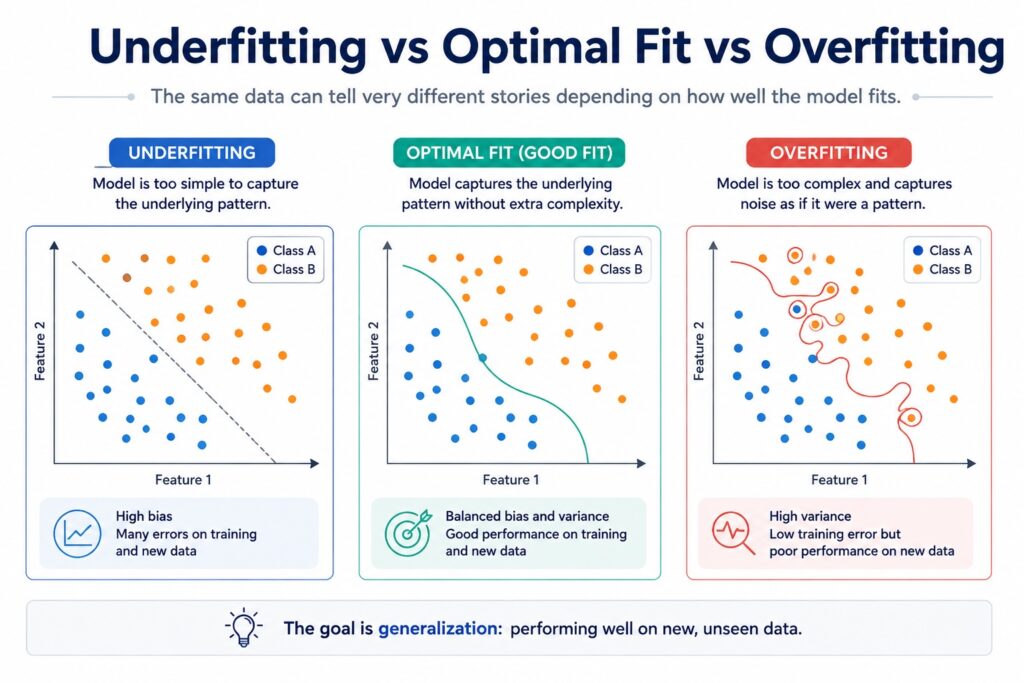
Overfitting vs underfitting in machine learning are opposite extremes of how a model fits the training data. Both represent an imbalance between learning and generalization, reducing predictive performance across the wider population. ML engineers must balance model complexity and generalization to improve impact on unseen data.
A key difference in overfitting vs underfitting in machine learning is the relationship between training accuracy and test or validation accuracy. Overfitting models have high training data accuracy but lower accuracy in test or validation data. Underfitting models have low accuracy for both training and test or validation data. Another variable is bias vs variance, where overfitting has low bias but high variance, and underfitting has high bias but low variance.
Comparison Table
| Characteristic | Overfitting | Underfitting |
|---|---|---|
| Training accuracy | High | Low |
| Test/validation accuracy | Lower | Low |
| Model complexity | High | Low |
| Bias | Low | High |
| Variance | High | Low |
| Generalization | Poor | Poor |
| Learns noise | Yes | No |
| Captures underlying patterns | Yes, but excessively | No |
| Typical remedy | Simplify or regularize | Increase complexity or improve features |
Comparison Summary
Overfitting vs underfitting in machine learning key difference is their relationship between training accuracy and test or validation accuracy. Overfitting typically has high accuracy with training data, but its performance is reduced on unseen data. Underfitting has poor accuracy with both training data and test or validation data. These differences are commonly evaluated using metrics and curves measured on unseen data. For a comparison of two widely used classifier evaluation methods, see ROC Curve vs Precision-Recall Curve Explained.
The model architecture can determine whether it is overfitting or underfitting due to its complexity. Models that have excessive complexity are likely to lead to overfitting and learn noise alongside meaningful patterns. Models that have insufficient complexity are likely to lead to underfitting and fail to capture underlying relationships. Therefore, ML engineers should select optimal model complexity to improve model fit.
Another key difference is the bias-variance trade-off, where bias and variance are two sources of prediction error. High bias is associated with models that are too simple to capture the underlying relationships in the data. High bias is typically associated with underfitting. Variance is associated with models that are too sensitive to the training data. This is associated with overfitting, where predictions are based on the training data rather than the wider population.
The primary objective of machine learning models is the ability to generalize across the population. Overfitting and underfitting are opposite causes of a model’s inability to generalize across the population. Both cases result in reduced reliability of the model on unseen data. Therefore, an essential aspect of machine learning is to optimally balance model fitting for improved real-world performance.
How Overfitting and Underfitting Affect Model Performance
ML models are intended to demonstrate good performance beyond the training data through generalization to unseen data as their primary objective. Both overfitting and underfitting result in poor generalization to unseen data, impacting the model’s performance on real-world observations. Therefore, they reduce model effectiveness, and the only reliable way to evaluate model performance is using unseen data. Model performance on unseen data can be measured using several evaluation metrics, each emphasizing different aspects of predictive performance. For guidance on selecting between two commonly used model evaluation metrics, see F1 Score vs AUC: Why It Matters More Than You Think.
Poor generalization causes the model to make unreliable predictions that reduce its robustness. This results in inconsistent production performance of the model, and it leads to increased prediction errors in real-world environments. These prediction errors often affect evaluation metrics such as precision and recall. For a detailed explanation of these metrics, see Precision vs Recall Explained. Therefore, there is reduced confidence in its outputs. Changing data distributions can further degrade the performance of models with poor generalization.
Real-World Impact
Models with poor generalization often make unreliable and erroneous predictions on real-world data, leading to inaccurate business decisions. If these models are applied to improving processes, then they will result in operational inefficiencies. The consequences are financial losses from poor predictions and increased business and regulatory risk. It will also lead to reduced confidence in machine learning systems and decreased stakeholder trust.
Relying on initial training data performance is insufficient to guarantee confidence in models. Model performance must be monitored continuously, and regular model retraining is needed as real-world environments evolve. Engineers must validate models using new and unseen data to maintain predictive reliability in production while adapting to changing data distributions. Therefore, ongoing machine learning lifecycle management is required.
Common Techniques to Prevent Overfitting
It is important to improve model generalization across real-world data and maintain performance beyond training data. While it is important for the model to learn meaningful underlying patterns, the model should not learn training-specific noise. It is necessary to prevent the model from memorizing training data and balance model complexity with predictive performance.
To prevent overfitting, multiple complementary techniques are available, with the choice depending on the machine learning algorithm, dataset characteristics, and business problem. Several of the techniques are combined to improve generalization, and an overview of some common techniques is presented below.
Cross-Validation
Both the training and validation datasets are samples from the population, and model performance can still rely on a single split. Instead, multiple data subsets are used to validate the model by partitioning data into training and validation folds. Evaluation is repeated across different data splits to derive a more reliable estimate of model generalization. This improves assessment of predictive performance, supports better model selection and hyperparameter tuning, and reduces the risk of overfitting.
Regularization
Overly complex models contribute to overfitting; therefore, regularization is used to penalize unnecessary model complexity. The core benefit is that it reduces model sensitivity to training-specific noise and prevents excessive parameter growth. There are two types of regularization commonly applied. L1 regularization encourages feature selection, while L2 regularization reduces parameter magnitude. This improves model generalization, balances model complexity with predictive performance, and reduces the risk of overfitting.
Feature Selection
Feature selection is another way to reduce input dimensionality and, in turn, model complexity, which reduces the risk of overfitting. This involves selecting the most informative features and removing features that are either irrelevant or redundant. This simplifies model complexity and improves learning efficiency with fewer input parameters. Feature selection reduces the risk of overfitting and improves model generalization. This is also strongly connected with feature importance analysis.
More Training Data
Training data is still a sample of the population. Therefore, there is the risk that a too-small sample does not represent the data distribution of the population. Hence, larger and more representative training samples provide a better representation of the wider population. This enables improved learning of underlying patterns and reduced influence of random sample noise. Consequently, this results in stronger model generalization and increased model robustness, along with reduced sensitivity to individual observations.
Early Stopping
Continual training can result in the model memorizing the training data and training-specific noise instead of generalizing across the population. Therefore, validation performance is monitored during training to detect diminishing validation improvement. At this point, training is stopped before the model memorizes the training data and learns training-specific noise. This is commonly applied to neural network training to improve model generalization and reduce the risk of overfitting.
How to Reduce Underfitting
It is important to improve the model’s learning capacity so that it can learn the underlying relationships in the training data. The model should have sufficient complexity without being unnecessarily simplified. Therefore, engineers should balance learning capacity with generalization.
There are multiple complementary techniques that engineers can apply to reduce underfitting, with technique selection depending on the machine learning algorithm. Additionally, these techniques are often combined to reduce underfitting and are influenced by dataset characteristics and problem complexity.
Increasing Model Complexity
Engineers should adopt more expressive machine learning models that increase model complexity where appropriate. These should increase the model’s learning capacity so that it can capture more complex underlying relationships. Additionally, engineers should avoid excessive model simplification and instead have the model better represent the data. A simple example is changing a linear model to a quadratic model when the data follows a quadratic relationship.
Better Features
Another important technique for improving underfitting models is improved feature engineering to provide the model with more informative predictive variables. Providing the model higher-quality input data will improve its representation of underlying patterns. This will enhance the model’s learning capability and improve its predictive performance. Therefore, richer feature representation will reduce underfitting.
Longer Training
Engineers can improve the model’s internal representation of the training data by having additional training iterations or epochs. This will allow the model to converge and improve parameter optimization with more complete learning of data patterns. Hence, in many cases, underfitting is due to insufficient training, and additional training enables the model to learn more effectively.
Improved Model Architecture
ML engineers should also select the appropriate model architecture. For neural networks, they should match the architecture to problem requirements and add additional layers or model capacity where necessary. They should align the architecture with problem complexity to improve representation of underlying relationships. This improves predictive performance while strengthening model generalization.
Real-World Example of Overfitting vs Underfitting
Machine learning has many real-world applications, where models must generalize from training data to the wider population. There are many machine learning domains where common principles of overfitting and underfitting apply. However, fraud detection is a useful representative example since it is now embedded in the workflow of financial institutions. Other important examples include spam detection, stock prediction, and image classification. All these examples demonstrate that learning patterns must generalize beyond training data.
Fraud Detection Example
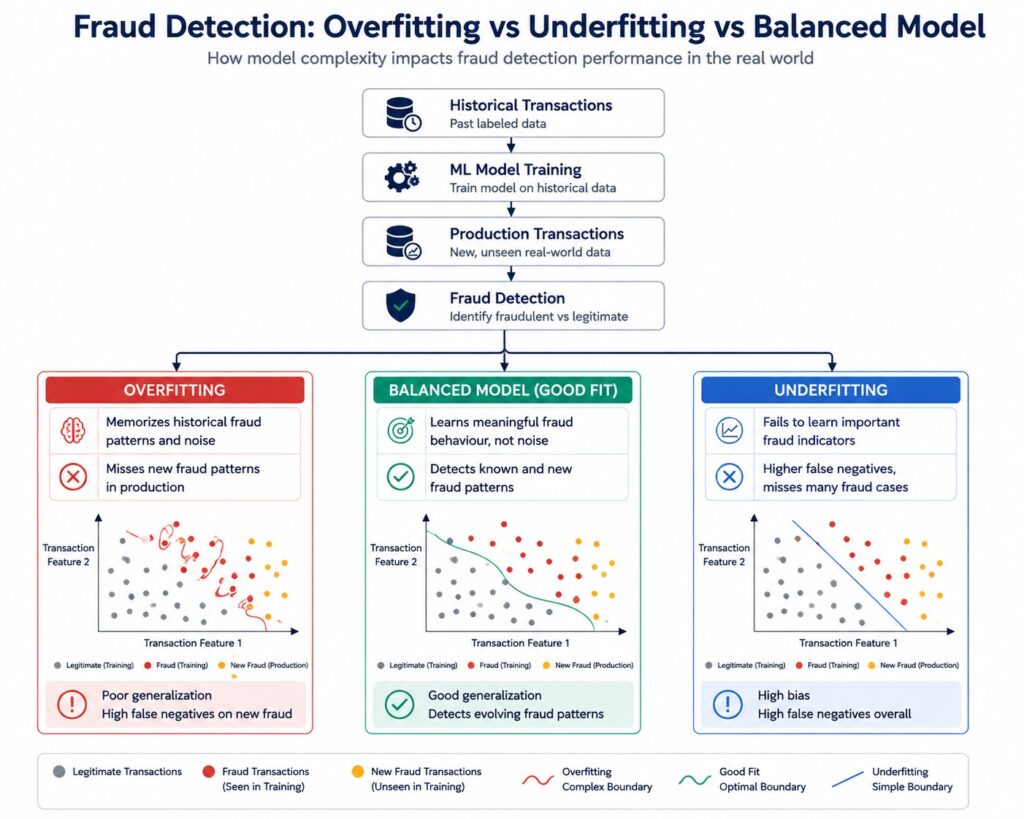
A unique characteristic of fraud detection, similar to stock market analysis, is that predictions are based on historical data. Engineers can only train fraud detection machine learning models on historical fraud patterns, with the risk of memorization of the training data. This leads to the risk of poor generalization to new fraud techniques and reduced detection of previously unseen fraud. These models are at risk of increased false negatives for evolving fraud patterns, resulting in financial loss and damage to reputation.
The other risk is using overly simple machine learning models that result in underfitting and fail to learn any meaningful fraud patterns. Therefore, the model has reduced detection accuracy, resulting in missed fraudulent activities and placing false confidence in financial transactions. The other risk is that simple machine learning models are unable to adapt to complex fraud behavior. Hence, good model engineering balances historical learning with generalization and the ability to detect evolving fraud patterns.
Other Applications
There are many other real-world applications that are adversely affected by either overfitting or underfitting. Examples include spam detection for identifying unwanted email, stock prediction for forecasting future market behavior, and image classification for recognizing visual objects and patterns. These have common dependencies on model generalization and need to learn meaningful underlying patterns but avoid memorization of historical examples. All these machine learning domains have the shared principle of reliable predictions on unseen data.
Overfitting vs Underfitting Graph Explained
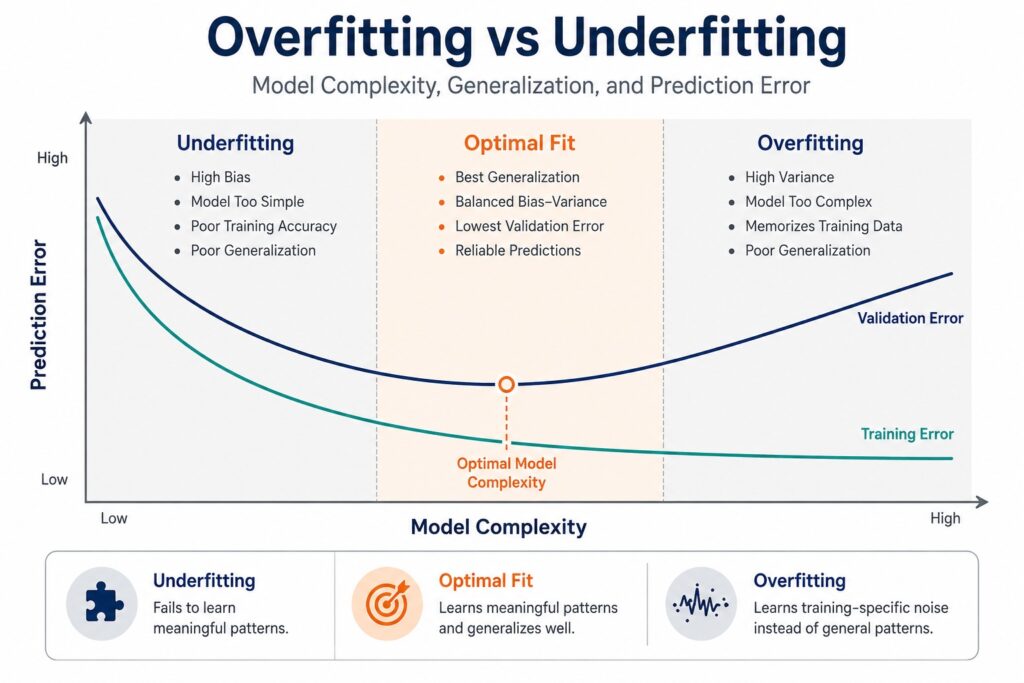
This infographic presents a visual representation of model fitting, showing the relationship between model complexity and model performance. It shows underfitting for low model complexity, optimal model fit at balanced complexity, and overfitting at excessive model complexity. This illustrates the model-fitting continuum.
It illustrates how both the training error and the validation error vary with model complexity. It shows the divergence between training and validation error as model complexity becomes excessive, resulting in overfitting. Additionally, it visualizes the bias-variance trade-off and identifies the point of optimal generalization.
Interpreting the Graph
The left side of the graph shows underfitting with low model complexity that results in both high training and validation error. The model has high bias and fails to learn the underlying patterns in the training data. The middle region of the graph represents the ideal model fit with the lowest validation error due to the strongest model generalization.
Model complexity increases as the graph moves from left to right, showing overfitting on the right side of the graph. The training error continues to decrease, but the validation error starts increasing, resulting in high variance. This includes memorization of training-specific noise. Machine learning aims to identify the point of optimal model complexity that balances learning with generalization.
Conclusion
Therefore, understanding overfitting vs underfitting in machine learning is fundamental to building models that generalize reliably to real-world data. Machine learning should learn meaningful patterns from training data and generalize to unseen data. It should avoid both underfitting and overfitting to improve predictive performance.
The primary measure of a model’s performance is generalization, where performance on unseen data is more critical than training accuracy. No machine learning model can achieve perfect predictions, and there is unavoidable prediction error in real-world applications. Engineers need to manage uncertainty in model predictions and maximize predictive reliability through generalization.
Additionally, as both machine learning environments and business requirements evolve, machine learning becomes a continual process with ongoing model performance monitoring. This is due to changing data distributions, which entails regular model validation and periodic model retraining. Therefore, there is continuous feature engineering and improvement along with hyperparameter and model tuning.
In summary, machine learning models need to learn meaningful underlying patterns but avoid memorization of historical training data. The goal of machine learning is to make reliable predictions on unseen data that result in better real-world decision-making. Therefore, successful machine learning is not about memorizing historical data—it is about learning meaningful patterns that generalize to the real world.
References
Books
Pattern Recognition and Machine Learning (Information Science and Statistics)
Christopher M. Bishop
The Elements of Statistical Learning: Data Mining, Inference, and Prediction, Second Edition (Springer Series in Statistics)
Trevor Hastie, Robert Tibshirani, Jerome Friedman
Deep Learning (Adaptive Computation and Machine Learning series)
Ian Goodfellow, Yoshua Bengio, Aaron Courville
Documentation
scikit-learn User Guide – Model Selection and Evaluation
TensorFlow Tutorials – Overfit and Underfit
Affiliate Disclosure: Some links in this article may be affiliate links. If you purchase a product or service through these links, AI Cloud Data Pulse may earn a small commission at no additional cost to you. We only recommend resources that we believe provide value to our readers.