Introduction
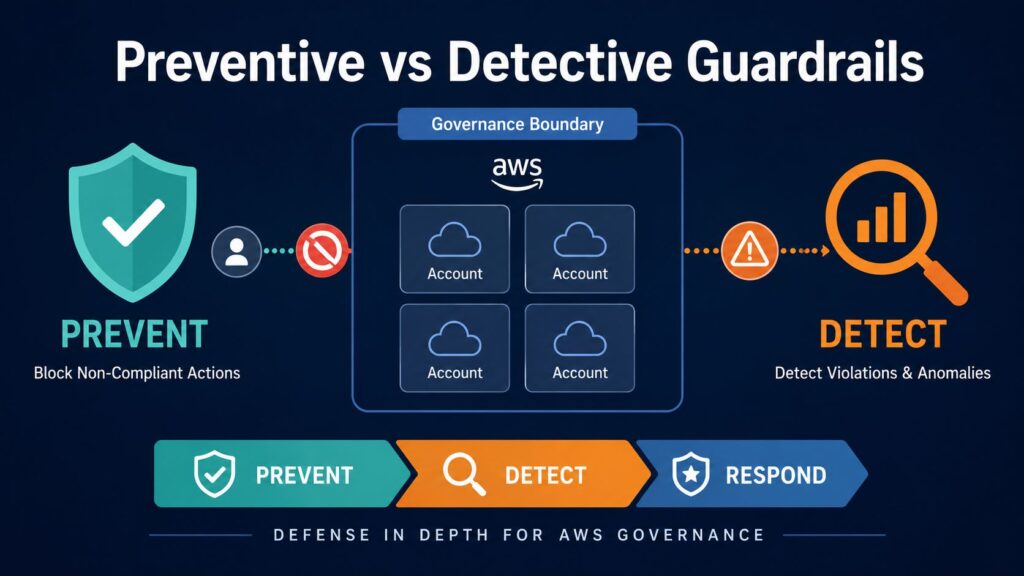
AWS Guardrails are governance controls that constrain the scope of actions that entities within the cloud environment can perform. Understanding Preventive vs Detective Guardrails begins with recognizing them as governance foundations for multi-account AWS environments. They become increasingly important as organizations grow in size and complexity. Their goal is to enforce consistent governance, strengthen security, support compliance, and reduce risk at enterprise scale.
Why AWS Guardrails Matter
Large enterprises have multiple AWS accounts that require governance controls applied consistently across accounts. This ensures consistency across the organization and, more importantly, standardizes security policy, which is essential for maintaining a consistent security posture. Guardrails also simplify regulatory compliance, reduce risk due to unauthorized actions, and reduce configuration drift. The main benefit is centralized governance while empowering decentralized ownership through controlled account autonomy.
Preventive and Detective Governance
There are two important types of guardrails, these are preventive and detective guardrails that enforce governance policies. Preventive controls block non-compliant actions and enforce compliant behavior either prior to deployment or execution. Prevention is powerful but will never cover all scenarios, and detective guardrails are required when there are non-compliant events. Detective guardrails identify suspicious activity and configuration drift, complementing preventive guardrails that block non-compliant actions.
Preventive guardrails are an implementation of the architecture-first security philosophy, in which security is implicit in the design. The goal is always to prevent security events before they occur while minimizing blast radius when they do. However, preventive controls will never stop all actions that lead to security events, and detective controls need to complement them. Sound enterprise security architectures promote defense-in-depth with both preventive and detective guardrails.
What Are AWS Guardrails?
AWS Guardrails are governance mechanisms that establish security, operational, and compliance boundaries for acceptable cloud behavior. They play a foundational role within multi-account AWS environments as part of the enterprise governance framework. They are not a single AWS service but are implemented across multiple AWS capabilities to ensure consistent policy enforcement. Together, they provide consistent governance across secure and compliant cloud environments.
Governance in Cloud Environments
Consistent governance across AWS accounts allows organizations to scale while maintaining enforcement of security and compliance policies. It simplifies operational governance across accounts, allowing decentralized account ownership within organizational constraints. This ensures centralized governance objectives with an enterprise-wide governance model.
Centralized governance is achieved through preventive guardrail enforcement and detective monitoring, reducing reliance on manual administration. Guardrails achieve consistent governance execution through automated policy enforcement, preventing unauthorized actions. They also provide continuous compliance monitoring and identify any configuration drift that could expose the enterprise to security or compliance risks.
Why Guardrails Matter at Scale
When organizations leveraging AWS grow, they have expanding cloud resources, increasing AWS workloads, and growing user populations. They also have diverse business unit requirements and varying security requirements, which increase governance complexity. This increases the risk of inconsistent controls, configuration drift, and multi-account sprawl, making consistent governance increasingly difficult. This makes scalable governance essential for maintaining a secure and compliant cloud environment.
Scalable enterprise governance is achieved through standardized governance controls that reduce human error. Guardrails provide automated policy enforcement and consistent security baselines as AWS workloads increase. They also enable new AWS accounts to operate with decentralized ownership while remaining within organizational governance boundaries. Additionally, they minimize resource configuration drift as cloud resources expand and ensure a consistent enterprise security posture.
Architecture vs Reactive Security
Architecture-first security minimizes the need to react to security events by preventing many of them from occurring. Preventive guardrails that block non-compliant actions are a layer of governance embedded in the architecture, alongside network segmentation and trust boundaries. While they significantly reduce risk, they cannot prevent every security event, making continuous detection essential. Therefore, they need complementary detective controls that provide continuous visibility and detect security events. Together, preventive and detective guardrails provide the defense-in-depth strategy required for mature AWS governance.
Preventive Guardrails Explained
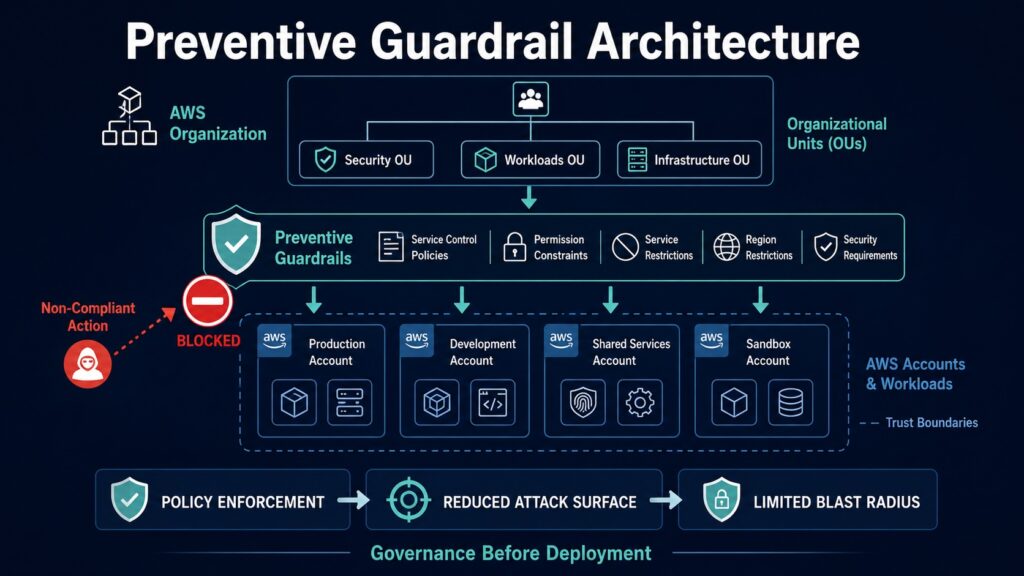
Preventive guardrails layer on top of trust boundaries and network segmentation, providing defense-in-depth by blocking non-compliant actions. They are proactive governance controls that enforce architectural policies by preventing unauthorized resource deployment and modification. By preventing non-compliant actions, they proactively reduce security risk and minimize security events before they occur. As the first layer of enterprise cloud governance, they establish consistent governance across multi-account AWS environments.
What Preventive Controls Do
Preventive control mechanisms enforce organizational policy by blocking policy-violating actions. Resource provisioning controls are a major subcategory that prevent non-compliant resource deployments before resources are created. This minimizes the need for post-deployment remediation. They also prevent unauthorized changes that could introduce security gaps. Overall, preventive controls follow a proactive governance model.
Preventive controls also support scalable enterprise governance by enforcing consistent security and compliance policies across AWS accounts. They establish standardized governance controls that achieve enterprise-wide consistency, reducing administrative overhead. This includes applying consistent policies across accounts independent of the account owner, reducing manual review. They improve compliance consistency, simplifying audits and regulatory compliance.
Blocking Risk Before Deployment
Blocking non-compliant deployments is a key responsibility of preventive controls, as it prevents policy violations. They therefore minimize the creation of insecure resources and insecure configurations within the cloud environment and, in turn, reduce organizational risk. The other key benefit is that they reduce reactive remediation due to non-compliant configurations, thereby lowering operational overhead. This supports security by design and reduces incident response effort due to fewer security events.
Preventive controls enhance the architectural perspective by limiting configuration errors that can weaken trust boundaries and network segmentation. This strengthens the overall security architecture by limiting opportunities for exposure of insecure resources and reducing the reachable attack surface. They also minimize configurations that could increase blast radius or amplify the impact of a security event. These isolation principles are explored further in AWS Resource Isolation Security. As a result, workloads begin operating from a more secure baseline.
Common AWS Preventive Guardrails
There are several AWS services that implement preventive guardrails as part of broader enterprise governance patterns. Together, these services provide complementary governance mechanisms that automate preventive policy enforcement across enterprise environments. Together, they form an essential part of a layered security architecture by preventing actions that weaken organizational security boundaries. They reduce operational overhead by consistent policy enforcement across multi-account AWS environments.
Organization and Identity Controls
Service Control Policies (SCPs) are an AWS service that implements highly important guardrails across Organizational Units (OUs) and AWS Accounts. They establish organization-wide authorization boundaries and the maximum permissions available within each AWS account. For a deeper explanation of organization-wide policy enforcement, see AWS Organizations and Service Control Policies (SCPs). Their primary mechanism is to define the maximum permissions available within AWS accounts by constraining effective IAM permissions and delegated administrative permissions. These organization-wide constraints complement the identity-level authorization controls discussed in AWS IAM Architecture Best Practices. They also impose restrictions on AWS services and AWS Regions, preventing unauthorized service use and Region deployments.
Resource and Security Controls
SCPs can enforce organizational encryption requirements by preventing the creation of unencrypted resources. These encryption requirements complement the cryptographic boundaries and key governance principles discussed in AWS KMS Architecture. Another important governance mechanism is resource tagging, and several AWS services can enforce mandatory resource tagging by preventing the creation of resources that do not meet organizational tagging requirements. SCPs also prevent actions that weaken network isolation and resource segmentation, minimizing the reachable attack surface and blast radius. SCPs achieve consistent enterprise governance because they are applied across Organizational Units (OUs) and member accounts throughout the AWS organization.
Detective Guardrails Explained
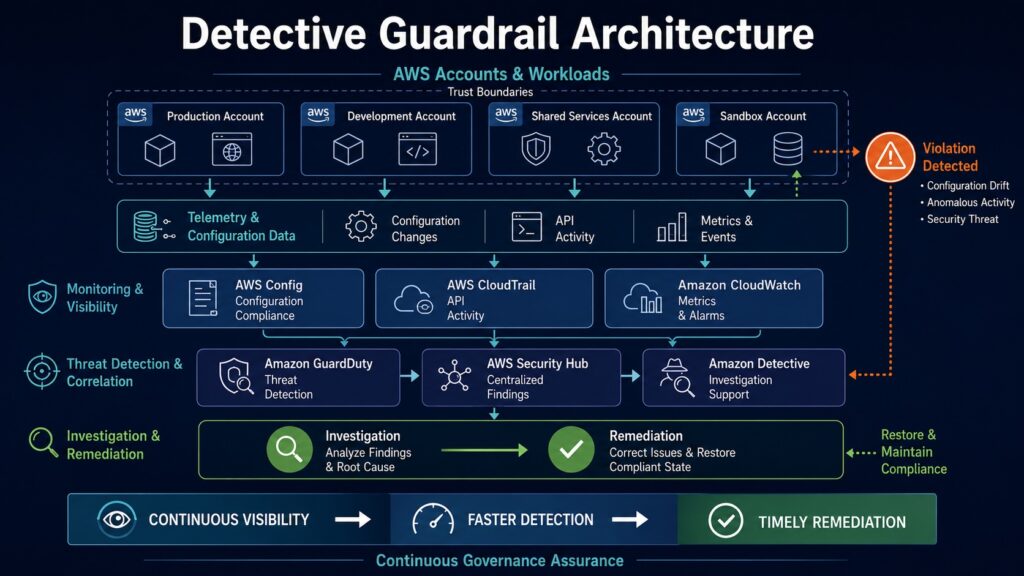
Preventive guardrails minimize resource exposure but can never prevent all security events, making detective guardrails critical whenever incidents occur. Detective guardrails complement preventive guardrails and form the second layer of defense in depth by continuously monitoring activity after it occurs. They detect policy and security anomalies and identify configuration drift that may slip through preventive controls. They are integral to continuous governance assurance across multi-account AWS environments.
What Detective Controls Do
Preventive controls prevent unauthorized activities, but detective controls monitor post-activity for all authorized actions. Even authorized activities can introduce policy violations and exhibit anomalous behavior. Over time, these activities can modify resource configurations, resulting in configuration drift. Detective controls monitor the cloud environment and perform continuous event analysis to uncover these occurrences and identify security risks. They also trigger investigations as part of the reactive governance model.
Since activities can make the environment non-compliant, detective controls enforce continuous compliance validation and enterprise security visibility. Once detective controls detect an incident, they trigger and support incident response and remediation activities. These controls reduce the time it takes to detect incidents before they can cause serious damage. They provide defense-in-depth through continuous security monitoring.
Visibility and Continuous Monitoring
Detective controls continuously monitor all events within the AWS environment to detect any potential incidents or causes. They monitor for any configuration drift that can weaken trust boundaries or network segmentation, increasing resource exposure to attacks. Also, they monitor for behavior anomalies that indicate compromised workloads and security events that may indicate malicious activity before significant harm occurs. Additional benefits are centralized governance visibility and operational transparency, providing continuous environment assessment.
The benefits of continuous monitoring include ongoing compliance validation, especially for trust boundaries and network segmentation that isolate resources. They also reduce detection time, enabling faster incident response to limit harm and accelerated remediation to reduce degraded functionality. Continuous monitoring also improves operational awareness and early threat detection, enabling faster containment before incidents cause significant harm. Overall, they complement preventive guardrails and strengthen enterprise security posture.
Common AWS Detective Guardrails
AWS provides a suite of complementary detective services that specialize in the different stages of the detection workflow. Even at the same stage, different services specialize in different perspectives of security monitoring. Together, these services provide infrastructure, configuration, and activity monitoring across the cloud environment, together they cover the cloud environment. Higher-level detective services perform threat detection and provide centralized security visibility for investigation and governance. Overall, they provide a layered detective architecture.
Configuration and Activity Monitoring
AWS Config is responsible for configuration compliance and configuration drift detection that can compromise trust boundaries and network segmentation. Organizations can extend this capability across AWS environments using the standardized compliance rules discussed in AWS Config Conformance Packs Explained. AWS CloudTrail performs activity monitoring by logging API activity that can expose patterns of anomalous behavior, uncovering potential threats. Amazon CloudWatch provides operational monitoring of metrics with alarms triggered when metrics are outside expected thresholds, indicating security and operational incidents. Together, these services provide the logging and monitoring foundation for continuous security visibility, as discussed further in the AWS Logging and Monitoring Guide.
Threat Detection and Investigation
Amazon GuardDuty is a downstream service that analyzes AWS telemetry and service-generated findings to identify potential threats. It searches for patterns within the raw data to detect potential threats that warrant further investigation and response. AWS Security Hub aggregates security findings to provide a centralized view of the cloud environment and the ability to find correlations. Amazon Detective supports security investigations by correlating related events and helping identify the root cause of security incidents. Together, they enable centralized incident investigation.
Preventive vs Detective Guardrails: Key Differences
Preventive vs detective guardrails are complementary governance controls where neither replaces the other. They have distinct security responsibilities that provide defense in depth. Preventive guardrails minimize security events by preventing non-compliant actions, while detective guardrails identify the security events that still occur. Together, they enforce continuous governance of the cloud environment by constraining workload activities and monitoring workload configuration and behavior. By following the steps of prevent, detect, and respond, they provide a comprehensive security posture.
Preventive vs Detective Guardrails Comparison
| Aspect | Preventive Guardrails | Detective Guardrails |
|---|---|---|
| Timing | Prevent non-compliant actions before resources are created or modified. | Detect policy violations, anomalies, and configuration changes after activities occur. |
| Purpose | Reduce organizational risk by preventing security and compliance violations before they affect workloads. | Improve visibility by identifying security events, policy violations, and operational issues requiring investigation. |
| Enforcement Style | Block unauthorized or non-compliant actions through preventive policy enforcement and governance controls. | Continuously monitor cloud activity, analyze telemetry, and generate findings, alerts, and investigations. |
| Governance Model | Proactive governance that reduces risk by enforcing organizational policies before changes take effect. | Reactive governance that continuously validates compliance and identifies security issues requiring remediation. |
| Operational Impact | Reduce security incidents, configuration errors, and post-deployment remediation, lowering operational overhead. | Reduce detection time, accelerate incident response, improve operational awareness, and support remediation activities. |
| AWS Examples | Service Control Policies (SCPs), IAM policies, IAM permission boundaries, tagging policies, encryption policy enforcement. | AWS Config, AWS CloudTrail, Amazon CloudWatch, Amazon GuardDuty, AWS Security Hub, Amazon Detective. |
| Strengths | Establish consistent governance, reduce attack surface, minimize blast radius, and enforce security by design. | Provide continuous visibility, detect emerging threats, identify configuration drift, and support security investigations. |
| Limitations | Cannot prevent every security event or detect threats that arise from authorized activities. | Cannot prevent incidents from occurring and depends on effective response and remediation processes. |
Why Both Guardrails Are Required
Preventive vs detective guardrails are complementary governance controls to minimize security incidents and their potential harm. Preventive guardrails reduce security incidents by preventing activities that introduce misconfigurations that weaken trust boundaries and network segmentation. Detective guardrails identify misconfigurations and security incidents when they occur, enabling timely responses that limit their harm. Together, they establish defense in depth with continuous governance and continuous security assurance with enterprise-wide visibility. Together with trust boundaries and network segmentation, these controls form a resilient layered security architecture that strengthens the enterprise security posture.
Why Mature AWS Security Uses Both
Neither Control Is Sufficient
Preventive controls form the first layer of proactive security, alongside trust boundaries and network segmentation. They prevent activities that introduce risk by weakening workload isolation, but many authorized activities can still introduce risk into the cloud environment. Several factors limit how effectively preventive controls can prevent every activity that introduces risk. The evolving threat landscape results in preventive controls lagging behind the introduction of new threats. Operational complexity and configuration drift reduce the ability of preventive controls to cover every combination of threats. Preventive controls cannot prevent every security incident, making detective controls a critical complement for defense in depth.
Detective controls are reactive by initiating responses after security events are detected. However, security incidents have already occurred, increasing the risk of operational disruption due to delayed risk mitigation. Security strategies that rely solely on detective controls risk overwhelming incident response capabilities as security events increase. Preventing security incidents is therefore preferable, allowing incident response teams to focus on the smaller number of events that bypass preventive controls. Together, preventive and detective controls provide layered defense in depth.
Building Mature Security Architecture
Preventive controls and detective controls follow well-established security architecture principles of layered defense against threats. They strengthen trust boundaries and network segmentation by reducing opportunities for threats to weaken these security boundaries. Preventive guardrails and detective guardrails form complementary security layers by preventing harmful activities and responding to residual incidents, reducing their disruption. These layers form an integrated security architecture that reduces the attack surface for the cloud environment.
Governance establishes constraints on the environment, allowing decentralized operations that cannot cross their boundaries. Preventive guardrails enforce governance by preventing activities that fall outside governance constraints. Detective controls provide centralized visibility across the environment, allowing operators and automated response systems to address activities that breach governance constraints. Preventive and detective controls can impose enterprise-wide consistency, reducing the risk of security gaps in the cloud environment.
Preventive and detective controls follow the principle of prevention, detection, and response to reduce disruption from threats. Combined, they form a resilient enterprise security architecture that improves operational resilience by reducing and responding to operational risk. They strengthen the enterprise security posture and support long-term governance of the environment. These guardrails also enable secure enterprise scalability by allowing new workloads to be deployed with lower risk. Furthermore, they enable continuous improvement of the enterprise security architecture.
Enterprise Guardrail Patterns in AWS
Multi-Account Governance Patterns
Enterprise governance at scale encompasses multi-account AWS architectures that impose constraints on configuration and allowable activities, enforcing trust boundaries. This is achieved through centralized governance that enforces organization-wide policy consistency through both proactive and reactive means. Preventive guardrails proactively enforce organizational policy through automation. Detective guardrails enable either operators or automated response systems to remediate violations of governance boundaries.
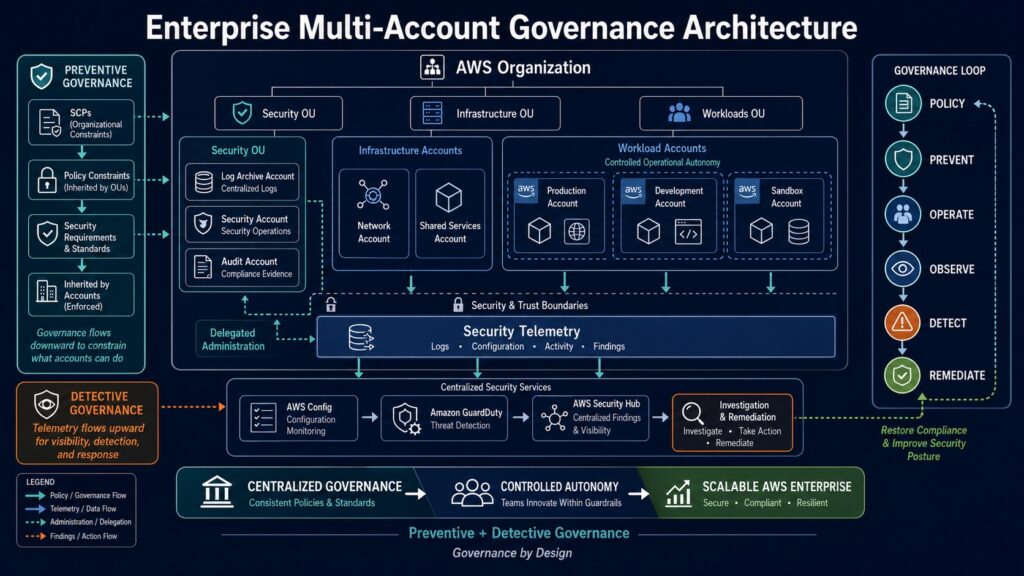
Centralized governance is implemented through Organizational Units (OUs) and AWS Accounts forming a hierarchical account structure. SCPs are the main preventive guardrails that OU members inherit and restrict allowable activities within AWS Accounts that form the trust boundaries. They reinforce environment isolation and business unit separation while allowing delegated administration within governance boundaries, reducing blast radius. SCPs enforce enterprise-wide governance consistency since AWS Accounts cannot override inherited SCPs.
Landing zones provide a standardized multi-account foundation that incorporates preventive and detective guardrails into account provisioning. Account deployment is restricted to automated deployment with the necessary guardrails, standardizing the network architecture and enforcing governance by design. These governance foundations are explored further in AWS Secure Landing Zone, including the multi-account architecture and security controls required for enterprise workloads. Landing zones also integrate federated identity, enabling centrally governed identities to access AWS accounts through temporary role-based credentials. Automated account deployment with guardrails establishes the foundation for scalable cloud enterprises.
Centralized Security Operations
Governance must also include remediating violations of governance boundaries since preventive guardrails will never prevent all violations. This remediation workflow must include centralized telemetry data collection, its centralized processing for violation detection, and its remediation. Centralized telemetry data collection is implemented with a centralized logging account that enables cross-account log aggregation and provides protected, centralized log storage. Additionally, this includes a security account that facilitates enterprise visibility and security investigations. An audit account provides controlled access to compliance evidence and governance records.
Several centralized security services enable telemetry and configuration data processing for violation detection. These follow the delegated administrator model, where designated AWS accounts centrally administer security services while maintaining separation from workload accounts. AWS Config is responsible for centralized monitoring of the AWS environment’s configuration, detecting configuration violations, and initiating automated remediation actions. GuardDuty analyzes telemetry data to detect potential threats, enabling manual or automated remediation. Security Hub provides centralized visibility into security findings and correlates related findings, enabling both manual and automated remediation.
Financial services are subject to regulatory compliance, making them an important example of governance through preventive vs detective guardrails. Preventive guardrails enforce separation of duties and least privilege, reducing the risk that a single compromised identity or account can cause widespread impact. Detective guardrails enable timely remediation that supports operational resilience when security incidents cause service degradation. Together, these controls support enterprise risk management and continuous security and compliance assurance, characteristics of mature enterprise security architecture.
Common Guardrail Mistakes
Unbalanced Guardrail Strategies
Enterprise architectures that rely only on detective guardrails have a reactive security posture, responding to security events only after they occur. This places a greater burden on remediation because security events can progress before they are detected, increasing their potential impact. Additionally, incident response and remediation capabilities risk becoming overwhelmed.
Conversely, overusing preventive controls can introduce excessive SCP restrictions with minimal improvement in limiting violations. They introduce operational friction, hampering efficiency and increasing cost and slowing delivery. Additionally, they constrict team autonomy, defeating the purpose of a decentralized architecture and introducing bottlenecks in any decision process. Governance becomes an obstacle, leading to frustration and teams introducing workarounds to bypass governance processes.
Poorly Designed Detection
Excessive alerts are one type of poorly designed detection, where many alerts are low-value findings that do not improve responsiveness. These can obscure important signals, degrade responsiveness, and lead to alert fatigue, where significant events are missed.
Another poor detection design is the lack of centralized visibility into telemetry or potential threats, fragmenting remediation. This also makes remediation inconsistent across the enterprise, exposing security gaps and increasing the risk of disruption. Furthermore, fragmented visibility can create unclear operational ownership, increasing the risk that incidents remain undetected or unresolved.
Governance Without Architecture
Preventive guardrails vs detective guardrails are only effective when built on well-architected trust boundaries and network segmentation. Flat account structures make guardrails harder to manage consistently, either reducing account flexibility through excessive restrictions or leaving accounts without critical governance controls. Excessive shared resources and weak trust boundaries both reduce resource isolation and increase blast radius. This forces guardrails to compensate for poor architecture, increasing governance complexity and organizational risk.
Layering governance on weak foundations increases the difficulty of guardrails enforcing constraints across the AWS environment. Sound architectural foundations establish well-defined trust boundaries and network segmentation that properly isolate resources. These foundations are then reinforced by appropriate preventive and detective controls, enabling controlled operational autonomy and scalable enterprise governance.
Conclusion
Preventive vs detective guardrails impose architectural governance on the cloud environment and are more than just individual AWS controls. They reinforce trust boundaries and network segmentation through preventive enforcement and detective remediation. Guardrails provide defense in depth to reduce workload attack surface and the blast radius.
Preventive and detective guardrails perform complementary security responsibilities of prevention and remediation. Preventive guardrails prevent activities before they become security incidents, including attacks or configuration changes that violate established governance boundaries. Detective guardrails identify residual risks and violations that preventive guardrails were unable to prevent. Together they provide defense in depth and enable continuous governance. They also enable scalable multi-account governance while allowing controlled operational autonomy.
Architecture defines security outcomes through resource isolation, while guardrails embed governance within that architecture. These multi-account foundations are further reinforced through identity and cryptographic boundaries, contributing to mature enterprise security architecture. This improves operational resilience and supports continuous improvement while enabling secure enterprise scalability. Ultimately, guardrails reinforce secure architecture rather than relying solely on reactive security.
References
- AWS Control Tower Controls Reference
- AWS Organizations — Service Control Policies
- AWS Security Reference Architecture
- AWS Control Tower — What Is AWS Control Tower?
- AWS Config Conformance Packs
- Amazon GuardDuty User Guide
- AWS Security Hub User Guide
Further Learning
AWS Security Cookbook: Practical solutions for securing AWS cloud infrastructure with essential services and best practices
by Heartin Kanikathottu
Pluralsight — AWS Security: Management and Security Governance
Affiliate Disclosure: Some links in this article are affiliate links. If you make a purchase through these links, AI Cloud Data Pulse may earn a commission at no additional cost to you. Recommendations are based on their relevance to the topics covered in this article.
As an Amazon Associate, I earn from qualifying purchases.