AWS IAM architecture best practices: Introduction
IAM as a Security Boundary
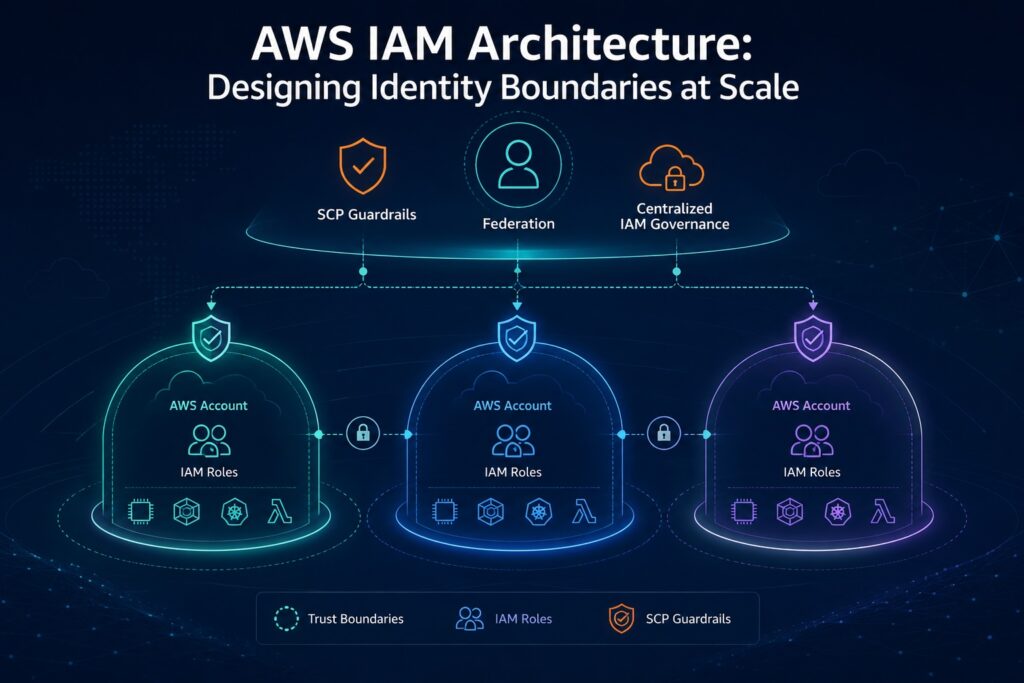
AWS IAM architecture best practices support isolating resources into trust boundaries by controlling access across these boundaries. This extends IAM beyond users and permissions by establishing identity as a core security boundary. Here, identities are confined to distinct trust boundaries that define the relationship between identity and security. IAM enables the architecture to control access across cloud workloads, establishing the architectural importance of IAM design. This is essential in enterprise-scale AWS environments, where security failures often result from poor IAM design. This makes IAM a crucial component of overall cloud architecture, aligning with principles from the AWS Well-Architected Framework.
Identity Boundaries in Multi-Account AWS Environments
Trust boundaries are foundational to security architecture in isolating resources, as discussed in AWS Resource Isolation Security. However, architects must build on them with well-designed identity boundaries that control the behavior of entities within these trust boundaries. The multi-account AWS strategy implements trust boundaries as AWS Accounts, forming a foundational element of an AWS secure landing zone for enterprise workloads. It then uses the role assumption model to assign permissions to entities within these accounts. Some AWS services reinforce these identity boundaries through additional authorization mechanisms. For example, AWS KMS Architecture demonstrates how cryptographic operations require both IAM permissions and KMS key policies before access is granted. Together with federation and centralized identity, these authorization mechanisms form the foundation of the interaction between IAM and AWS Organizations. Hence, identity boundaries follow the principle of least privilege at scale to prevent privilege escalation and reduce blast radius through IAM segmentation.
Governance and Cross-Account Trust Design
Hence, enterprise environments must follow AWS IAM architecture best practices through role-based design. These practices are vital for establishing cross-account trust relationships, which are at the core of trust boundary architecture. Architects must also establish governance-focused IAM patterns to prevent rogue or overly permissive access patterns beyond least privilege. These are secure cloud design principles that form part of architectural best practices that minimize common IAM mistakes at scale.
Why AWS IAM Architecture Best Practices
AWS IAM Architecture Best Practices for Security Boundaries
Trust boundaries granting permissions alone are insufficient in securing AWS environments at scale, even though they are foundational. Controlling the authorization of permitted entities is an essential layer in securing the environment. IAM architecture is a foundational security layer since it controls workload interaction through authorization, establishing the relationship between architecture and authorization. Architects must integrate IAM into the cloud architecture to enable identity-driven access control and minimize unauthorized access. They must scale this across the enterprise and make it consistent through IAM governance.
Poor IAM Design Increases Blast Radius
Poor IAM structure can lead to overly permissive authorization, resulting in overprivileged IAM roles with security implications in several ways. This can lead to excessive trust relationships across trust boundaries, increasing lateral movement risks, and leading to uncontrolled cross-account access. As a result, it potentially expands the blast radius that segmentation is meant to address, risking resources from compromised workloads. There is also the grave risk of privilege escalation, especially when acquiring administrative privileges and access. Additionally, there is policy sprawl across environments, leading to operational complexity growth
AWS IAM Architecture Best Practices for Enterprise Governance
Enterprises consist of multi-account AWS environments but need centralized identity management to reduce operational complexity. Therefore, architects must align IAM with AWS Organizations and establish a federation architecture so AWS Accounts and IAM identities are orthogonal. The most common mechanism for achieving this is the role assumption model, in which roles define authorization and enforce least privilege. Architects also impose a governance layer on these roles through SCP by establishing guardrails on authorizations within accounts. This architecture enables scalable cloud security operations.
Architects integrate identity boundaries with trust models by following IAM architecture best practices and secure cloud design principles. They need to balance security with operational flexibility when regulating workloads through proactive IAM design. Additionally, they need to balance long-term operational maintainability while continually reducing architectural security debt. This is done in the background of enforcing enterprise governance requirements.
AWS IAM Identity Boundaries vs Network Boundaries
Network Boundaries Control Reachability
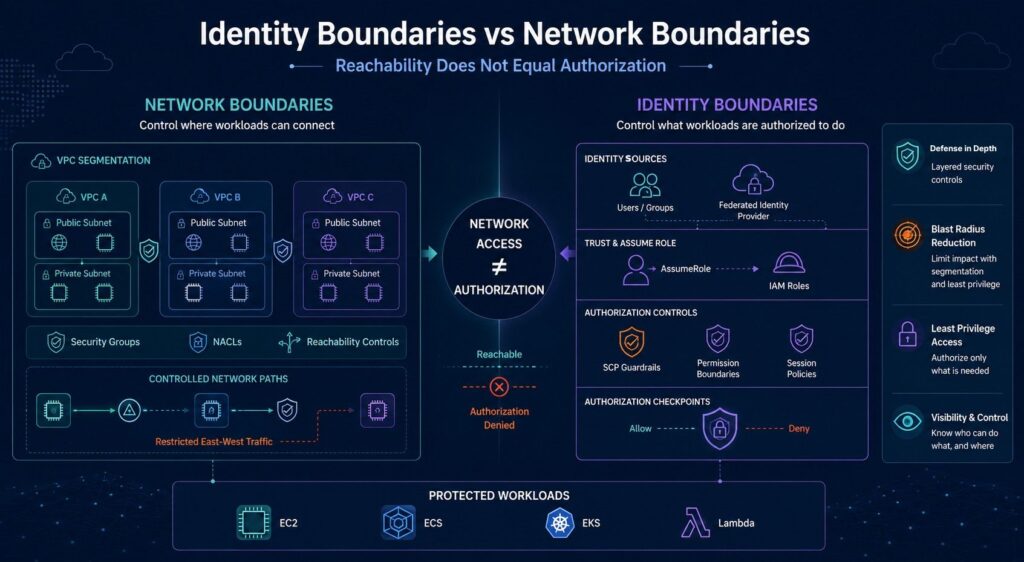
Network segmentation follows architecture-first security principles, as discussed in AWS Infrastructure Security: Why Architecture Comes First, by minimizing the number of resources any compromised workload can reach across the network. The largest segmentation unit is the Virtual Private Cloud (VPC), but the architecture can further segment VPCs into subnets. The architecture establishes routing paths and removes any unauthorized network paths, thereby reducing the exposed attack surface for resources. The architecture controls workload reachability to resources between VPCs, Network ACLs for subnets, and Security Groups for resources. Furthermore, the architecture controls east-west traffic, further reducing the attack surface.
Network boundaries are the first security layer in which resource isolation is implicit in the network, preventing direct workload exposure. Segmenting the network into VPCs, then into subnets, and limiting their paths reduces the blast radius for any failures or compromises. Additionally, segmentation controls internet access, further limiting attack vectors from external actors. While segmentation controls the network paths, it does not control who can access resources through these paths. Hence, network access is not equal to authorization, and layered security controls are required. These same principles apply to hybrid connectivity architectures where enterprise environments connect to AWS through private circuits or encrypted tunnels. Understanding the trade-offs between transport isolation and encryption is critical when evaluating AWS VPN vs Direct Connect Security.
Identity Boundaries Control Authorization
While network segmentation controls network access between workloads, it does not control which entities are authorized to access workloads. IAM identity boundaries are the next layer of security controls above NACLs and Security Groups, which control authorization through these network paths. Hence, it controls permissions after access is established via IAM roles and policies, enforcing least privilege. Identity segmentation typically defines who can access workloads, whereas permission boundaries define what actions they are permitted to perform. This prevents overprivileged access by restricting service actions using SCP and imposing guardrails on these permissions.
The distinction between network segmentation and identity boundaries is that network segmentation defines reachability while identity boundaries enforce authorization. This establishes authorized entities within segmented networks where IAM is a secondary containment layer on network segmentation. IAM boundaries control actions after authentication, preventing lateral privilege usage across network paths. This includes role isolation, where entities are prevented from accessing resources even when they can reach them via the network. Architects can also apply identity governance at scale and limit privilege escalation paths through SCP.
Architecture Requires Both Boundary Types
Architectures that integrate network and identity boundaries create a defense-in-depth model, containing compromises and failures. Together, they reinforce trust boundaries by limiting network paths and permissions to access them. This principle also extends to hybrid AWS environments, where connectivity choices influence trust assumptions and attack surface exposure. For a detailed discussion, see AWS VPN vs Direct Connect Security: The Security Trade-offs That Actually Matter. By layering segmentation with least privilege, architectures reduce blast radius, secure multi-account AWS environments, and minimize architectural security gaps. By supporting trust policies and role assumptions, they enable a coordinated governance strategy. These AWS IAM architecture best practices help organizations enforce layered security controls and reduce the risk of privilege escalation across multi-account environments.
AWS IAM Architecture Best Practices for Roles and Trust Policies
IAM Roles Establish Identity-Based Authorization
The key construct for Identity boundaries is the IAM role, which abstracts identity and grants federated entities access to AWS resources. IAM grants temporary credentials to entities, thus eliminating long-term credentials that are difficult to manage. It also limits authorization to roles, known as role-based authorization. Workloads can assume permissions through roles, where permissions are assigned only to roles, not to workloads. Architects assign permissions to roles by attaching IAM policies to roles, thereby separating identities from permissions. The approach reduces credential management complexity and enables scalable identity management.
The role assumption model used for identity boundaries performs dynamic authorization by using AWS STS temporary tokens as time-limited credentials, as described in the AWS Security Token Service documentation. It establishes service-to-service authentication and reduces the exposure of static credentials when granting specific permissions to workloads. These are further specialized for the main AWS computational workloads, as discussed in EC2 vs ECS vs EKS: Why AWS Compute Security Isn’t the Same; for EC2, they translate as instance profiles. For ECS, they specialize as task roles, and for EKS, they become Kubernetes IRSA concepts and execution roles for Lambda functions. This enables a scalable cloud-native identity architecture.
Trust Policies Define Trust Boundaries
AWS accounts are the primary organization’s trust boundaries operating at the macro level. However, trust policies associated with IAM Roles are trust boundaries that operate at the micro level. This involves trust establishment that specifies which principals are permitted to assume identities, as described in the IAM Roles and Trust Policies documentation. Trust establishment differs from authorization, which specifies the permissions granted to identities. It provides AssumeRole permissions that grant principals within trusted AWS accounts to assume identities in different AWS accounts. IAM users and roles are principals and can become service principals through federated identities. The role assumption model limits their actions through role policies and prevents unauthorized identity acquisition, maintaining trust boundary integrity. This secure trust relationship design enforces cross-account trust governance.
Architects must design trust policies to ensure trust boundary integrity that they can weaken through poor design. Poor decisions include excessive trust relationships, wildcard principal risks, and unrestricted AssumeRole permissions. These can lead to trust propagation dangers where a principal can gain access to a prohibited trust boundary through an intermediary. Entities can exploit unrestricted permissions to escalate privileges and move laterally through trusted identities. Architects must minimize the number of trusted entities while enforcing least privilege within trust policies. Furthermore, they should tightly scope trust relationships and segment trust domains.
Federation and Cross-Account Trust Models
Enterprises have thousands of entities comprising users and systems, and managing access is paramount. They prevent the workforce from becoming IAM users and implement federation architectures that centralize identity providers. The most widely used protocols are SAML federation or OIDC federation that integrates the workforce with identity providers, as described in the AWS Identity Federation documentation. They issue temporary credentials allowing centralized authentication governance, typically through IAM roles. This allows separation between authentication and authorization, making enterprise identity scalable. Also, architects can control cross-account role assumption and strengthen trust boundaries.
Governance of IAM Roles and Trust Relationships
Large enterprises will have thousands of IAM roles and trust relationships, and hence require governance-focused IAM architecture. The core mechanisms are SCP guardrails that prevent privilege escalation and excessive permissions while enforcing consistent enterprise IAM standards. Architects should restrict privilege role creation and establish role lifecycle management. They should also actively monitor trust relationships and regularly audit AssumeRole activity using CloudTrail log data, as described in the AWS CloudTrail documentation. This will help them to continually prevent architectural security debt from accumulating.
IAM + SCP Governance Model
IAM Roles as the Foundation of Authorization
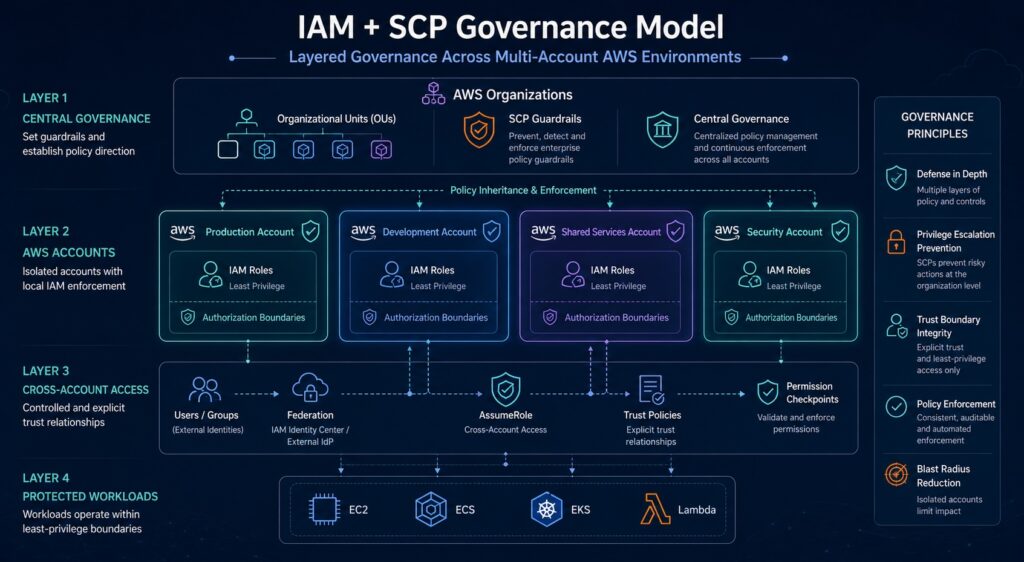
Identity and Access Management (IAM) roles serve as the foundation of security boundaries since they separate identities from authorization. They reduce reliance on long-term access keys that create security risks by providing temporary credentials through AWS STS. This allows permissions to be task- or workload-specific, supporting least-privilege enforcement and enabling scalable authorization across workloads. These roles are common across computational workloads, including EC2, ECS, EKS, and Lambda functions. This simplifies identity management and reduces the risk of credential exposure. It also allows architects to establish centralized authorization patterns. These IAM role patterns differ significantly across compute platforms, as discussed in EC2 vs ECS vs EKS: Why AWS Compute Security Isn’t the Same, where EC2 uses instance profiles, ECS uses task roles, and EKS relies on Kubernetes IRSA and pod-level identity models.
SCPs as Enterprise Governance Guardrails
The ability to tailor permissions independently from identities is a core advantage to security management. However, these roles can become overly permissive without adequate controls across the AWS environment. Implementing SCPs at the AWS Organizations level applies governance across Accounts and OUs. Unlike IAM policies, SCPs restrict permissions rather than grant them, thereby limiting the maximum allowed permissions and preventing privilege escalation paths. They therefore enforce consistent security standards across the AWS environment and reduce policy drift across environments. This strengthens the multi-account governance strategy.
IAM Governance Best Practices for Layered Security
Layering IAM roles with SCPs provides defense-in-depth against privilege-escalation paths, especially across trust boundaries. These roles control authorization within trust boundaries implemented by AWS Accounts, whereas SCPs define organization-wide permission boundaries. Combined, they enforce layered identity governance to prevent excessive permissions at multiple levels and reinforce the principle of least privilege. This limits the blast radius from compromised identities and improves enforcement of trust boundaries. Establishing guardrails at multiple levels separates operational flexibility from governance control, thereby aligning security architecture with enterprise risk management. This also reduces architectural security debt over time.
Cross-Account Governance and Trust Relationships
Trust boundaries are essential for securing AWS resources and workloads, but they need to interact across these boundaries for enterprises to function. Therefore, it is necessary to permit cross-account role assumption through trust relationships. However, excessive trust can increase lateral movement risks, so they must remain tightly scoped. IAM trust policies define permitted principals, whereas SCPs help regulate cross-account permissions. The workforce often requires access to various accounts, so federation centralizes authentication, with common protocols such as SAML and OIDC. This is complemented with temporary credentials supplied by STS, reducing static credential exposure. This allows the architecture to balance security and operational scalability, typically with CloudTrail auditing for ongoing compliance monitoring.
Common IAM Architectural Mistakes
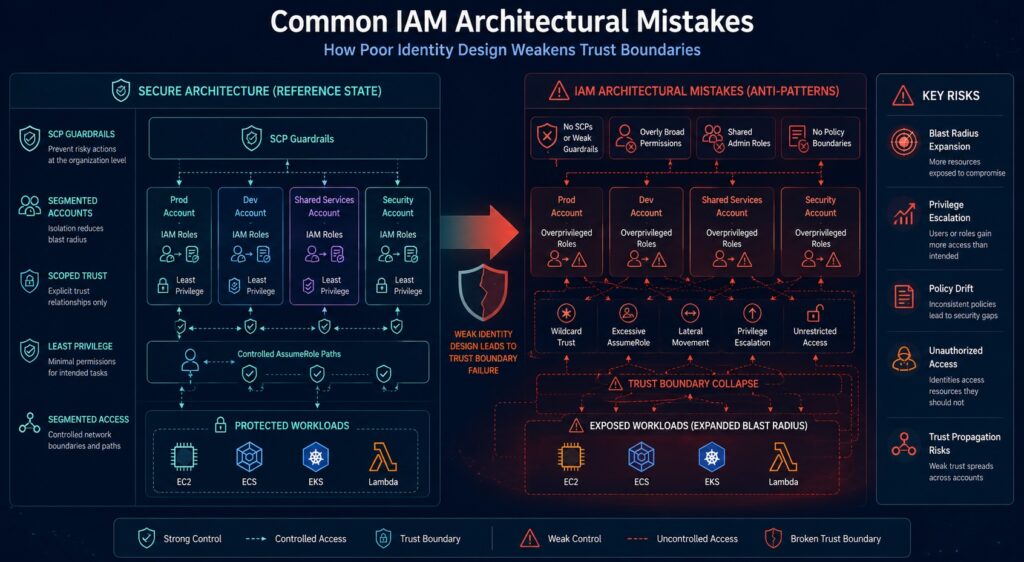
Capabilities like IAM Roles and AssumeRole, along with SCP, will not prevent the impact of poor architectural decisions. Several common architectural mistakes weaken trust boundaries, leaving resources overexposed.
Overprivileged IAM Roles and Policies
These undermine resource isolation enforced through network segmentation and trust boundaries. Excessive permissions can cross these segments and boundaries, thereby increasing the attack surface. There are several examples of excessive permissions, including wildcard permissions, that violate the principle of least privilege. Another example is overprivileged roles that permit unnecessary lateral movement than needed, increasing blast radius. This also includes granting administrative roles, unnecessarily increasing risk by compromised entities. Authorization granularity limits workloads to specific tasks, whereas shared roles reduce this granularity. This lack of role specialization weakens workload isolation.
Weak Trust Relationships and Cross-Account Access
Trust boundaries are foundational to resource isolation and more fundamental to network segmentation. Weakening trust boundaries increases the vulnerability of resources to attack. Although entities need to interact across these boundaries, loose trust relationships will weaken these trust boundaries. This is caused by unrestricted AssumeRole permissions that create escalation paths and wildcard principals that introduce unauthorized access risks. Shared trust models also expand lateral movement exposure, weakening trust boundaries. Besides weak trust relationships, poor federation design weakens identity governance in controlling who gets authorized.
Poor Governance and Lack of Centralized Controls
Poorly designed role policies and trust relationships also stem from poor governance and policy inconsistency due to decentralized IAM management. Both stem from the absence of organizational structure and SCP guardrails that enforce governance over permissions and trust. This leads to inconsistent standards that create operational drift, along with manual permission management that does not scale effectively. CloudTrail monitoring is also essential because, without it, visibility into security events and incident diagnosis becomes limited. This lack of controls weakens the enterprise’s security posture and also increases architectural security debt over time.
Failing to Align IAM with Security Architecture
IAM is an essential layer over network segmentation and trust boundaries, but if poorly integrated, it will weaken them. Security cannot rest solely on IAM using authorization to secure exposed workloads. The identity boundaries established by authorization must complement trust boundaries established by AWS Accounts. Whereas Security Groups and NACLs control reachability, IAM controls actions after network access is established. Therefore, misaligned identity boundaries create layered security gaps that allow unauthorized entities to cross trust boundaries through permitted network paths. This weakens defense-in-depth rather than strengthening it.
IAM Architecture Best Practices
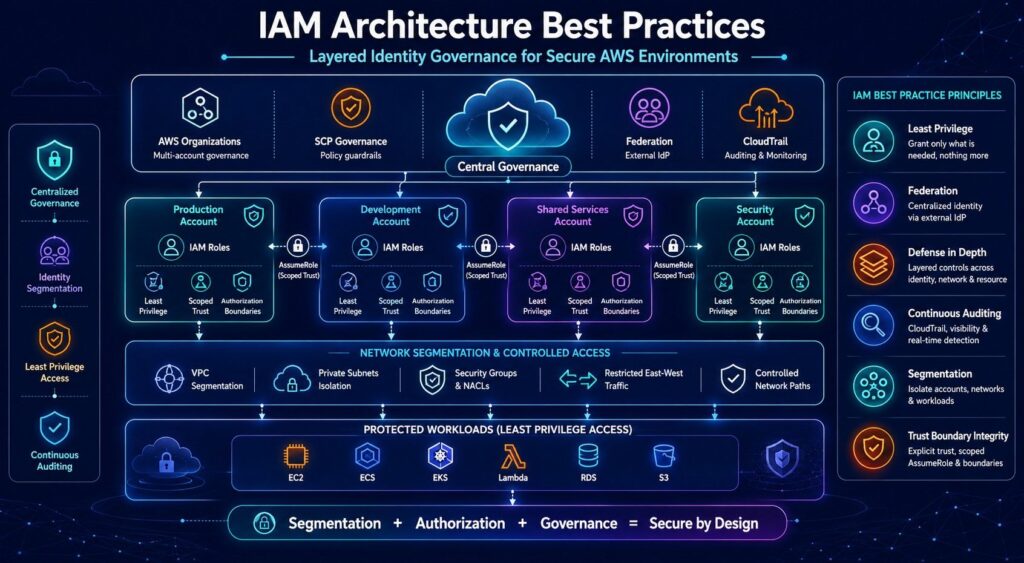
After examining common mistakes, we can focus on IAM architecture best practices for segmentation, trust boundaries, and identity governance.
Design IAM Around Trust Boundaries
Well-architected AWS environments use AWS Accounts as primary trust boundaries. Properly aligning identity boundaries with account segmentation reinforces trust boundaries for layered defense-in-depth, as discussed in AWS Resource Isolation Security. This ensures that authorization is scoped to isolated environments and reduces the blast radius in multi-account environments. Limit cross-account trust relationships and tightly scope them to prevent unnecessary lateral movement and cross-account interaction. Network segmentation should also be reinforced with IAM controls to reduce exposure risks.
Enforce Least Privilege with Role-Based Design
Security architecture assumes that even well-architected AWS environments remain potentially hostile. Even when having sound network segmentation, trust boundaries, and IAM identity boundaries. Assume that any entity can be compromised. Therefore, privileges should remain tightly scoped to the specific role or workload task being performed. Therefore, align each IAM role with a workload-specific task and limit permissions to that task, following AWS IAM best practices. Moreover, restrict wildcard permissions wherever possible and minimize administrative access. This also extends to separating human and machine identities and avoiding long-term credentials, favoring temporary credentials via AWS STS.
Govern Permissions with SCP Guardrails
Never assume that AWS roles are created according to sound IAM security principles; they may be overly permissive, either intentionally or unintentionally. Use SCPs to enforce organization-wide governance by restricting the maximum permissions allowed to entities with overly permissive roles, as discussed in AWS Organizations & SCPs: Preventing Risk at Scale and the AWS Service Control Policies documentation. Also, use SCPs to prevent privilege escalation across accounts, which is critical to trust boundary integrity. Also, apply SCPs at the OU level for fine-grained control; for example, production accounts are more restrictive than development accounts. Use SCPs to enforce centralized governance and improve compliance posture.
Strengthen Federation and Cross-Account Access
Decouple authentication from authorization to effectively manage enterprises with a large workforce, which also includes machines accessing resources. Integrate enterprise identity providers with SAML or OIDC that grant temporary credentials to identities, reducing static credential risks. Since entities must interact across accounts, ensure that cross-account access is limited by tightly scoped trust policies. This is achieved through restricted AssumeRole permissions and minimized trusted principals. Additionally, audit trust relationships regularly, using a tool like CloudTrail that monitors AssumeRole activity.
Continuously Audit and Refine IAM Architecture
Enterprise environments and threat landscapes continually evolve, as well as AWS environment utilization. Hence, it is essential to continually review IAM governance due to changing role usage and permissions. Continually monitor role usage and permission growth and remove any stale permissions and unused roles. Also, audit trust relationships regularly and identify any privilege escalation paths that have arisen due to the changing environment. This ensures that governance evolves alongside cloud growth and the changing threat environment.
Conclusion
IAM Architecture as a Core Security Layer
In well-architected AWS environments, IAM must extend beyond a simple authentication and authorization service. IAM identity boundaries should provide an additional layer of defense for resources isolated by network segmentation and trust boundaries. AWS Accounts form the trust boundaries that establish primary isolation boundaries. IAM identity boundaries reinforce these trust boundaries by limiting authorization within them. They also complement network segmentation by controlling authorization across permitted network paths. They achieve this through IAM roles that control workload authorization and AssumeRole permissions that control cross-account access. It also enables scalability by decoupling authentication and authorization through federated identity management.
Governance and Architecture Must Evolve Together
AWS environments continually evolve alongside enterprise requirements and the expanding adoption of AWS services. However, adapting to evolving threat environments is always urgent. These changes cause role permissions and trust relationships to expand over time, requiring continual auditing to prevent weakening trust boundaries. Therefore, IAM governance requires continual refinement to adapt to these changes. This ensures that preventive controls continue to minimize the risk of privilege escalation. An important tool in this arsenal is CloudTrail, which provides visibility into authorization activity.
IAM architecture must continually align with the enterprise security strategy, and identity governance must support secure cloud transformation. Architects must ensure that segmentation and authorization work together and that governance guardrails reinforce trust boundaries. Ultimately, secure IAM architecture reduces operational and security risks while strengthening the enterprise security posture. These AWS IAM architecture best practices help enterprises scale secure cloud governance across complex multi-account environments..
Further Reading and Learning Resources
- AWS Certified Security Specialty Study Guide — deeper coverage of IAM, SCP governance, CloudTrail, and AWS security operations.
- AWS Security by Dylan Shields — practical guidance for implementing layered AWS security architecture and governance controls.
Structured Learning and Hands-On AWS Security Training
For readers looking to deepen their practical understanding of AWS IAM, SCP governance, federation, and enterprise cloud security architecture, structured learning platforms can help reinforce these concepts through hands-on labs and guided training paths.
I recommend exploring AWS security and governance learning paths on Pluralsight, particularly for:
- IAM architecture and least privilege design
- AWS Organizations and SCP governance
- CloudTrail auditing and monitoring
- Identity federation and role assumption models
- Enterprise cloud security operations
Affiliate Disclosure
AI Cloud Data Pulse participates in affiliate programs, including Amazon Associates and other educational partner programs. This means that qualifying purchases made through links on this site may earn a small commission at no additional cost to you.
These recommendations are provided to support readers looking to deepen their understanding of AWS, cloud security, AI, and enterprise architecture topics. AI Cloud Data Pulse only recommends resources that are relevant to the subject matter and valuable to its audience.