
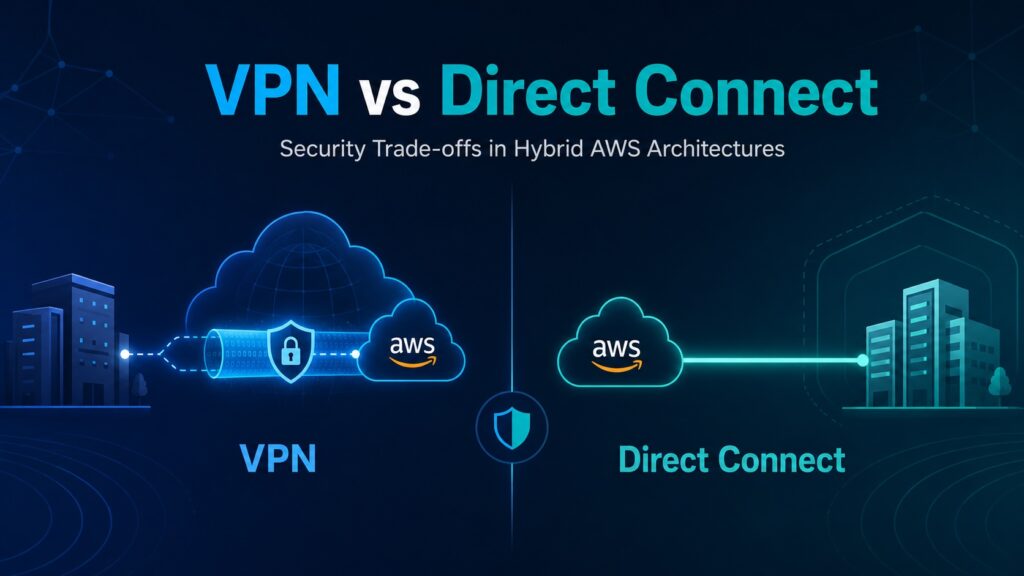
Introduction to AWS VPN vs Direct Connect Security
Making security implicit through boundaries and network segmentation does not replace explicit security controls, such as IAM and external access controls. External access controls in AWS VPN vs Direct Connect Security form a critical yet often overlooked security layer. This connectivity directly affects the attack surface and the trust boundaries against external actors.
Engineers often view AWS Direct Connect as more secure because it is private. Meanwhile, they perceive VPNs as less secure because of their internet exposure. However, this understanding is highly superficial, as security is far more intricate and depends on encryption, routing, and architectural design. It is a mistake to say there is a clear winner with AWS VPN vs Direct Connect Security, since private connectivity does not automatically guarantee secure connectivity. For a broader discussion on architecture-first cloud security principles, see AWS Infrastructure Security: Why Architecture Comes First. Engineers must understand trade-offs and use cases in selecting the right external controls.
AWS VPN vs Direct Connect Security Fundamentals
What AWS Site-to-Site VPN Actually Provides
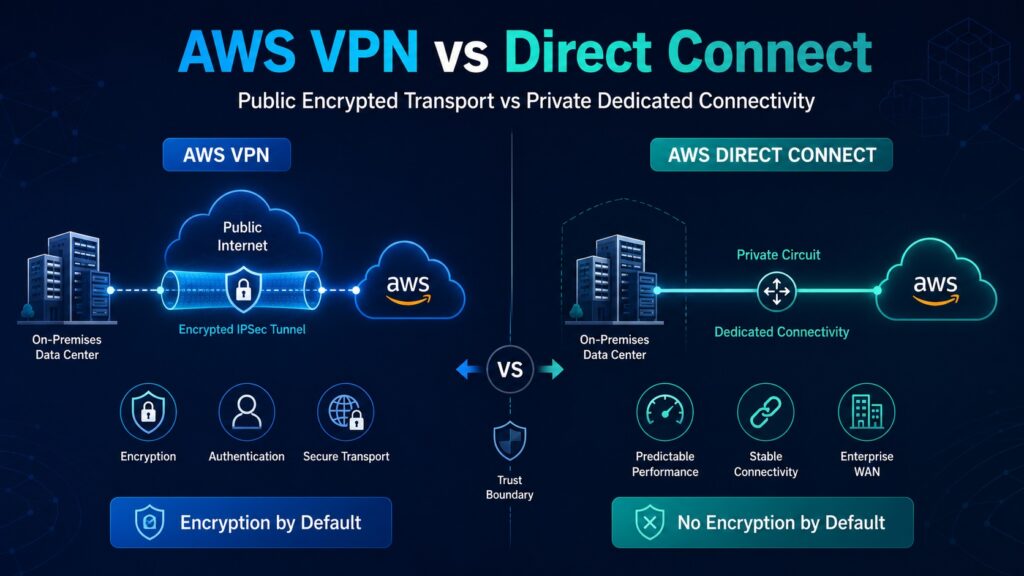
AWS Site-to-Site VPN establishes IPSec tunnels over the public internet. Traffic traverses untrusted networks that may intercept packets. VPN enforces security through cryptographic protection rather than path isolation. It encrypts data in transit end-to-end by default using standard protocols. AWS manages VPN endpoints, where it provisions and maintains the VPN gateway on the cloud side. Customers manage the on-premises/customer gateway devices for end-to-end encryption by default. This reduces operational overhead and enables rapid deployment of secure tunnels.
What AWS Direct Connect Actually Provides
AWS Direct Connect establishes a dedicated private circuit to AWS, allowing customers to bypass the public internet entirely. Connectivity is provisioned through AWS Direct Connect locations and via carrier connections from on-prem sites. This provides several benefits over the public internet, including predictable network performance due to consistent latency and bandwidth. Direct Connect favors use cases with high-throughput and stable workloads. However, it does not provide encryption by default, and this must be implemented separately; options include overlay VPN and MACsec. Its main use case is extending existing corporate network boundaries into AWS that rely on the concept of trusted network assumption.
Encryption in AWS VPN vs Direct Connect Security
IPSec Encryption in VPN
Encryption in transit is a key security fundamental that IPSec provides using several encryption standards that work together. AES (Advanced Encryption Standard) encrypts the actual data traffic to protect the confidentiality of transmitted data and the integrity of packets during transport. IKE (Internet Key Exchange) establishes and manages the secure connection between VPN endpoints through authentication and secure key negotiation and exchange. VPN enables encryption by default to protect traffic regardless of network paths that it assumes are untrusted. Therefore, it treats secure transport as a core requirement rather than an operational add-on using cryptographic protection along with authenticated tunnel establishment.
Why Direct Connect Is Not Encrypted by Default
Direct Connect is a dedicated private circuit that provides predictable connectivity and isolation from the public internet. However, bypassing the Internet alone does not make it secure since it does not automatically provide encryption or cryptographic protection. In fact, sensitive traffic may still be exposed within enterprise environments or across intermediary provider infrastructure. Additionally, misconfigured networks may expose sensitive traffic to bad actors.
Organizations that use Direct Connect often layer on it either MACsec encryption, IPSec VPN overlays, or additional in-transit security controls. MACsec protects Layer 2 Ethernet traffic and data traversing physical network links. VPN overlays provide cryptographic protection over Direct Connect paths. Organizations often use Direct Connect for performance in conjunction with a VPN overlay for encryption.
Network Reachability and Attack Surface
Public Internet Exposure in VPN
AWS Site-to-Site VPN traffic traverses the public internet along with any intermediary carrier infrastructure and externally reachable network paths. Therefore, it is exposed at the transport path level, packet routing level, and the public network accessibility level. Hence, the underlying network is not trusted since packets may be intercepted, inspected, or travel through hostile environments. This mirrors broader edge security principles where exposed transport paths still require layered protection mechanisms. This is why it applies IPSec encryption, which protects payload confidentiality and secures data in transit, preventing readable packet inspection. This secures communication over exposed transport paths by reducing risk through encryption and authentication.
Private Circuit Does Not Eliminate Risk
AWS Direct Connect, using private carrier infrastructure and enterprise-controlled network environments, does not guarantee trusted communications. These private circuits still depend upon proper enterprise segmentation with secure internal routing, alongside controlled administrative access. Security risk can still originate from insider threats, compromised internal systems, and lateral movement across trusted environments that attackers can exploit.
Therefore, private connectivity is not inherently secure and requires fewer explicit protections, which is often assumed. This assumption leads to misplaced trust boundaries that potentially allow excessive network reachability and weak internal isolation controls. While private connectivity reduces exposure, it does not eliminate attack surfaces. It still requires strong segmentation, explicit access controls, and layered security enforcement.

Routing, Failover, and Trust Boundaries in AWS Hybrid Architectures
BGP Routing in VPN and Direct Connect
External connections to AWS networks commonly use the Border Gateway Protocol (BGP), whether routing through AWS VPN or Direct Connect. BGP enables flexible hybrid connectivity, dynamic failover behavior, and adaptive routing during outages or path degradation. Whereas this adaptability is valuable to maintain connectivity, it can expose vulnerabilities due to poor configuration. It directly affects network reachability, accessible resources, and trust boundaries across environments. Architects must make important design choices for trust boundaries and network segmentation.
Failover Patterns and Security Implications
A common failover pattern organizations use is AWS Site-to-Site VPN as a backup connection for AWS Direct Connect. Hence, failover changes the underlying network path, but it also modifies network exposure characteristics and the connectivity’s trust assumptions. This changes exposure models, operational dependencies, and encryption assumptions. Consequently, security teams need to account for failover routing policies, security inspection consistency, and monitoring visibility during connectivity transitions. Monitoring hybrid connectivity transitions is also critical for maintaining consistent operational visibility and security observability. Overall, any resiliency planning must factor in security implications.
Defining Trust Boundaries Correctly
The architectural principle of defining trust boundaries extends to external networks connecting to AWS either through AWS VPN or Direct Connect. Therefore, private connectivity does not replace IAM enforcement, explicit authorization controls, network segmentation boundaries, and least-privilege access design. Understanding how identities, roles, policies, and permission boundaries operate within AWS environments is equally important for establishing secure authorization controls. For a deeper discussion, see AWS IAM Architecture: Designing Identity Boundaries at Scale. Architecture should treat the private network as a separate network segment and boundary subject to security controls. These security controls include authentication, authorization, and policy enforcement as applied to other boundaries. Segmentation should also limit lateral movement and reduce blast radius during compromise events, following the principles discussed in AWS Resource Isolation Security. Network segmentation strategies also depend on understanding how Security Groups and NACLs enforce boundaries at different layers.
AWS VPN vs Direct Connect Security Trade-offs Explained
When VPN Is the More Secure Option
Even though it traverses the public Internet, AWS VPN is more secure than Direct Connect when environments prioritize protecting data in transit. Using the IPSec encryption mitigates Internet exposure risk using AWS VPN and packet interception concerns by preventing traffic inspection attempts. AWS VPN also has lower operational complexity than Direct Connect, as well as fewer connectivity dependencies and simpler provisioning workflows. VPN is a good choice for smaller enterprise environments and for disaster recovery connectivity patterns.
When Direct Connect Is the Better Choice
There are other scenarios where Direct Connect is better due to public Internet throughput and latency issues. Since it bypasses the public Internet, it provides predictable network performance and consistent latency characteristics. Its dedicated bandwidth capacity is free from internet-path variability issues. Furthermore, Direct Connect favors environments that require operational consistency, stable routing behavior, and controlled enterprise connectivity. Hence, it improves transport reliability, performance consistency, and network stability. Direct Connect is typically used by enterprises to integrate AWS with centralized corporate data centers.
When to Combine VPN and Direct Connect
VPN and Direct Connect are not mutually exclusive, and many enterprises combine them into layered connectivity with security controls. The most common approach is to overlay VPN on top of Direct Connect. Architects often term this as the encrypted Direct Connect pattern. This pattern combines predictable network performance with cryptographic traffic protection. Organizations deploying this pattern achieve defense-in-depth security along with improved resiliency during failover events. VPN overlay mitigates internal exposure risks that are still present in private networks. This layered approach also aligns with segmentation and identity-aware security models.

Why Direct Connect Is Not More Secure by Default
It is important to reiterate this, since many organizations are lulled into a false sense of security, with potentially serious implications. AWS Direct Connect is not inherently more secure simply because it bypasses the public Internet. Private circuits supported by Direct Connect still rely on infrastructure integrity and secure enterprise design. Organizations should architect private network security with network segmentation and boundaries, along with security controls. Effective resource isolation ensures that private connectivity does not unintentionally expand trust zones across AWS environments. Mature AWS environments often reinforce these boundaries through multi-account segmentation and SCP guardrails.
Along with network segmentation, hybrid architectures should also support IAM enforcement, encryption in transit, and explicit authorization controls. Additionally, architects should treat private connectivity as simply one architectural layer and not as a complete security model. They need to apply all the principles of implicit security architecture, including clearly defined trust boundaries and least-privilege access design. Architects also need to determine attack surface exposure and blast radius during compromise events.
Choosing Between AWS VPN vs Direct Connect Security
There is no universal answer to AWS VPN vs Direct Connect security since both these services address different operational and security issues. This choice boils down to operational requirements and organizational risk tolerance, along with connectivity scale and performance expectations. Both these approaches rely on different trust assumptions, operational models, and security trade-offs. Architects can also layer these approaches to address both operational and security requirements.
Strong hybrid security architectures must support network segmentation and clearly defined trust boundaries. They also need to support segmentation with encryption in transit and layered security mechanisms. Trust boundaries need support from IAM enforcement and explicit authorization controls. Therefore, architects should treat private connectivity as one layer within the broader security architecture, not as a complete security solution on its own.
Further Reading
- AWS Certified Security – Specialty Study Guide
- Practical Cloud Security
- Security Engineering: A Guide to Building Dependable Distributed Systems
If you want to build deeper expertise in hybrid networking and AWS security architecture, Pluralsight offers hands-on courses covering AWS networking, hybrid connectivity, IAM, and cloud security design.
Affiliate Disclosure: Some links in this article may be affiliate links. AI Cloud Data Pulse may earn a commission from qualifying purchases or subscriptions at no additional cost to you. These partnerships help support the site and its content.
