
Introduction: Why Architecture is the First Infrastructure Security Control
The Hidden Timing of Security Decisions
Sun Tzu said that every battle is won before it is ever fought, likewise, security outcomes are already determined at design time. This makes architecture the first security control in AWS since it defines trust boundaries. The simple explanation here is that attack surfaces are already created even before deployment commences. Investing first in architecture establishes the constraints that tooling operates within, so it is bounded within the attack surface. Therefore, architecture is calling the shots without adding late controls to play catch-up. For a broader, architecture-first perspective on AWS security, see AWS Infrastructure Security: Why Architecture Comes First.
Why Tool-Centric Security Thinking Fails
Prevention is better than cure, and tooling alone is just the cure and only addresses symptoms, but never the structure. This is seen in detection tools, where it is assumed that failure has occurred. However, good architecture would have prevented it in the first place. Also, identity controls may serve as the gatekeeper, but cannot prevent the reach of whoever can get in. Associated with these tools are alerts that scale with exposure but never reveal the intent of malicious actors. Architecture limits what tools can prevent making it the first security control in AWS.
Architecture as the First Security Control in AWS
Unlike tools that operate within the attack surface and react, architecture defines it, with profound implications for attackers. This is expressed as trust boundaries that are design decisions establishing the reach for any actor. The trust boundaries comprise the architectural topology that sets the blast radius and the reach and impact of any security event. Accordingly, boundary-enforcing controls enforce architectural intent. This architectural principle extends directly to edge security patterns, where services such as AWS Shield, CloudFront, and AWS WAF enforce these boundaries before traffic reaches the VPC, as explored in AWS Edge Security: WAF, Shield, and CloudFront in Practice.
How This Article Is Framed
The focus of this article is firmly centered on adopting the right mindset before implementing any mechanisms. Therefore, this article places architecture over tooling as the first security control for AWS. This follows the well-established guideline of principles before services.
Shared Responsibility: The Context for AWS Security Architecture
To better understand architecture’s roles as the first security control in AWS, it is essential to understand the joint responsibility model.
What “Shared Responsibility” Actually Means
Shared responsibility is the division of security control between AWS and the customer, where the division is not on outcomes. AWS’s responsibility is to secure the underlying cloud infrastructure that customers operate on, drawing from its deep expertise. Correspondingly, customers are responsible for securing the architectures they build on top of the cloud infrastructure. This shared responsibility does not translate to shared accountability. This is because only the customer is answerable for the security outcomes of what they design and deploy. Accordingly, customer design choices define the customer’s environment security posture, with the customer owning these outcomes.
Misinterpretation: Shared Responsibility = Shared Accountability
The shared responsibility model allows abstraction to hide the underlying infrastructure, allowing customers to focus on delivering business value. However, many managed services can lead customers to believe ownership is delegated to AWS. This flawed understanding of security is further compounded by tooling that creates a false sense of coverage. Hence, these responsibility boundaries blur accountability, which is not present. This lures customers into thinking that defaults are safer than they actually are. The danger is that failures only surface after exposure, resulting in costly lessons, both financial and reputational.
Accountability Cannot Be Outsourced
Although AWS assumes responsibility for the underlying infrastructure, the outcomes still remain owned by the customer. Therefore, the design decisions that the customer makes carry accountability for the customer and not AWS. Furthermore, the implication is that controlling the underlying infrastructure does not result in the transfer of responsibility. Accordingly, customers cannot assume any security posture that is not supported by their architecture. It follows that exposure reflects the customer’s architectural choices. It is important for customers to understand that ownership persists even with abstraction.
Why This Matters for Infrastructure Security
Why AWS IAM Is Not Infrastructure Security
What IAM Actually Controls
It is important to understand AWS IAM and how it fits within the security framework, and why it is not infrastructure security. IAM is the AWS service that performs both identity authentication and authorization of human and non-human users. It manages the permissions for authenticated users to invoke specific actions within AWS. Additionally, it is responsible for establishing resource-level access conditions for both logged-in users and other AWS resources. IAM achieves this through policy-based decision evaluation whenever requests are made to invoke actions. IAM also ensures that there is enforcement of access permissions at request time, making it highly responsive. Overall, it forms AWS’s identity-centric control plane.
Identity Does Not Define Reachability
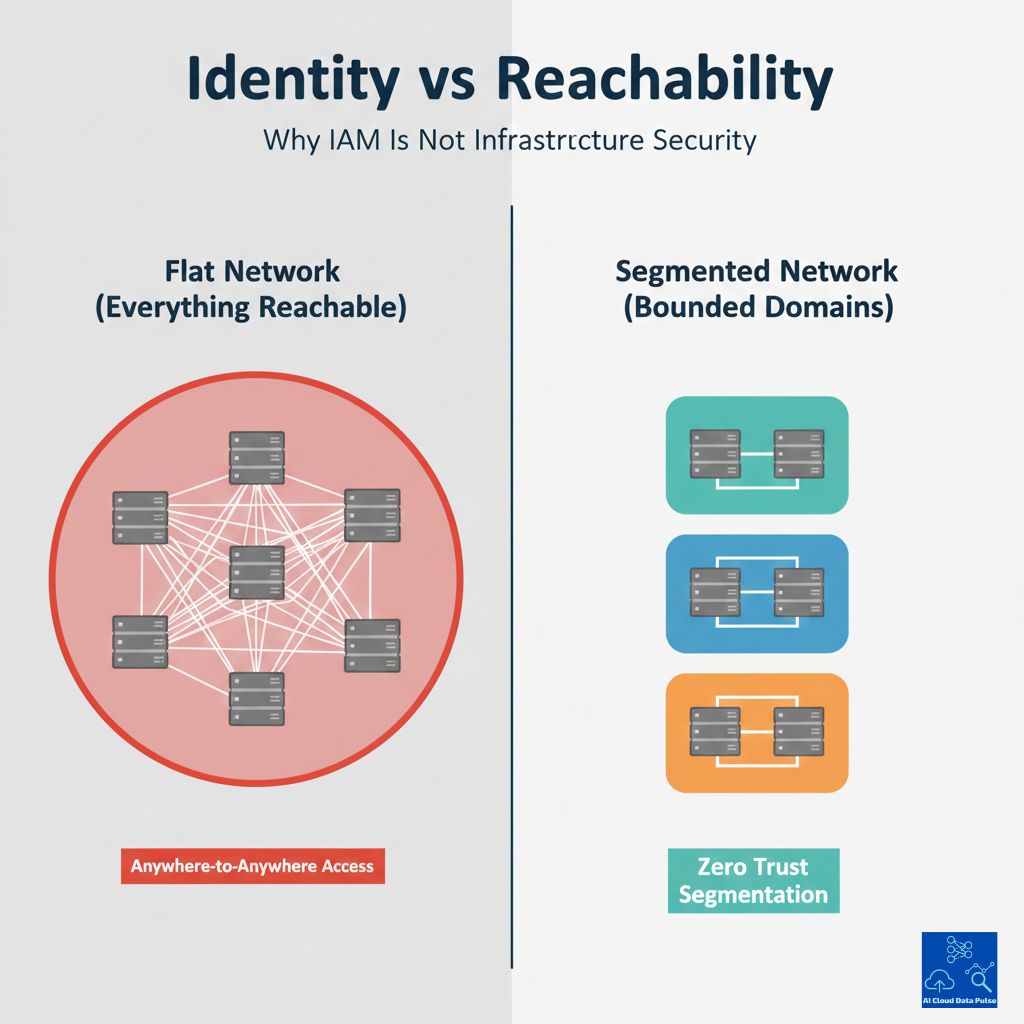
IAM forms part of AWS security architecture, but is not the complete solution since network paths exist independently of identity. These network paths that determine the reachability of other resources are established before authorization by the existing architecture. Subsequently, exposure of AWS resources is defined by the network topology that IAM has no control over. Here, IAM can only govern actions once a request has reached an AWS resource, not before. Consequently, establishing a flat network where all resources are reachable amplifies the identity risk of a bad actor gaining access. IAM can only grant permissions, but it can never shrink the attack surface.
Why IAM Cannot Enforce Architectural Boundaries
Architectural boundaries are defined by the topology, and IAM only authenticates and authorizes users who want access to AWS resources. Additionally, IAM has no control over network paths that allow users to reach AWS resources. IAM also has no control over trust zones, where components are allowed to trust each other under specific assumptions. Furthermore, reachability precedes authorization, where a network path is already established prior to any authorization. Another limitation is that IAM policies cannot specify resource isolation but only conditions for access. This also includes blast radius that is not scoped by identity but by network topology.
How IAM Becomes a Compensating Control in AWS Security
Unfortunately, many AWS operators end up trying to use IAM to offset excessive reachability, which is not its function. This typically occurs whenever there is architecture exposure, and they make IAM restrict actions more heavily, but it can never remove paths. Another side effect is that this increased complexity to enforce safety makes the system less manageable. Furthermore, it masks upstream design weaknesses, accumulating technical debt as poor design decisions are made. Also, by becoming less manageable, the system’s operational fragility increases.
IAM in the Proper Security Hierarchy
However, when placing architecture as the first security control in AWS, IAM effectively reinforces the established architectural boundaries. IAM is essential for restricting access by malicious users once resource exposure is constrained. Also, within trust zones, IAM effectively limits actions that malicious actors can perform. Once well-architected boundaries limiting blast radius are established, IAM effectively complements these preventive designs.
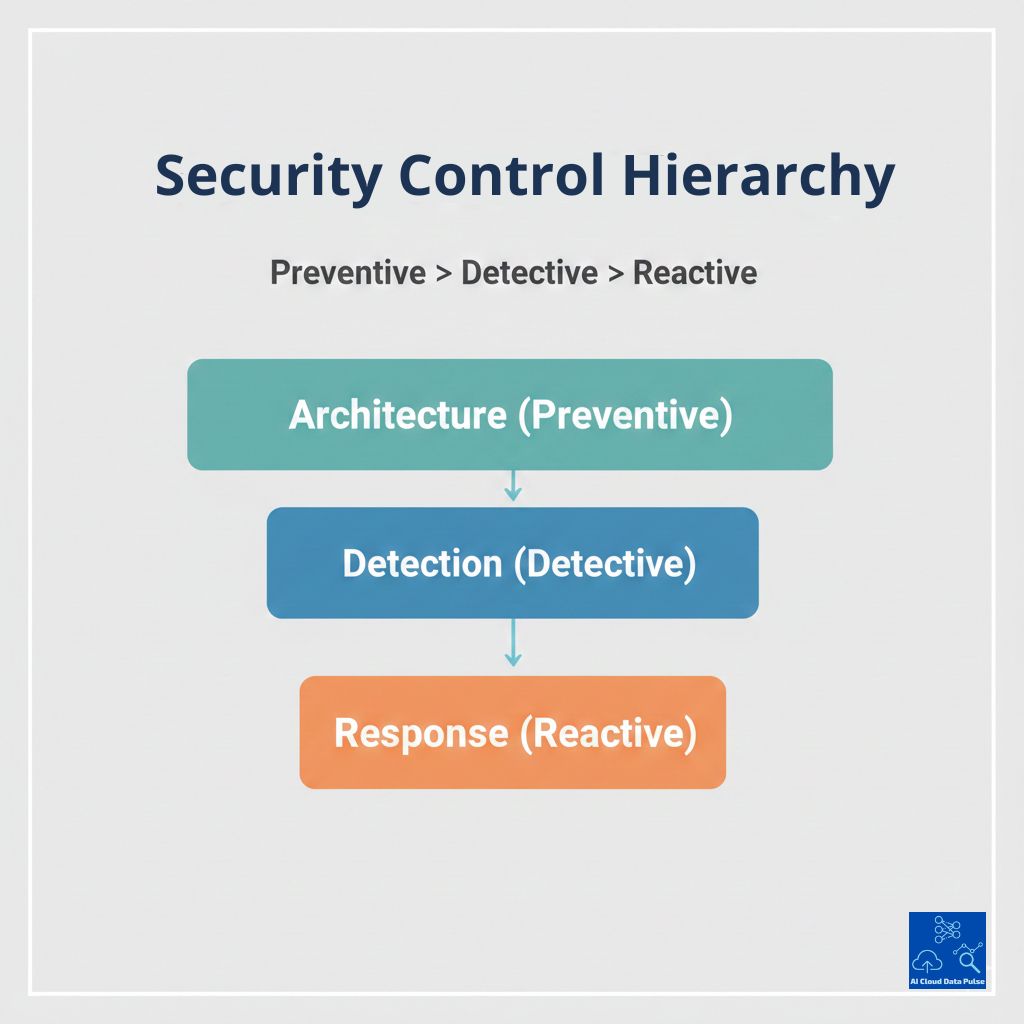
The AWS Security Control Hierarchy: Preventive > Detective > Reactive
Why AWS Security Controls Form a Hierarchy
Security begins with AWS architecture because different security controls act at different stages of failure, either before, during, or after failure. Early controls before failure can reduce risk by eliminating the conditions that make it possible for failure to occur. In contrast, later controls assume exposure to since their role is to remediate any occurrence of failure. Accordingly, not all controls provide equal leverage, since risk-prevention controls enhance security more than remediation controls. However, engineers can misplace emphasis on remediation controls, resulting in increased complexity. Instead, architectural principles favor earlier intervention with preventative controls.
Preventive Controls: Eliminating Failure Modes
Architectural prevention within AWS is superior to tooling since it actively stops unsafe states from ever existing. This is achieved because the design of the topology constrains the exposure of resources from attack vectors initiated by malicious actors. The key mechanism that constrains resource exposure is trust boundaries that block the propagation of malicious activity. This architecture removes failure classes, including unauthorized external access, lateral movement across environments, and privilege escalation via overexposed services. This strategy is passive safety since the defaults deny unintended access either by neglect or malicious intent. Significantly, the risk is reduced prior to runtime, making the system inherently safer.
Detection Controls: Assuming Failure Has Occurred
Even with the best architectural prevention, it is highly naive to assume that it is foolproof. It is equally critical to be able to operate whenever there is exposure and detect it as early as possible. This makes it extremely vital to quickly identify signals of any exposure that arises before determining the root causes. Early detection depends on observable signals and telemetry patterns, as explored in the AWS Logging and Monitoring Guide. Detection relies on observable activity patterns that reveal exposure early, particularly through structured telemetry such as metrics, logs, and dimensions, as explored in my guide on CloudWatch Metrics and Dimensions Best Practices. Hence, the architecture must generate alerts prior to implementing any isolation around the exposure. Ultimately, the architecture shapes this effectiveness.
Reactive Controls: Managing Impact, Not Risk
Upon detection of exposure, the primary action is to immediately address the compromise or failure before it escalates. Subsequently, the focus of any response is to contain the exposure and to ensure system recovery. In other words, the immediate response is to limit the impact of any incident and not the exposure. Managing impact effectiveness is highly dependent on prior detection, so all the incident response stages are critical. However, any incident response should also identify design gaps, enabling teams to further secure the architecture.
Why Architecture Biases Toward Prevention
While response to security incidents is highly critical, design decisions should always precede runtime events. These include topology design that constrains possible states, reducing the number of security incident scenarios that could occur. Supporting topology are boundaries that eliminate exposure paths, preventing propagation of malicious activity. Overall, these architectural choices ensure that prevention is embedded at build time.
Architecture as the First Security Control
AWS Architecture Defines the Infrastructure Security Attack Surface
The core goal is to reduce the attack surface as much as possible, making it tougher for malicious actors. Consequently, architecture is the primary security control because it defines the topology that determines the exposure paths. Network paths between AWS resources create potential attack vectors for malicious actors, which good design principles aim to reduce. This control is achieved through multiple architectural layers, including private connectivity patterns such as those explained in VPC Endpoint vs PrivateLink. For a deeper architectural explanation of how AWS enforces these boundaries using layered network controls, see my analysis of Security Groups vs NACL in AWS. Reachability compounds vulnerability since it precedes authorization. If an actor cannot even reach the resource, then authorization is not needed.
Architecture aims to manage public endpoints since they are the biggest culprits that expand the surface area. Another aspect that needs tight control is implicit trust since it increases systemic risk, for example, black list versus white list. However, a powerful architectural principle is segmentation that constrains the attack scope.
Trust Boundaries as Security Decisions
The gatekeepers within the AWS security architecture are the trust boundaries that define permitted communication between entities. The critical aspect of trust boundaries is that trust is explicitly defined and is never assumed. Allowing entities to communicate because they are not marked as “untrusted” is not strong enough. This enables segmentation to separate risk domains and to effectively quarantine any malicious actors. This is achieved by ensuring that crossing boundaries requires effective controls to block malicious activities from one segment to another. In contrast, allowing implicit trust means malicious actors can cross boundaries simply because they were never identified as malicious, until it is too late. Hence, good design choices are needed to establish trust zones.
Topology Determines Blast Radius
Blast radius is a key consideration in AWS security architecture, which is based on the fact that connectivity defines propagation paths. These are the propagation paths through which malicious activities can propagate. This is particularly true for flat networks where most or all resources can communicate with each other without meaningful segmentation. This magnifies the compromise impact where malicious actors can literally hop around the network. AWS security architecture prevents this by segmenting the network to constrain lateral movement of malicious activity. Isolating resources from one another limits their exposure across environments. Therefore, the simple principle is that shared domains expand systemic risk while structural boundaries contain failures. Simple real-world example of ships with sealed compartments limiting fire or flooding.
Controls Enforce Architectural Intent
After considering the design of AWS secure architectures, it is equally important to translate this into enforceable policies. The first consideration of enforceable policies is to reinforce trust boundaries since they are the first line of defence from malicious actors. Another critical class of enforceable policies is those that constrain actions within the topology, limiting options available to bad actors. It is equally vital to proactively validate intended isolation since it may not have been adequately set up. Another critical enforcement is preventing any deviation from the architectural design, these controls uphold architecture and prevent any substitutes.
Why Architecture Must Come First as the Security Control
From consideration of topology and trust boundaries, architecture is the first AWS security control. This is because topology and trust boundary design precede deployment. Establishing the constraints enforced by these designs early is fundamental to eliminating any downside risk. This also ensures that possible states of the AWS environment are defined at build time.
How Architectural Thinking Produces Security Outcomes
Security as an Emergent Property of Design
Within architecture, security is not a separate component, but it is implicit throughout the architecture. The architectural aspect is the set of constraints that shape possible system states within the AWS environment. Possible system states are directly related to system security since fewer reachable states reduce exploitability by malicious actors. Furthermore, making boundaries explicit removes ambiguity, thereby denying possible gaps that bad actors can exploit. Often, many resources do not need to interact with each other. Therefore, isolating them from each other limits the possibility that malicious actors can benefit from unintended interactions. These examples clearly show how secure behaviour flows from structured design.
Constrained Reachability Reduces Risk
Security-first architecture reduces the combination of attack paths for malicious actors, and ensuring fewer network paths reduces attack vectors. Also, limiting exposure to each resource narrows the entry points that malicious actors can use to attack that resource. This is built around the concept of segmentation that blocks lateral movement of actions, limiting opportunities of attack. This reinforces the isolation of resources that confines the scope of any compromise of these resources to malicious activity. The most important thing here is that reduced complexity simplifies threat modeling, leading to more effective security processes.
Defined Trust Simplifies Decision-Making
Architectural best practices are strict on enforcing explicit trust between boundaries since they remove hidden assumptions that create gaps for exploitation. Additionally, establishing clear boundaries guides policy decisions that enforce design intent on who is allowed or is not allowed to communicate. Also, fewer communication paths help to completely map them out, and since they are known, simplifies reviews. This is in contrast to many paths that can never be known, thereby making systems highly vulnerable. Given this design intent and simplicity, this accelerates incident triage by reducing the number of unknowns.
Reduced Blast Radius Lowers Impact
AWS systems are architected with the full knowledge that no security will ever prevent resource compromise. However, through reduced blast radius, architecture can certainly limit any secondary effects of contaminated resources by keeping them localized. By isolating contaminated resources, this helps to reduce the number of systems that require remediation. With fewer systems needing remediation, this helps to shorten any recovery timelines whenever resources are compromised. By shortening recovery timelines, this helps to minimize disruption to the business whenever resources are contaminated.
Discipline in Architecture Reduces Downstream Complexity in AWS Security Controls
Making security implicit in the architecture ensures that fewer compensating controls are needed in the AWS environment. This leads to simpler IAM policy structures that further enhance security since more complex policies lead to bugs and security gaps. Another significant benefit is that detection noise is reduced, allowing teams to focus on more genuine security incidents, thereby reducing fatigue. An additional benefit is more predictable incident responses, allowing teams to quickly and effectively respond to any incident.
Why Architecture-First Security Scales in Complex Environments
Complexity Amplifies Weak AWS Security Architecture Design
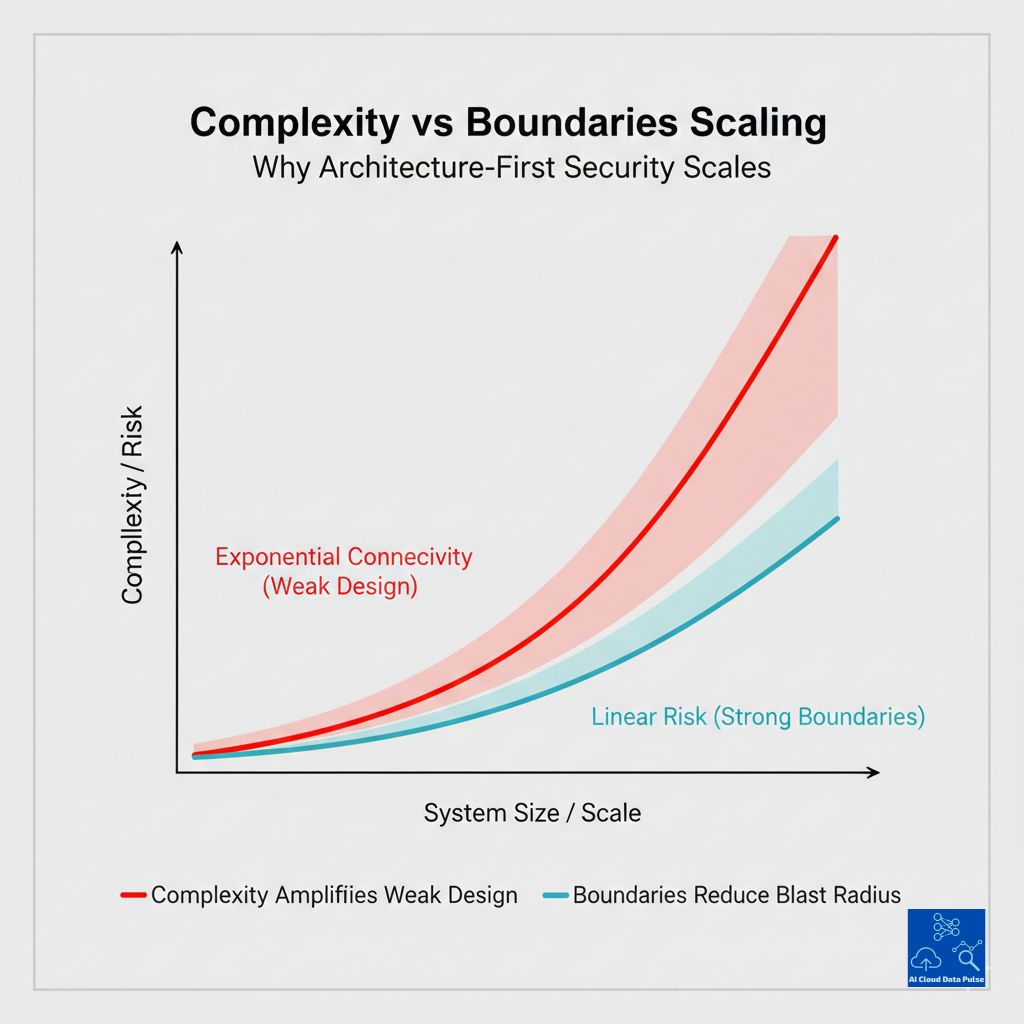
This is why architecture-first security is needed, because complexity amplifies weak design in several ways. Increased complexity exponentially increases connectivity in poor designs that not only compound exposure, but also cannot be tracked or managed. The other poor design choice is implicit trust, which further compounds exposure. More entities mean more implicitly trusted actors that could be malicious. Also, poor design choices lead to more policies to compensate, which makes security management more unclear and murky. This finally leads to where any minor misconfiguration can cascade system-wide, leaving it highly vulnerable to attacks.
Strong Boundaries Scale Linearly
This is the secret weapon against the exponential effect of complex scaling by establishing segmented domains. Segmented domains prevent new components from connecting to every other component that leads to exponential growth in connectivity. Also, maintaining strong boundaries ensures that trusted zones are clearly defined in the face of increased complexity. Furthermore, strong boundaries ensure that the blast radius stays contained as system complexity increases. Finally, maintaining strong boundaries ensures that governance remains consistent across the AWS environment without increasing complexity affecting it.
Prevention Becomes More Valuable at Scale
These preventative measures are even more valuable at scales since detection volume explodes in large environments. Here, prevention reduces exposure and the number of possible events that can occur, and thereby their detection. Also, incident response effort scales with surface area, so reducing surface area or holding it steady also reduces incident response or keeps it steady. This means that increased exposure leads to increased detection then in turn leads to alert fatigue. Therefore, implementing constraints early reduces the downstream operational load of detection and responses.
Conclusion: Infrastructure Security Is a Design Discipline
Security Outcomes Are Architectural Consequences
Effective security is based on reduced system states that are shaped by design decisions, where the number of possible states determines exposure. This is due to increased exposure of resources, which increases their risk profile and probability of attack. In contrast, while tooling reinforces security, it never reduces the exposure of resources from the outset.
AWS Architecture Precedes Every Security Control
Architecture precedes tooling from the outset, where topology is already in place prior to IAM operating. The same is true for reachability that exists before authorization, and by removing most paths between resources, makes authorization simpler. This also extends to establishing trust boundaries before implementing policies and also simplifying them, reducing bugs that introduce security gaps. This clearly shows that prevention begins at design time, making systems implicitly more secure.
Discipline, Not Tools, Creates Durable Security
Applying discipline in establishing consistent boundary design reduces ambiguity that results in security gaps that tools try to plug. Furthermore, segmentation of resources reduces systemic risk by limiting their exposure and opportunity for attacks. Additionally, by constraining reachability, propagation of resource contamination is significantly curtailed. In summary, design discipline scales across environments, and tooling is never overworked.
AWS Architecture Is the First Security Control: Further Reading
AWS Well-Architected Framework
White Paper – AWS Security Reference Architecture (AWS SRA) – core architecture