

AWS Config Conformance Packs: Introduction
As companies ramp up their use of AWS cloud and scale up their resources, they are continually increasing cloud governance complexity. This translates into continually scaling AWS Config rules across additional resources. An additional challenge is ensuring consistency in compliance across multiple accounts due to resource scaling and maintaining trust boundaries. Consequently, in these challenges, architects borrow from software methodologies by packaging AWS Config rules into reusable compliance frameworks. They are termed AWS Config Conformance Packs, which automate governance of AWS environments. This aligns with the architecture-first AWS security model, where governance and compliance enforce architectural boundaries across accounts and environments, reinforcing the resource isolation principles that reduce blast radius in AWS architectures.

What Are AWS Config Conformance Packs
Packaging Compliance Rules Into Deployable Frameworks
To ensure the consistent application of multiple AWS Config rules to multiple AWS Accounts, it follows to group them. Grouping these rules is achieved by bunding AWS Config rules into a single template. These are YAML-based templates that define compliance rule sets for AWS resources in each account. They are compliance frameworks that are reusable and support governance enforcement. Additionally, they map rule collections to standards such as CIS or NIST, further aligning with regulatory requirements. Overall, they simplify large-scale compliance rule deployment.
Standardizing Governance Across AWS Environments
By applying AWS Config Conformance Packs to all accounts, architects can ensure consistent compliance enforcement across these AWS accounts. These conformance packs are associated with AWS Organizations that provide centralized governance and are not fragmented across accounts. Deployment of these conformance packs allows AWS Config to continuously evaluate resource configurations against these rule frameworks. In conjunction with AWS Config Aggregator, they provide aggregated compliance visibility across environments due to a consistent rule set. Subsequently, the overall benefit is that encapsulating AWS resource policies in templates simplifies policy management at cloud scale.
Why AWS Config Conformance Packs Matter for Cloud Compliance
Continuous Compliance Monitoring in Dynamic Cloud Environments
Even relatively small organizations end up rapidly provisioning and scaling AWS resources for their infrastructures, making governance a top priority. Additionally, this infrastructure is continually changing and getting updated, resulting in its configuration drift, potentially creating security gaps. Subsequently, having infrastructure continually reconfiguring necessitates implementing continuous enforcement of compliance checks on its resources, followed by any necessary remediation. This responsibility falls on AWS Config to detect configuration deviations through AWS Config rule evaluations, making it a key component of detective guardrails in AWS governance. Consequently, AWS Config Conformance Packs apply these rule sets automatically as the only practical way for continuous monitoring of configuration drift. Therefore, they enable real-time visibility into compliance posture.
Aligning Cloud Resources with Security and Regulatory Frameworks
AWS Config rules are intended to implement compliance frameworks as code, adhering to the model of infrastructure as code. Furthermore, they align with regulatory standards such as CIS, NIST, and PCI DSS, which are directly enforced within the infrastructure. Therefore, they enable the translation of regulatory controls into technical rule checks that support the code model. Architects are then able to automate validation of resource configuration against policies through AWS Config rules. However, effective governance also requires strong identity and authorization controls to ensure that only approved principals can modify resources and configurations. For a deeper discussion, see AWS IAM Architecture: Designing Identity Boundaries at Scale. Subsequently, automated validation through Conformance Packs supports audit readiness and governance reporting.
Scaling Governance Across Multi-Account AWS Architectures
Most commercial users of AWS invariably end up with multi-account AWS environments that continually increase governance complexity. Subsequently, it is imperative to centralize compliance enforcement using AWS Organizations to address governance of multi-account environments. Accordingly, governance must be consistent across all accounts, which necessitates the consistent deployment of rule frameworks across these accounts. Additionally, it is necessary to aggregate compliance visibility through AWS Config Aggregator. Altogether, AWS infrastructure must ensure a unified governance posture across distributed environments. This reflects the architecture-first AWS security model implemented through an AWS secure landing zone, where account boundaries and centralized governance establish consistent security and compliance controls across the multi-account environment. These account boundaries form the foundation of AWS Resource Isolation Security and help contain failures within defined trust zones. These governance patterns also align closely with broader compute isolation strategies discussed in EC2 vs ECS vs EKS: Why AWS Compute Security Isn’t the Same, where architectural boundaries and workload isolation directly affect cloud security posture.
How AWS Config Conformance Packs Work
Rule Templates Defining Compliance Frameworks

AWS Config Conformance Packs are YAML templates containing collections of AWS Config rules used to evaluate resource configuration compliance. Therefore, each rule evaluates specific resource configuration conditions to determine whether it complies with organizational policies. Subsequently, these rule sets codify compliance frameworks or governance policies for automated checking of configuration compliance. Furthermore, these templates allow mapping configuration controls to external standards. These include the Center for Internet Security (CIS) and the National Institute of Standards and Technology (NIST). Finally, these templates support the principle of reuse, enabling consistent policy enforcement.
Deployment Across AWS Accounts and Regions
AWS Governance teams can deploy AWS Config Conformance Packs to individual accounts or organizational units. However, recommended practice is to integrate these conformance packs with AWS Organizations to support centralized multi-account governance through config rules. Subsequently, this ensures consistent application of rule frameworks across AWS regions contained within conformance packs. Consequently, governance teams can establish uniform enforcement of compliance policies across distributed environments using conformance packs. This works in conjunction with scalable deployment models that support enterprise-wide cloud architecture governance.
Continuous Evaluation and Compliance Reporting
The AWS Config Conformance Pack provides AWS Config with the rule set for it to continuously evaluate resource configurations. These rules assess resource configuration against compliance conditions and determine their compliance status. AWS Config records this compliance status for each evaluated resource for auditing and possible remediation. However, this is for each individual account and region; subsequently, AWS Config Aggregator collects these for aggregated compliance visibility. Finally, reporting this compliance evaluation supports governance monitoring and audit readiness.
AWS Managed vs Custom Conformance Packs
AWS Managed Conformance Packs: Predefined Compliance Frameworks
Governance teams already have prepackaged AWS Config Conformance Packs available from AWS that are aligned to common standards. They are termed as AWS Managed Conformance Packs that contain preconfigured rule sets for frameworks such as CIS AWS Foundations Benchmark. The main benefit is that they enable rapid deployment without custom template development, allowing teams to set up AWS Organizations governance quickly. Additionally, they provide baseline security controls for AWS environments built on real-world AWS security experience. They also provide standardized compliance checks across resources, also based on security best practices. The core advantage they offer is minimal configuration by governance teams for initial adoption. However, their flexibility is limited by each organization’s specific governance requirements.
Custom Conformance Packs: Tailored Governance and Policy Enforcement
Many organizations have specific requirements, and they need to modify existing AWS Managed Conformance Packs. Therefore, they need to create their own defined YAML templates for custom rule sets that they use as AWS Config Conformance Packs. This allows them to map internal security policies to AWS Config rules, thereby codifying them. However, they can still extend or modify AWS Managed rule frameworks by copying them into their YAML templates. This combination provides organizations with fine-grained control over compliance conditions for the environments. This flexibility allows their conformance packs to support industry-specific regulator requirements, whereas AWS Managed are far more general. Furthermore, governance teams can integrate these YAML templates with enterprise governance and risk models. However, there is increased complexity in supporting their lifecycles, similar to the software lifecycle model.
Deploying Conformance Packs Across Multiple AWS Accounts
Centralized Deployment Using AWS Organizations
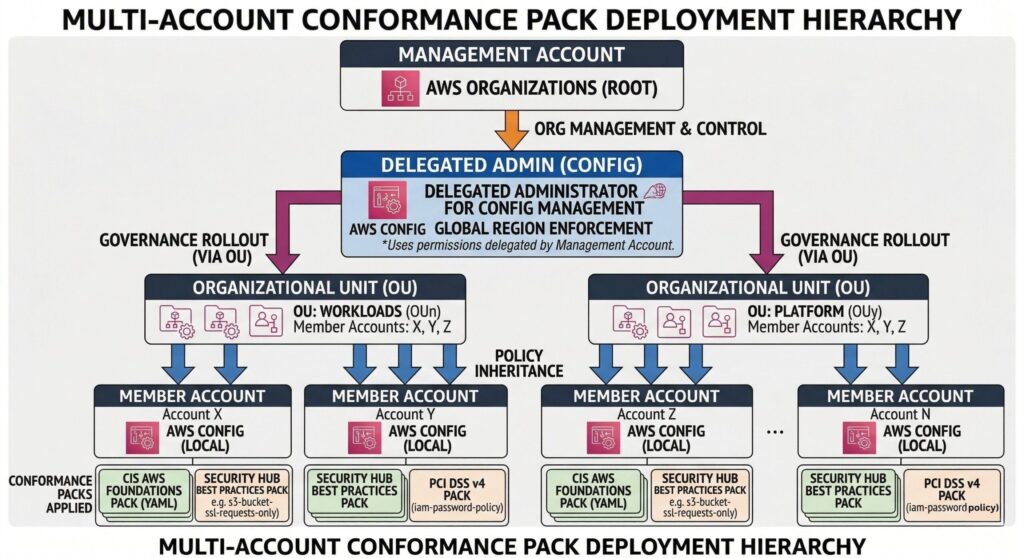
AWS Config Conformance Pack templates address the need for centralized governance in multi-account AWS environments. They work with AWS Organizations, which provide a hierarchical account structure using organization units (OUs). These OUs have AWS Accounts as members or other OUs as members. Subsequently, governance teams deploy Conformance Packs to the OUs within it, which in turn deploy to their members. AWS Config deploys conformance packs to accounts and selected regions via its API, using OUs. It is enabled by the delegated administrator model for AWS Config management, establishing the control plane for governance and compliance rollout.
Propagation of Compliance Frameworks Across Accounts
The control plane for the governance and compliance rollout ensures a uniform application of AWS Config Conformance Packs across AWS accounts. This ensures that there is consistent rule evaluation across distributed environments since all accounts and regions use the same rule set. Therefore, governance teams can enforce standardized compliance baselines for all AWS accounts and regions. Furthermore, this helps to eliminate fragmented governance implementations where different rule sets were deployed to individual accounts and regions. Additionally, this automates the propagation of updates to rule frameworks, removing issues associated with manual deployment. Hence, governance teams can align compliance posture across all accounts.
Aggregated Visibility and Cross-Account Compliance Monitoring
Distributing conformance packs to each account and region, its corresponding AWS Config instance evaluates compliance against the conformance pack rule set. Additionally, the AWS Config Aggregator provides central aggregation of compliance data across accounts and regions. This provides cross-account visibility into compliance status without checking each account and region individually. AWS Config Aggregator displays this through consolidated compliance dashboards for governance teams. This allows governance teams to identify non-compliance resources across accounts and regions and initiate any remediation action. These dashboards also support audit reporting and enterprise-wide monitoring by having aggregated compliance data in one place.
Best Practices for Using Conformance Packs
Start with Baseline Frameworks, Then Customize
AWS Managed Conformance Packs already encode best practices around configuration governance, and teams should adopt them as initial baselines. As a result, they can quickly align with common standards such as CIS benchmarks with minimal effort. Once they have established their config baseline, they can start identifying gaps between the baseline and the organization’s specific requirements. Upon completion of this gap analysis, teams can extend the baseline using custom YAML templates to create tailored rule sets. Furthermore, teams should continuously perform iterative refinement of governance frameworks based on needs.
Align Conformance Packs with Organizational Policies
Ideally, AWS Config Conformance Packs and Config rule sets should express organizational policies as code. Therefore, governance teams should look to map internal security policies directly to AWS Config rules. This also entails translating regulatory controls into technical rule checks to ensure the AWS environment conforms to regulatory oversight. Encryption governance is one example, where Config rules can evaluate whether resources comply with required encryption configurations while AWS KMS provides the underlying key-management and authorization architecture. AWS KMS Architecture explains how KMS key policies and IAM permissions establish these encryption boundaries across AWS environments. Furthermore, this ensures consistency between governance policies and enforcement. This also enables integration with any existing enterprise risk and compliance frameworks, such as ServiceNow GRC. Additionally, teams can maintain traceability between rules and policy requirements.
Implement Centralized Monitoring and Continuous Improvement
The rationale behind AWS Config Conformance Packs is closely associated with centralized control and monitoring. AWS Config Aggregator: Multi-Account Compliance Monitoring in AWS details how AWS Config Aggregator provides centralized compliance visibility. This enables continuous monitoring of compliance across accounts and regions by governance teams. They can quickly identify recurring non-compliance patterns and develop remediation strategies to address them. Internal security policies and regulatory requirements are continually changing, and governance teams should iteratively refine their rule sets. This also includes feedback from operations, where teams should manage conformance packs as evolving governance artifacts.
Common Challenges and Limitations of AWS Config Conformance Packs
Cost Implications of Continuous Rule Evaluation
Cost is an essential consideration for any architectural decision, where AWS Config pricing is based on configuration items and rule evaluations. Furthermore, governance teams need to factor in cost amplification due to high-scale, multi-account environments. Another consideration is when there is increased spending driven by frequent resource configuration changes.
False Positives and Rule Accuracy Limitations
While consistency across environments is essential, AWS Config rules can be too general and not apply to certain accounts or regions. These cases and others can create non-critical violations that generate noise in compliance reporting and overload governance teams. Therefore, teams should actively tune rules, parameters, or scope exclusions.
AWS Config Conformance Pack Customization and Maintenance Complexity
AWS Config Conformance Pack customization implements policies as code; as a result, teams are faced with all the software maintenance issues. Hence, teams need to manage and version custom YAML-based Conformance Pack templates. They also need to apply ongoing updates as AWS services and compliance rules evolve. Furthermore, there is also testing and validation overhead before deploying changes across environments.
Remediation Workflow Gaps and Operational Overhead
AWS Config Rules and AWS Config Aggregator primarily detect configuration gaps but do not rectify these. Teams should look to automate remediation wherever possible; consequently, they need to utilize Lambda or SSM Automation for corrective actions. This also introduces lifecycle management since these are code with the need to design, test, and maintain remediation workflows.
Effective remediation must also verify that corrective actions restore compliance and prFovide escalation when automation fails. For the broader engineering approach—including controlled guardrail deployment, remediation verification, and exception management—see Security Automation in AWS: Guardrail Engineering at Scale.
AWS Config Conformance Packs: Conclusion
AWS Config Conformance Packs assist in automating configuration compliance across AWS environments and ensure consistency across accounts and regions. This results in reducing manual governance and policy enforcement effort, freeing governance teams to address critical issues that may arise. AWS Organizations enables the centralization of the deployment of conformance packs to ensure consistent rule sets across accounts and regions. Meanwhile, AWS Config Aggregators aggregate configuration compliance for centralized visibility and reporting. This allows integration with broader AWS security services and compliance tooling, making conformance packs a key element of end-to-end governance.
Further Reading
AWS Documentation
Config Conformance Packs Documentation
AWS Config Aggregator Documentation
Books and Advanced Learning
Affiliate Disclosure: As an Amazon Associate, AI Cloud Data Pulse earns from qualifying purchases. Some links in this article are Amazon affiliate links. If you purchase a product through these links, we may earn a small commission at no additional cost to you. We only recommend resources that we believe provide value to our readers.
AWS Security (Dylan Shields)
The Cybersecurity Guide to Governance, Risk, and Compliance (Jason Edwards and Griffin Weaver)
AWS for Solutions Architects: Design and scale secure AWS architectures with GenAI strategies and real-world patterns (Saurabh Shrivastava, Neelanjali Srivastav, and Dhiraj Thakur)
