
Introduction
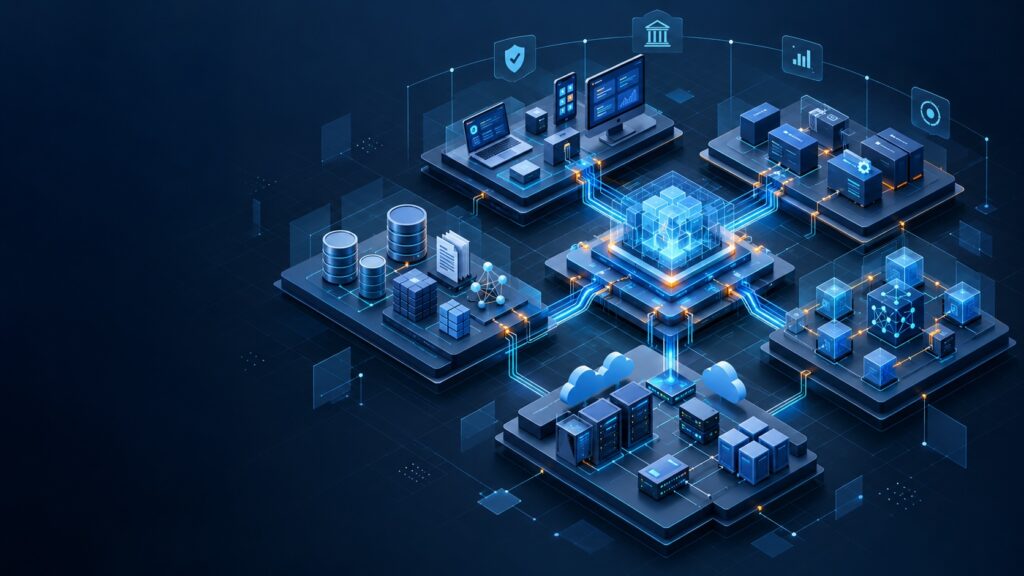
Similar to other digital technologies, AI has progressed from the laboratory through early isolated experiments and proofs of concept. There is rapid growth in machine learning and GenAI use cases that are transitioning from individual solutions to shared enterprise capabilities. These include multiple AI workloads across business units, diverse enterprise data sources, and multiple models and AI services. Hence, there is a growing need for enterprise AI architecture as these dependencies increase.
Enterprise AI goes beyond individual LLM, ML model, or AI platform selection and includes the integration of data, models, applications, and infrastructure. Several architectural constructs become critical, including security and governance, with operational capabilities spanning the AI lifecycle. Significantly, there are interdependencies between architectural components that require consistent interaction between enterprise AI capabilities. There are also important non-functional requirements, including reliability and availability, security, and regulatory compliance. This necessitates a coherent architecture with centralized governance that establishes constraints while allowing appropriate workload autonomy and maintaining operational visibility and manageability.
This article will establish the principles needed to derive vendor-neutral enterprise reference AI architectures. It will propose the core architectural layers and components. These include data and knowledge foundations, models and AI services, and orchestration and application capabilities. The architecture will also include the orchestration and application capabilities. Also, it will include the infrastructure and platform foundation, along with security across all architectural layers. Other key capabilities include enterprise-wide governance, operations, and observability across the AI lifecycle, as well as relationships and dependencies between layers.
What Is Enterprise AI Architecture?
From AI Projects to Enterprise Platforms
Enterprise AI architecture is the structured organization of enterprise AI capabilities around technology and platform components. These include enterprise data and knowledge resources that are used by models and AI services. Next are the models and AI services themselves, followed by the applications and integration services that use these AI capabilities. Cutting across the architecture are security and governance controls, along with operational and lifecycle capabilities. These architectures span the enterprise and go beyond the selection of particular technology products.
Similar to other computing technologies, AI began as a set of independently designed workloads. These typically involved duplicated platforms and capabilities with inconsistent architectural patterns. However, they are transitioning toward shared enterprise services with reusable data access and integration. These are characterized by common AI models and services leveraging shared infrastructure and platform capabilities. Additionally, cross-architectural capabilities include consistent security and governance controls along with common operational services. However, these are balanced with appropriate autonomy for individual AI workloads through standardization without excessive centralization.
Characteristics of Enterprise AI Architecture
Enterprise AI architectures typically comprise capabilities implemented as modular architectural components with loose coupling between them. There are also clearly defined component boundaries that are implemented through standard interfaces and APIs. These architectures define interoperability across data and knowledge services and enable AI models and services to be interchangeable. Another important characteristic is allowing individual components to evolve independently.
Another core characteristic is the ability to scale across users and business units, allowing growth in concurrent AI workloads. The architecture must handle increasing model and inference demands along with expanding enterprise data volumes. It must also deliver production reliability and availability while ensuring consistent application performance. Furthermore, it must support fault tolerance, graceful degradation, and resilience to component failures.
Particularly with AI, security must be embedded throughout the architecture, with governance by design imposing constraints on workloads. These are implemented with centralized enterprise policies and guardrails, along with consistent identity and access controls. They should support end-to-end operational observability along with AI asset and model lifecycle management. Finally, the architecture should support policy enforcement across shared capabilities while enabling appropriate workload and team autonomy.
Enterprise AI Reference Architecture
A Layered Enterprise AI Model
For enterprises to scale their AI capabilities, they need to adopt a common architectural structure and organize these capabilities into logical domains. Furthermore, they need to have a shared vocabulary across architecture and engineering teams as well as consistent architectural patterns across AI workloads. This includes separating the logical architecture from the implementation choices to make architectural guidance technology-agnostic and capabilities vendor-neutral. Hence, they need a foundation for workload-specific architectures that are adaptable to different enterprise requirements.
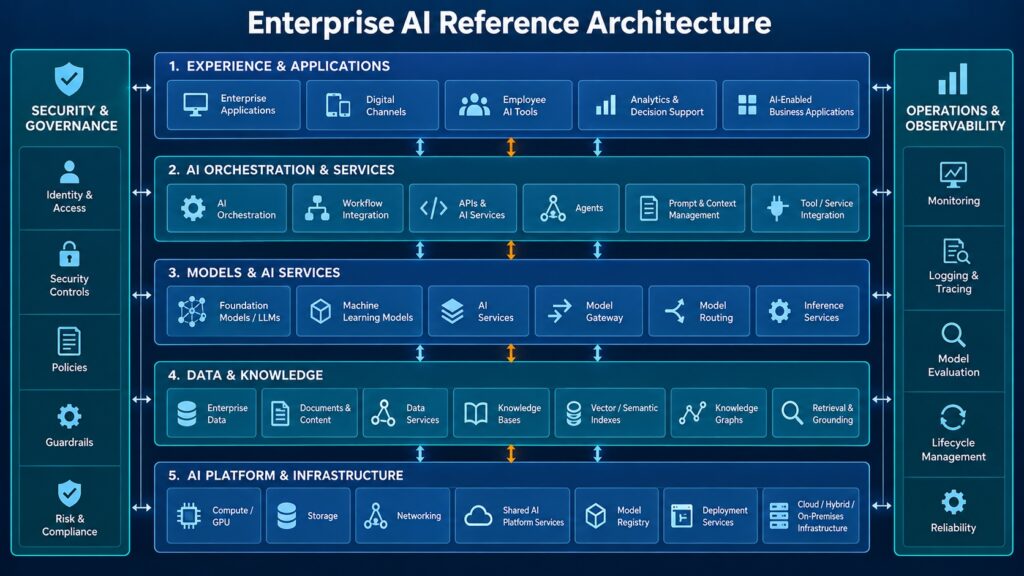
The Layers pattern is one of the oldest and most fundamental architectural patterns and is cataloged in Pattern-Oriented Software Architecture. This is the pattern that is used for the enterprise AI architecture presented here, with the different domains organized into separate layers. The top layer is Experience and Applications, through which enterprise applications consume AI capabilities. Under it is the AI Orchestration and Services layer, which integrates applications, models, tools, and data. Below it are the actual Models and AI Services that provide the AI capabilities. The next layer below is Data and Knowledge, which comprises the enterprise data, contextual information, and knowledge resources. The bottom layer is the AI Platform and Infrastructure, which provides the compute, storage, networking, and platform services.
Interactions Between Architectural Layers
These layers are interconnected capabilities rather than isolated tiers, with dependencies between applications and orchestration services. Orchestration connects models, tools, and enterprise data, while models themselves depend on data and infrastructure. The infrastructure supports capabilities throughout the stack, with defined interfaces (or contracts) between the architectural layers. These are standard APIs and integration patterns that enable loose coupling between components and the independent evolution of individual layers.
Cross-Cutting Enterprise Capabilities
Security and governance are fundamental capabilities, with security spanning every architectural layer and governance imposing constraints across the complete AI architecture. These are cross-cutting capabilities, with governance establishing enterprise policies and architectural guardrails. Security establishes enterprise identity and authentication, along with consistent authorization and access controls. This also includes data, model, and application security. Governance and security provide centralized controls while enabling appropriate workload autonomy.
Operations and observability span all architectural layers and provide end-to-end operational visibility across all AI workloads. This enables monitoring of applications, models, data, and infrastructure, as well as model and AI service evaluation. Operational teams can monitor performance, reliability, operational health, and availability. This also enables AI asset and model lifecycle management and provides support for continuous operational improvement.
The reference architecture is a logical model that is separated from physical implementation. Therefore, no prescribed technology stack or dependency on a specific vendor is required. Architects can map enterprise technologies to logical layers and select different platforms to meet different enterprise requirements. They are free to choose between cloud, on-premises, and hybrid deployment models and map organizational responsibilities to capabilities. This enables them to apply consistent architectural principles across implementations.
Data & Knowledge Layer
Enterprise Data Foundation
Data is fundamental to enterprise AI capabilities, which need reliable access to trusted enterprise data to serve users and stakeholders. Enterprise data serves as inputs for models to make inferences and as training data for machine learning. It also serves as business context for AI applications and provides grounding for generative AI responses. Architects should separate data resources from individual AI workloads to decouple them and allow each to evolve independently.
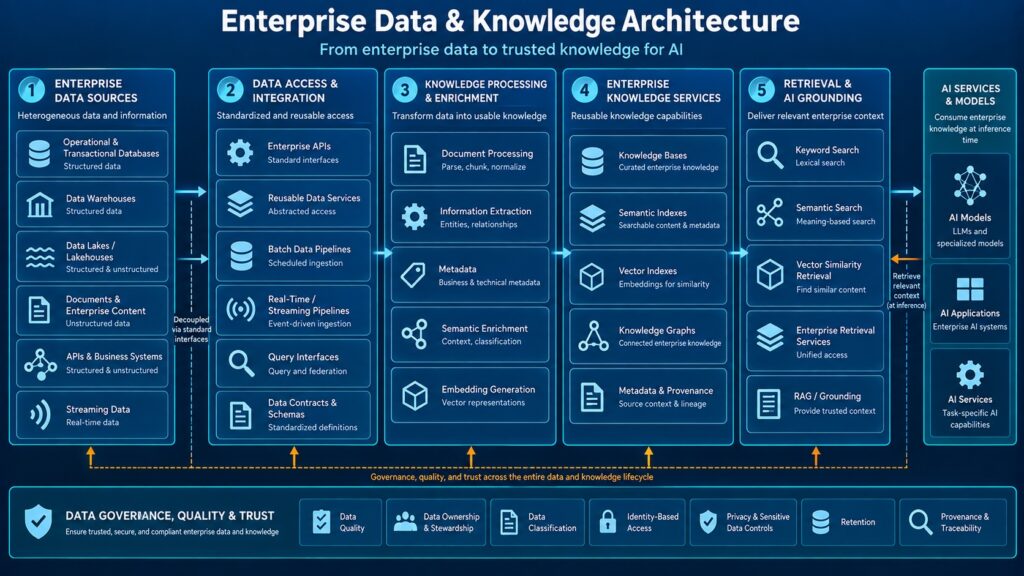
Large enterprises operate within a heterogeneous data landscape where there is both structured and unstructured information. Data and information are also stored across different storage systems, including operational and transactional databases. Additional storage platforms include enterprise data warehouses, data lakes and lakehouse platforms, as well as documents and enterprise content repositories. There are multiple mechanisms for data access, including APIs and streaming. Since data is distributed across business units and platforms, it is necessary to provide common access and consistent interfaces for consuming enterprise data.
Data Access and Knowledge Services
For the AI layer to effectively access enterprise data, architects must establish standardized enterprise data access mechanisms. These mechanisms include APIs and reusable data services, batch and real-time data pipelines, streaming data interfaces, and standard query interfaces. Consistent data contracts and schemas define how data is exchanged through these mechanisms. Architects must integrate across heterogeneous data platforms and abstract underlying storage technologies. These access mechanisms must decouple AI workloads from data platforms.
The key capability is transforming raw data into usable AI context by processing documents and unstructured content. This includes extracting relevant information and metadata, where metadata describes enterprise information assets. This also includes semantic enrichment of enterprise content and converting content into embeddings. Additionally, these knowledge services should provide semantic and vector indexes along with knowledge graphs and relationships. Overall, these capabilities should make enterprise knowledge available to AI services while preserving source context and provenance.
Architects should clearly define the mechanisms for retrieval of relevant enterprise information, with context supplied at model inference time. Enterprise knowledge bases should support traditional keyword and semantic search along with vector similarity retrieval. The goal is to ground AI model responses in enterprise information and reduce reliance on model-internal knowledge. The layer should separate retrieval capabilities from underlying models, allowing both to evolve independently.
Data Quality, Governance, and Trust
For stakeholders to trust AI capabilities, the enterprise data they consume must also be trustworthy and based on accurate underlying information. Characteristics of trustworthy data include completeness, consistency across enterprise data sources, along with freshness and timeliness. Along with quality, the provenance and traceability of data consumed by AI back to its original sources are critical for establishing trust and explainability. For machine learning models, understanding which input features influence predictions can provide another dimension of model explainability.
Governance is also critical for controlling access and enforcing defined data ownership and stewardship. Governance should enforce enterprise data classification. It should also enforce identity-based access policies along with privacy and sensitive-data controls. Another critical control is the enforcement of data retention requirements. Overall, existing data governance requirements should extend to AI access, applying zero-trust principles to AI entities and establishing clear governance boundaries.
AI & Model Layer
Models and AI Services
While LLMs have emerged as the workhorse of AI, they do not cover every AI use case. Different models are optimized for different AI use cases, and enterprise AI manages multiple model types. Alongside foundation models and LLMs, there are traditional machine learning models and deep learning models. Models serve as underlying computational capabilities, with AI services exposing these capabilities. They provide standard service interfaces for model consumption, separating models from consuming applications. This enables reuse and independent model lifecycle management.
Different workloads have specific model requirements that include model capability and task suitability alongside accuracy and quality requirements. For classification models, these quality requirements can be evaluated by examining true and false predictions across the different outcome classes. Additional requirements include inference latency and performance, as well as cost and resource consumption. Other requirements include security and data-handling requirements, along with regulatory and compliance constraints. These varied models and providers are abstracted through common interfaces, reducing application dependency on individual models. This also reduces provider-specific coupling, enabling model substitution without redesigning the application.
Model Access and Inference
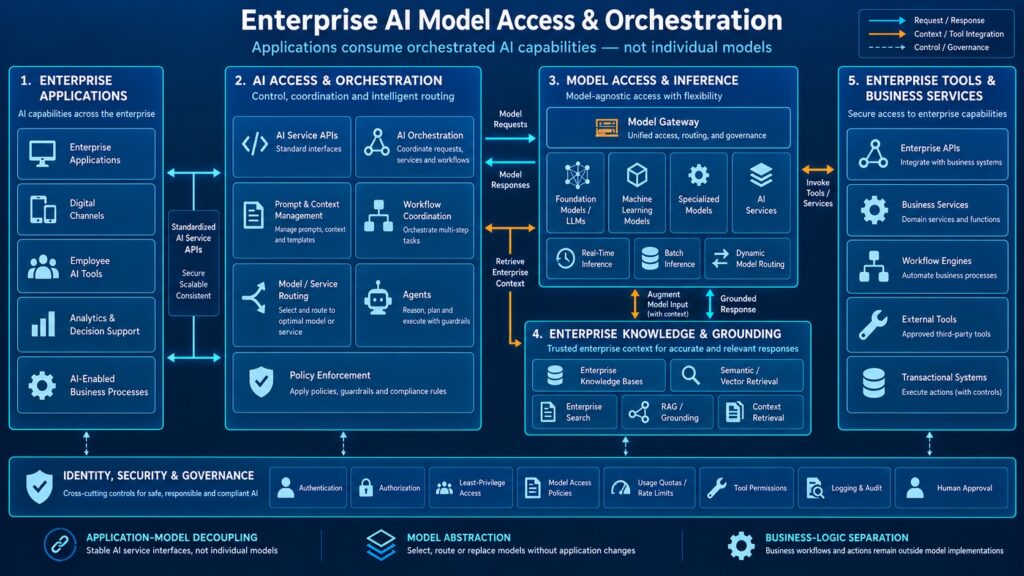
Model abstraction provides a standardized mechanism for model consumption with APIs and model endpoints, along with managed inference services. Also, model gateways serve as common access points to models with consistent interfaces across different model types. They abstract underlying model implementations and connect orchestration to model services. Furthermore, they decouple applications from model deployment details and provide consistent model access across enterprise workloads.
Enterprise AI exposes inference as runtime model execution with inputs and contextual data supplied to models. Enterprise AI supports real-time inference for interactive workloads and batch inference for asynchronous workloads. Additionally, enterprise AI supports scalable inference capabilities to address latency and throughput requirements. It also manages workload-specific performance characteristics and associated compute and memory requirements to enable efficient resource utilization.
Enterprise AI also selects models based on workload requirements and provides dynamic routing across available models based on capability and performance. Additionally, it can select models based on cost considerations. It also centralizes model access through authentication and authorization controls. It enforces policies at model access points, including usage quotas and rate limits, while providing model usage tracking and auditability.
Grounded and Augmented Model Capabilities
Retrieval-augmented generation (RAG) provides a connection between the AI & Model and the Data & Knowledge layers. It enables the retrieval of relevant enterprise information, with enterprise context supplied at inference time. This grounds responses in authoritative enterprise information and provides access to current information beyond the model’s training data. This separates enterprise knowledge from model parameters and enables the independent evolution of models and knowledge sources.
Models are one component of enterprise AI systems and integrate with enterprise retrieval systems while interacting with external tools and services. Enterprise APIs and data services augment model capabilities, alongside business logic and workflow integration. Significantly, enterprise AI provides orchestration across models, tools, and data, with model capabilities exposed as reusable services. Models are decoupled from consuming applications, and model logic is decoupled from business workflows, enabling the independent evolution of models and applications.
Application & Orchestration Layer
Enterprise AI Applications and APIs
There are many enterprise applications that consume AI capabilities, with an increasing number of business applications enhanced with AI functionality. Other growing uses include customer-facing digital channels and employee productivity tools that use AI, along with analytics and decision-support systems. Because these applications consume capabilities from lower architectural layers, they must be decoupled from those layers. This also makes AI capabilities reusable across multiple applications.
APIs serve as boundaries between applications and AI services and provide standardized service interfaces, enabling reusable enterprise AI services. They also abstract underlying model implementations through consistent application integration patterns, enabling application independence from individual models. This reduces application-to-model coupling, allowing model replacement without application redesign and enabling the introduction of new AI capabilities through stable interfaces. Both applications and AI services can evolve independently.
AI Orchestration and Workflows
Many enterprises are seeking integration with enterprise business services, rather than simply consuming AI capabilities through an API. This necessitates coordination across AI capabilities, interaction between applications and models, and integration with enterprise data and knowledge. Additionally, enterprise AI needs to sequence AI processing and establish model and service routing. It also needs to establish context management across interactions and support prompt construction and management. Furthermore, it must support multi-step task execution and manage dependencies between processing steps.
Additionally, enterprises are now embedding AI capabilities into their business processes and workflows, which entails integration with enterprise workflow engines. Enterprise AI must establish business rules governing AI-enabled processes and enable human approvals and human-in-the-loop controls. It must also integrate event-driven AI processing with traditional transactional systems and channel AI-generated outputs into downstream processing. Furthermore, it should enable controlled execution of business actions while separating business logic from individual models. Retaining business logic outside model implementations allows the independent evolution of models and business processes.
Agents and Autonomous Execution
Orchestration is further abstracted with AI agents serving as enterprise orchestration patterns, using models to provide reasoning capabilities for goal-oriented task execution. Agents dynamically select tools and services and interact with enterprise APIs, while accessing enterprise data and knowledge. Agents consume existing enterprise capabilities and maintain context across actions to enable multi-step workflows while adapting based on intermediate results.
Governance of agents is also paramount, with explicit identities for AI agents and the application of zero-trust principles through authentication and authorization of agent actions. Enterprise AI must control agent access to enterprise tools with least-privilege permissions, clearly defined permitted actions, and restricted execution boundaries. Other governance capabilities are also needed, including monitoring, logging, and auditing, as well as human-in-the-loop oversight.
Infrastructure & Platform Layer
Compute, Storage, and Networking
AI workloads require compute and storage resources to perform their tasks, whether for training or inference. These resources are needed not only for AI workloads but also to support other enterprise AI layers. Hence, both general-purpose CPU compute resources and GPUs for accelerated AI workloads are needed. Since there are different resource profiles for training and inference, elasticity is also needed. Storage requirements cover training and evaluation datasets as well as model artifacts and checkpoints. Overall, resource management is critical to ensure cost-efficient infrastructure consumption.
Networking is the other important infrastructure consideration given the need for connectivity across architectural layers. This includes application-to-AI connectivity, model access to enterprise data platforms, and connectivity between distributed AI services. Different networking implementations are needed, with high-bandwidth networking for data-intensive workloads and low-latency connectivity for interactive inference. Networking must align with enterprise security controls, with segmentation and isolation as well as private connectivity to enterprise resources. It should also ensure secure access to AI services and provide resilient network paths.
Cloud, Hybrid, and On-Premises AI
Enterprise AI should support multiple enterprise deployment models, including public cloud AI infrastructure, private cloud environments, and on-premises AI infrastructure. It may span hybrid deployment architectures that also incorporate edge AI environments and external SaaS and model providers. Enterprise AI must also support workload-specific placement decisions while addressing scalability and capacity requirements, as well as enterprise data locality. Significantly, it must meet security and isolation requirements, along with regulatory and compliance constraints. Overall, it must provide a consistent logical reference architecture across deployments, while allowing different physical implementations across workloads.
Shared AI Platform Capabilities
Enterprise AI infrastructure should provide shared platform capabilities by abstracting underlying infrastructure and providing reusable services across AI teams. It should support development by providing standardized development environments and establishing model registries and catalogs along with model deployment services. Overall, it should reduce duplication across AI workloads through shared inference infrastructure, along with data and knowledge integration services.
The infrastructure should support centralized platform standards for overall governance while ensuring appropriate workload and team autonomy. It should establish standardized AI deployment patterns, separate platform capabilities from individual workloads, and reduce workload-to-infrastructure coupling. Also, it should enable the independent evolution of platform services and AI applications. In cloud environments, these standardized deployment patterns can build on a secure landing zone that establishes the foundational security and governance controls for enterprise workloads. Furthermore, it must enforce overall enterprise governance, including enterprise security controls.
Security & Governance
Security Across the AI Architecture
Enterprise AI is part of the wider enterprise architecture and should extend enterprise security controls to every architectural layer. This begins with clearly defined trust boundaries and defense in depth, with layered security controls extending to the underlying infrastructure. The next layer of defense is to follow zero-trust security principles for all entities and apply consistent authentication across AI capabilities. This includes model and AI service identities, service and workload identities, and explicit identities for AI agents. It must also extend authorization based on enterprise policies, including controls governing access to enterprise data, models, and tools.
Enterprise AI extends information and workload protection to AI capabilities since it has to protect model artifacts along with model inputs and outputs. This also includes protecting prompts and contextual information along with enterprise data consumed by AI. It achieves this first proactively, with network segmentation and isolation along with private connectivity where appropriate. Next, it establishes secure access through secure AI service APIs and interfaces. It also applies encryption in transit and at rest, with centralized secrets and credential management. Above that, it applies traditional threat modeling techniques adapted for AI capabilities.
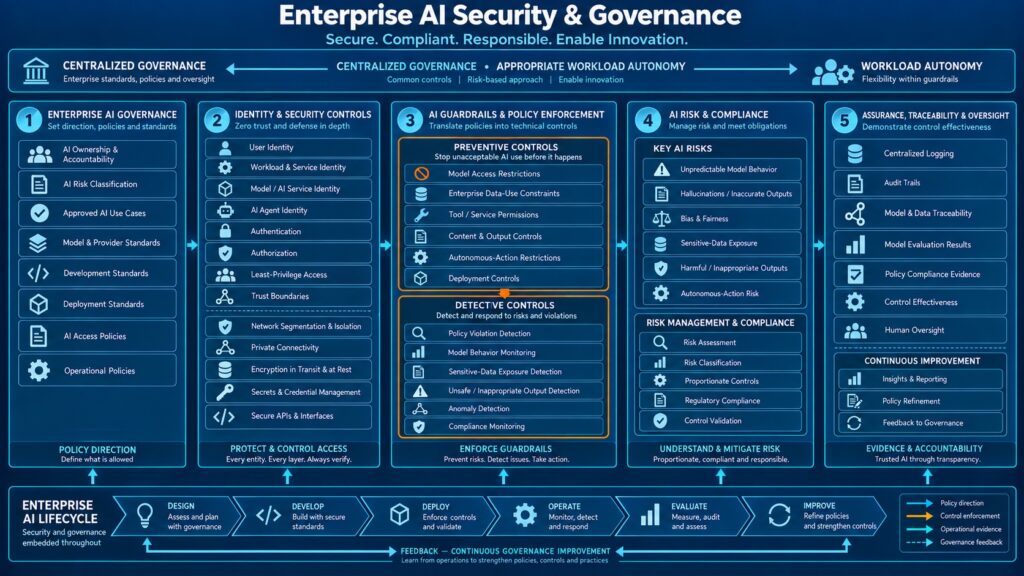
Enterprise AI Governance and Guardrails
Enterprises leveraging AI capabilities must extend their existing governance policies to AI governance and impose constraints across the AI lifecycle. This begins with defined ownership of AI capabilities and establishing clear accountability and responsibility. This is followed by AI risk classification, along with enforcing approved AI use cases, and then model and provider standards. Enterprise AI governance should then establish AI development and deployment standards with AI access and operational policies. In cloud environments, these governance policies can be translated into organization-wide preventive controls that establish boundaries for individual workloads.
Enterprise AI then translates these governance policies into enforceable guardrails, including both preventive and detective controls. It should automate policy enforcement, including model access restrictions, content and output controls, and enterprise data-use constraints, along with permitted tool and service access. Paramount are restrictions on autonomous actions. Other controls include standardized deployment controls and controls embedded in shared AI capabilities.
Enterprise AI should centralize enterprise governance standards while ensuring appropriate team and workload autonomy. This approach provides shared governance capabilities, reusable policy controls, standardized guardrail patterns, and paved-road deployment patterns. This reduces workload-specific governance duplication. Centralized governance also provides stronger oversight for high-risk capabilities while applying proportionate controls for lower-risk workloads.
AI Risk, Compliance, and Assurance
AI risk management extends traditional enterprise technology risk management to address new threats posed by AI-enabled systems across the complete lifecycle. AI-specific model risks comprise unpredictable model behavior, hallucinations and inaccurate outputs, bias and fairness risks, and sensitive-data exposure. Significantly, inappropriate or harmful outputs are closely associated with autonomous-action risks. Overall, enterprises must classify these and other risks and implement controls that are proportionate to their risk classifications.
An important dimension of AI security governance is end-to-end logging and traceability, serving as evidence of governance effectiveness. This provides demonstrable policy compliance and evidence of operation within defined risk tolerances. It also provides audit trails across the AI lifecycle for both models and data, along with model evaluation results. This links governance with operational observability and provides feedback from operations into governance.
Operations & Observability
AI Operations and Lifecycle Management
Enterprise AI components that span the enterprise AI architecture are a subset of enterprise applications and services that require end-to-end lifecycle management. This covers AI application deployment and configuration, model and AI service deployment, and enterprise data dependency management. Additionally, it must support infrastructure operations. Furthermore, it must maintain consistent operational processes across workloads with ongoing production management.
Model and AI service lifecycle management is particularly important, with unique requirements around model version management. Additionally, enterprise AI architecture must ensure controlled model deployment supported by model registration and cataloging. Model lifecycle management also includes model retirement and decommissioning. Furthermore, it must control model lifecycle transitions and make them traceable, supporting independent model evolution.
Observability and Evaluation
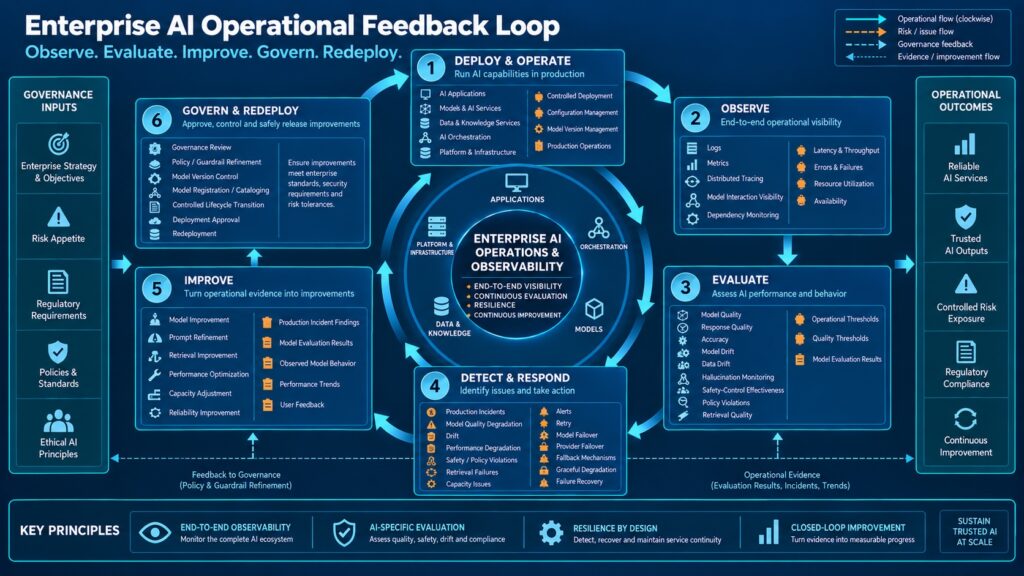
Observability is at the core of enterprise architectures, and enterprise AI architecture must extend it across all layers. Each layer must have centralized logs and metrics. The architecture must also provide end-to-end request tracing along with model interaction visibility. Monitoring across the layers must include dependencies, latency, throughput, errors, failures, resource utilization, and availability. It must avoid isolated component monitoring and provide unified operational visibility.
AI-specific monitoring extends traditional operational monitoring by continuously evaluating models, including their quality and response quality. Significantly, monitoring includes accuracy measurements along with model and data drift detection. Model evaluation provides a structured approach for measuring model performance and determining whether models meet defined quality requirements. Other important AI-service monitoring dimensions include hallucinations, safety-control effectiveness, policy violations, and retrieval quality. The architecture must also establish operational and quality thresholds. Ultimately, it evaluates AI capabilities against expected behavior and provides feedback into model lifecycle management.
Reliability and Continuous Improvement
Resilience across architectural layers and recovery from expected failures at each layer are core requirements for enterprise AI architectures. Production availability requirements should support fault-tolerant AI services through model failover, external provider failover, fallback mechanisms, retry mechanisms, and graceful degradation. Enterprise AI should also establish capacity management and support failure recovery.
The continuous operational feedback loop is a core requirement of observability for model improvement, prompt refinement, and retrieval improvement. Specific observability data used for improvement includes production incident findings, model evaluation results, observed model behavior, performance trends, and user feedback. These enable continuous improvement across the AI lifecycle, including refinement of governance policies and guardrails.
Architecture Principles & Trade-offs
Enterprise AI Architecture Principles
Many architectural principles are extended to enterprise AI architecture that support loose coupling and abstraction. These include modular architectural components with clearly defined component boundaries through shared interfaces and APIs. There is decoupling between layers and modules to enable the interchangeability of models and services and the independent evolution of architectural layers. Also, there is separation between logical and physical architecture to minimize technological coupling.
The intent of architectures is to achieve consistency and reuse without stifling workload and team autonomy through excessive centralization or rigid uniformity. This is achieved through shared enterprise capabilities, reusable architectural patterns, and standardized integration patterns, while allowing workload-specific implementation choices. As established earlier, enterprise AI architecture applies centralized enterprise governance with standardized security guardrails while preserving team and workload autonomy.
Enterprise AI architecture must impose and enforce constraints, especially given the risks introduced by AI-enabled systems. It must proactively enforce governance and security while incorporating observability, resilience, and lifecycle management. These are cross-cutting architectural capabilities and controls that span every architectural layer, providing operational visibility across layers. It must also support traceability and auditability and provide continuous operational feedback.
Architectural Trade-offs
Abstraction is a powerful paradigm within modern enterprise systems for reduced coupling that promotes reuse, portability, and shared platform services. However, this does introduce complexity and potential latency that is often insignificant compared with the benefits abstraction offers. However, there are cases where these issues become more dominant, requiring architects to apply abstraction judiciously where it provides architectural value rather than for its own sake.
Enterprise AI architecture governance is paramount in promoting consistency through enterprise-wide architectural standards and shared capabilities. However, many teams and workloads have unique requirements, and enterprise controls may prevent their optimal performance. There should be sufficient flexibility in the architecture and governance processes to properly manage exceptions, enabling workload optimization while maintaining alignment with governance policies.
Conclusion
Enterprise AI architecture encompasses individual models, individual platforms, and isolated applications but goes beyond these to form an integrated enterprise-wide architecture. Along with models and AI services, it provides layers for experience and application capabilities, and data and knowledge. This also includes AI orchestration and services, along with AI platform and infrastructure. It establishes interdependencies between these layers. Furthermore, it provides governance and security across all layers, along with operations and observability across the AI lifecycle.
It must also follow core architectural principles, including modular components with clearly defined boundaries, implemented through standard interfaces and APIs. Enterprise AI architecture must provide abstraction between layers with loose coupling, enabling independent component evolution. Additionally, it must separate logical and physical architecture, enabling technology-independent architectural guidance. Furthermore, it must incorporate governance, security, and operational readiness by design. Finally, it must provide standardization while preserving workload autonomy.
This article serves as the foundation for the wider exploration of enterprise AI architecture. Further articles will detail AI architecture, governance and risk, enterprise GenAI and LLM architecture, and AI operations and production. These articles will present a deeper treatment of individual layers and cross-cutting capabilities. They will expand on architectural trade-offs and progress from reference architecture to implementation decisions.
Further Reading and Resources
Affiliate Disclosure: Some links on this page are affiliate links. As an Amazon Associate, AI Cloud Data Pulse earns from qualifying purchases. We also participate in the Pluralsight affiliate program and may earn a commission if you subscribe or purchase through our links, at no additional cost to you. We only recommend courses and resources that provide genuine value to our readers.
External References
Buschmann, Frank, et al. — Pattern-Oriented Software Architecture, Volume 1: A System of Patterns
NIST — Artificial Intelligence Risk Management Framework (AI RMF 1.0), NIST AI 100-1
ISO/IEC 42001:2023 — Information Technology — Artificial Intelligence — Management System
ISO/IEC 23894:2023 — Information Technology — Artificial Intelligence — Guidance on Risk Management
NIST SP 800-207 — Zero Trust Architecture
Google Cloud — AI Adoption Framework
Recommended Books
Designing Machine Learning Systems: An Iterative Process for Production-Ready Applications
by Chip Huyen
AI Engineering: Building Applications with Foundation Models
by Chip Huyen
Building Machine Learning Powered Applications: Going from Idea to Product
by Emmanuel Ameisen
Pluralsight Learning
For readers seeking structured learning, Pluralsight provides courses covering AI architecture, machine learning, generative AI, cloud platforms, and related enterprise technologies. These courses can complement the architectural concepts presented in this article with practical technical learning and implementation skills.
Explore AI and machine learning courses on Pluralsight
Affiliate Disclosure: Some links in this section are affiliate links. AI Cloud Data Pulse may earn a commission from qualifying purchases or subscriptions made through these links, at no additional cost to you. As an Amazon Associate, I earn from qualifying purchases. Recommendations are based on their relevance to the topics discussed in this article.
