What Is AWS Infrastructure Security Architecture
Defining Infrastructure Security in AWS
AWS infrastructure security is defined by architecture, not solely by IAM, which handles authentication and authorization, as discussed in architecture-first security in AWS. Architecture determines how infrastructure enforces security by establishing trust boundaries for AWS resources and defining access paths. It also shapes the network design that controls reachability and exposure. Ultimately, architecture defines the topology that determines the effective attack surface of AWS resources and entities. This makes architecture the primary control for reducing risk in AWS environments. These principles align with the AWS Well-Architected Framework security pillar.
Why Architecture Defines Security Outcomes
Architecture defines security outcomes for AWS infrastructure because key security decisions are made at design time rather than at later stages. Since architecture shapes the exposure and isolation of resources, it must be established from the start. The resulting topology enforces trust boundaries around resources, which IAM then supports through authentication and authorization. Network paths overlay this topology and define potential attack vectors. As a result, poor design across these layers propagates systemic risk.
Prevention vs Detection vs Response
Preventing resource exposure to attacks reduces risk and the likelihood of incidents requiring detection and remediation. Detection identifies threats after an attack has begun, potentially causing harm. Response mitigates impact after resources are compromised, when damage may already have occurred, and remediation is required.
Key Takeaways
In this article you’ll learn:
- Why architecture—not IAM—is the primary security control
- How reducing reachability minimizes the attack surface
- When to use PrivateLink and VPC Endpoints
- How CloudFront, WAF, and Shield work together
- Why AWS accounts are the strongest security boundary
How AWS Infrastructure Security Components Work Together
These best practices reinforce AWS infrastructure security architecture principles.
Layered Security Model in AWS Infrastructure Security Architecture
AWS infrastructure security architecture maps to AWS as a layered model, with network segmentation serving as the foundational security layer by establishing trust boundaries. The next layer defines private connectivity between segments, removing unnecessary exposure paths. Above this, edge protection filters and controls external traffic, limiting external exposure. Finally, Detection and monitoring provide visibility across these layers to identify and respond to threats that penetrate the architecture. Each layer reinforces the others, but the strongest security control remains the architecture itself.
Preventive vs Detective Controls in Context
Prevention is preferable, as it denies malicious actors the opportunity to compromise resources. Therefore, preventive controls should be established to eliminate exposure before attacks occur. However, not all attacks can be prevented, so detection controls must also be implemented to identify threats during security events. Architecture enforces preventive controls through network segmentation, boundary design, and connectivity control to reduce exposure. Monitoring supports detection but does not reduce exposure.
The Core Principle: Reduce the Attack Surface
What Attack Surface Means in AWS
Architecture is the starting point for preventing attacks by reducing the attack surface. In AWS, the attack surface is the set of all reachable entry points to resources. These include public endpoints and exposed interfaces that provide access to AWS resources. Network paths between these interfaces and endpoints enable access between components and the external environment, as controlled by security groups and network ACLs in AWS. As a result, misconfigured connectivity can unnecessarily expose resources to other components or the external environment. This makes reachability the primary factor in determining exposure in AWS environments.
Why Reachability Precedes Authorization
Reachability is fundamental to attack prevention, as malicious actors cannot exploit unreachable resources. Therefore, network access to a resource must exist before authorization is evaluated. As a result, authorization is only applied after connectivity is established. Eliminating reachability removes the entire attack path, denying malicious actors any opportunity to exploit the resource.
Public Endpoints as the Primary Risk
Public endpoints expose resources to the internet, making them the primary source of risk. This risk can be reduced using private connectivity patterns such as VPC endpoints and PrivateLink. Internet exposure significantly increases the attack surface, as any external entity can attempt access. This reachability enables unsolicited access attempts at scale. As a result, public access expands potential attack vectors without practical limits.
Private Connectivity in AWS Security Architecture
Why Private Connectivity Reduces Risk
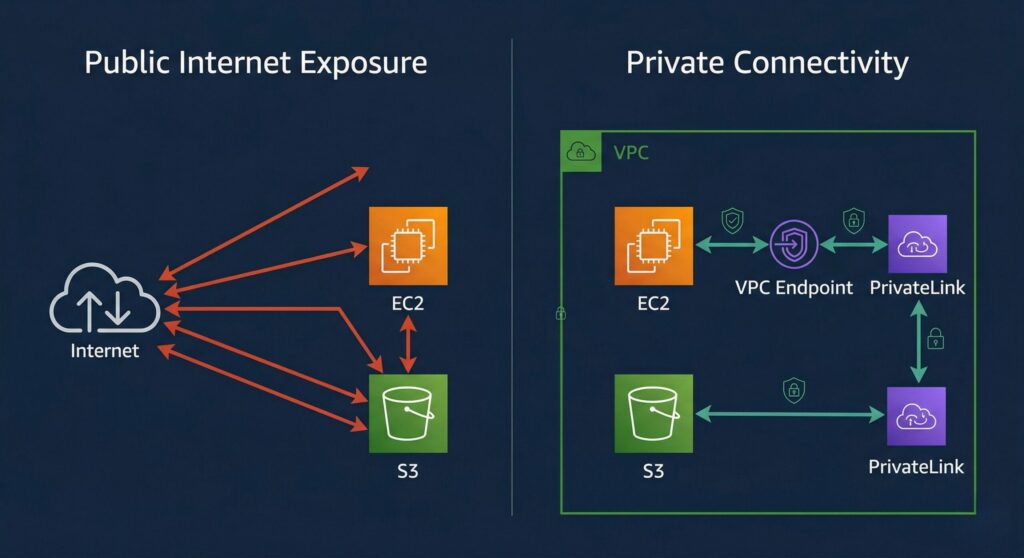
Public internet exposure is the primary risk for AWS resources, and removing this exposure is critical. Private connectivity addresses this by ensuring network paths do not leave the AWS backbone. As a result, it reduces the number of reachable entry points and the overall attack surface, limiting opportunities for malicious actors. This approach restricts access paths to trusted services and components. This is why private connectivity is a foundational control for reducing exposure in AWS architectures.
VPC Endpoints and PrivateLink Patterns
Several AWS controls implement private connectivity by keeping network paths within the AWS backbone. Gateway endpoints were introduced first, enabling private access to services such as S3 and DynamoDB. Interface endpoints followed, providing private connectivity using PrivateLink. PrivateLink enables secure service-to-service communication across VPCs while ensuring traffic remains within the AWS backbone. These endpoint patterns eliminate the need for internet gateways or public access when resources communicate within AWS. This shifts connectivity from public exposure to controlled, private access paths.
Minimizing Service Exposure
Architecture that enforces boundaries limits services to private endpoints by default, with no public internet access. As a result, internal services are not exposed to the internet, preventing access by malicious actors. Through private connectivity, service access is restricted to only the required components, making monitoring and management more controlled. Public access is prevented by using internal communication paths between services that remain within the AWS private network. This ensures that services are only accessible within explicitly defined trust boundaries.
Private Connectivity vs Public Edge Security
Business networks deployed to AWS still require public access to interact with external entities. Edge protections complement private connectivity by filtering necessary external traffic, while private connectivity eliminates unnecessary exposure. Private access removes attack paths, whereas edge controls manage them. As a result, they operate at different security layers.
Edge and Perimeter Protection in AWS
Layer 7 vs Network-Level Protection
Security cannot rely solely on private connectivity, and edge protection in AWS is essential for guarding resources against external attacks. These controls operate at two levels. Network-level protection controls traffic at Layers 3 and 4. Application-level protection operates at Layer 7, filtering HTTP/S requests based on header information. Network-level controls restrict access paths before requests are processed, while application-level controls inspect and block malicious traffic.
DDoS Mitigation and Traffic Filtering
The primary network-level protection is against DDoS attacks that flood the network with Layer 3 traffic. Managed services absorb and mitigate these large-scale attacks. At the application level, traffic filtering blocks malicious or suspicious HTTP(S) requests. Application-level controls also perform rate limiting to prevent abuse and excessive requests. Edge protections further reduce load on backend resources by normalizing HTTP(S) traffic. This ensures that malicious traffic is filtered before it reaches application resources.
CloudFront as a Security Boundary
CloudFront complements application-level and network-level protection by serving as the global edge entry point for applications. As a result, it isolates backend resources from direct internet exposure. It supports layered protection by integrating with WAF and Shield, which provide application- and network-level protection, respectively. Together, they cache and filter requests before they reach origin services. This makes CloudFront a critical boundary that separates external traffic from internal services.
Observability as a Supporting Control (Not Primary)
Why Monitoring Does Not Replace Architecture
Monitoring is essential for any security solution, but it detects issues without preventing exposure to malicious actors. Detection occurs after an attack has already begun and may have already compromised resources. In contrast, architecture reduces risk by preventing attacks before monitoring is required. This makes monitoring a supporting control rather than a primary security mechanism.
CloudWatch, CloudTrail, and GuardDuty Roles
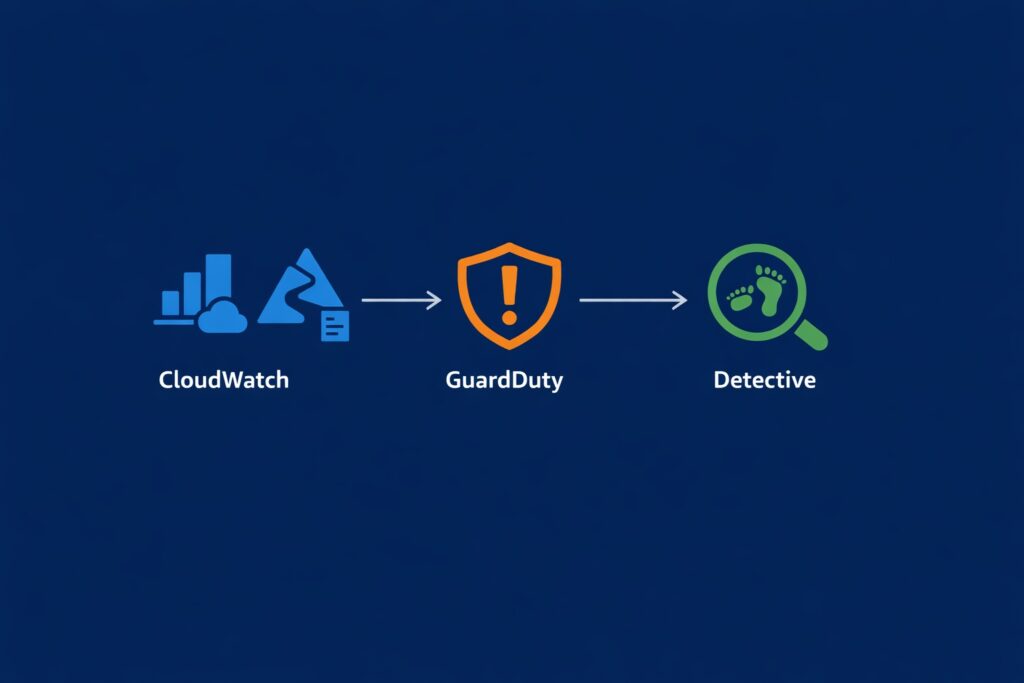
Several AWS services operate at different stages of the monitoring pillar in AWS security architecture. CloudWatch provides metrics, logs, and real-time monitoring, forming the raw data used for threat detection. CloudTrail records API activity and account actions that can reveal malicious behavior. GuardDuty operates downstream, ingesting data from these services to detect threats using anomaly and behavior analysis. Together, these services provide visibility across AWS environments. This pipeline enables detection but does not reduce exposure to threats.
Detection vs Investigation in AWS Security
Detection forms the initial stage of the observability pipeline by identifying threats in near real time. Investigation is a downstream stage that analyzes these events to determine root causes and identify architectural weaknesses. Detection triggers alerts, while GuardDuty and AWS Detective provide deeper context for investigation. This distinction reinforces that detection identifies problems, while investigation explains them.
Detection vs Prevention in AWS Security
Preventive controls block attacks before they occur, significantly reducing the risk of resource compromise. However, not all attacks can be prevented, making detection essential for identifying threats once they begin. While prevention reduces exposure, detection provides visibility into attacks in progress. This reinforces that prevention is the primary control, with detection serving as a supporting mechanism.
Compute Security Boundaries: EC2 vs ECS vs EKS
Instance vs Task vs Pod Isolation
Compute resources are high-value targets and require additional isolation layers. EC2 instances, as virtual machines, provide isolation at the instance level. ECS tasks isolate workloads at the container task level. EKS pods isolate workloads within Kubernetes scheduling boundaries. As abstraction increases from EC2 to ECS and EKS, security complexity shifts upward into identity, orchestration, and configuration layers rather than disappearing entirely. These layers represent different isolation boundaries, each shifting responsibility between the user and AWS. For a deeper comparison of how security responsibilities shift across virtualization, containers, and Kubernetes orchestration, see EC2 vs ECS vs EKS: Why AWS Compute Security Isn’t the Same.
IAM Roles, Task Roles, and IRSA
Supporting these isolation boundaries are identity controls that grant access to compute resources. EC2 instances operate at the infrastructure level, with IAM roles providing permissions to instances. ECS workloads operate at the task level, with task roles assigning permissions to containers. Kubernetes pods use fine-grained IAM permissions enabled by IRSA. These identity mechanisms align access control with the underlying compute isolation boundaries.
Why Managed Compute Shifts Risk Up
Managed services abstract infrastructure, including isolation boundaries and controls, but do not eliminate risk. Instead, responsibility shifts from infrastructure to configuration and identity. As a result, misconfigurations at higher layers increase systemic impact and risk. As a result, risk shifts from infrastructure exposure to configuration and identity management.
Multi-Account Strategy as a Security Control
Accounts as the Strongest Isolation Boundary
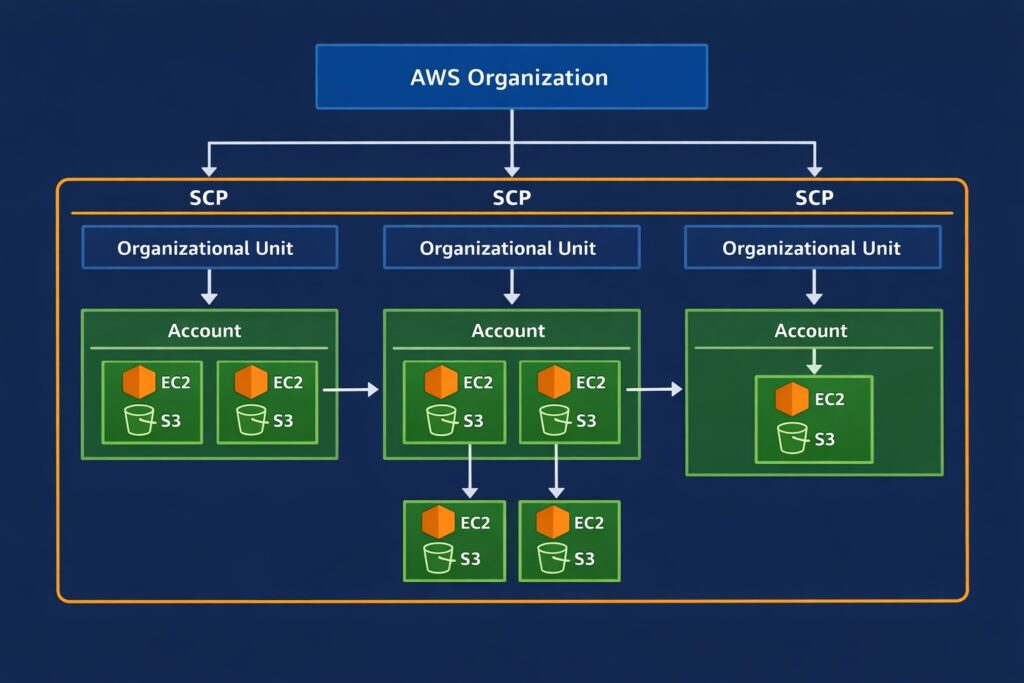
Grouping resources into isolation boundaries is a fundamental principle of security architecture. AWS accounts provide hard isolation between resources, making them the strongest isolation boundary. These boundaries limit the blast radius of security incidents and compromised resources. However, resources in different accounts still need to interact. Cross-account access serves as the control between accounts, requiring explicit configuration and trust.
Organizational Units and Blast Radius Reduction
AWS accounts are the primary grouping for resources into isolation boundaries, with Organizational Units (OUs) grouping accounts at the next level. In both cases, grouping is based on function and risk. As a result, the OU structure defines isolation boundaries at scale. Segmenting accounts limits the blast radius when an account is compromised. Grouping accounts also enables consistent controls by applying policies at the OU level and enforcing them across large environments.
SCPs as Preventive Guardrails
SCPs are the mechanism for enforcing preventive controls by restricting allowed actions. They apply at the AWS account or OU level across all identities within member accounts. The principle behind SCPs is to define guardrails rather than grant permissions, ensuring security boundaries are enforced consistently across accounts.
Hybrid Connectivity and Trust Boundaries
Many organizations operate across on-premises environments and AWS and require secure connectivity between them.
VPN vs Direct Connect Security Trade-offs
There are two primary connection types between on-premises environments and AWS: VPN over the internet and Direct Connect over private circuits. VPN provides encrypted communication over the public internet and is easier to implement. In contrast, Direct Connect provides private connectivity without traversing the internet, reducing exposure. However, security still depends on encryption, routing, and trust boundaries, and not the connection type alone. Organizations using Direct Connect often layer VPN over the connection for additional encryption. This reinforces that connectivity choices define trust boundaries rather than guarantee security. For a detailed analysis of encryption, routing, segmentation, and hybrid trust-boundary design, see AWS VPN vs Direct Connect Security: The Security Trade-offs That Actually Matter.
Extending Trust Boundaries On-Premises
When organizations operate across on-premises environments and AWS, they form a shared trust boundary. Subsequently, weak on-premises controls become the weakest link in the chain, introducing risk into AWS environments. Tight connectivity between these two environments extends the attack surface and increases the number of potential attack vectors. Therefore, hybrid environments are only as secure as their weakest boundaries.
Routing and Failover Considerations
Traffic paths are integral to segmentation, as routing decisions control these paths across hybrid environments. Misconfigured routes can create unintended access paths and potential attack vectors. Failover mechanisms must be configured to preserve security boundaries during outages. There should be no trade-off between resilience and security.
AWS Infrastructure Security Architecture Best Practices
These best practices reinforce AWS infrastructure security architecture principles.
Minimize Public Exposure
Only services that require external access should be exposed, while all others should default to private access wherever possible, using private connectivity patterns such as VPC endpoints and PrivateLink. This includes avoiding unnecessary public endpoints and internet exposure to reduce the attack surface. As networks and requirements evolve, exposed interfaces should be continuously reviewed and removed where no longer needed. This reinforces that reducing exposure is the most effective way to reduce risk.
Enforce Segmentation Early
Segmentation should be designed into the environment before resources are deployed, using controls such as security groups and network ACLs in AWS. This includes defining trust boundaries at the start of the architecture. Broad access patterns should be prevented early, as they increase the attack surface and opportunities for compromise. Enforcing isolation upfront minimizes costly rework. This ensures that security is built into the architecture rather than added later.
Use Managed Security Boundaries
AWS-managed services provide integrated controls that incorporate best practices and should be the first choice for enforcing security boundaries. This includes leveraging built-in controls such as security groups and SCPs as part of the AWS infrastructure. These services also provide managed protections that reduce operational complexity. This allows security to be enforced consistently without increasing operational overhead.
Align Architecture with Least Privilege
Security controls across the network and identity layers should enforce least privilege to prevent unnecessary access, as discussed in architecture-first security in AWS. This includes limiting access paths to reduce potential attack vectors. IAM policies should align with architectural boundaries to reduce operational complexity. Access is controlled by both design and policy.
Final Thoughts on AWS Infrastructure Security Architecture
Security Decisions Are Made at Design Time
Security posture is ultimately defined by architectural decisions and supported by security controls. Trust boundaries and exposure are established at design time, not as an afterthought. Poor design choices propagate risk throughout the system.
IAM Is Necessary but Not Sufficient
IAM enforces permissions within trust boundaries but does not control reachability, making it insufficient for the overall security posture. Authorization alone cannot protect exposed resources. Architecture must restrict access paths before IAM is applied. This demonstrates that IAM supports security but does not define it.
Strong Architecture Reduces Operational Burden
Following strong architectural principles is a proactive approach that reduces the need for reactive security measures. This includes establishing well-defined boundaries that simplify monitoring and management. As a result, fewer exposed paths reduce incident response complexity.