
Introduction to AWS Compute Security EC2 ECS EKS
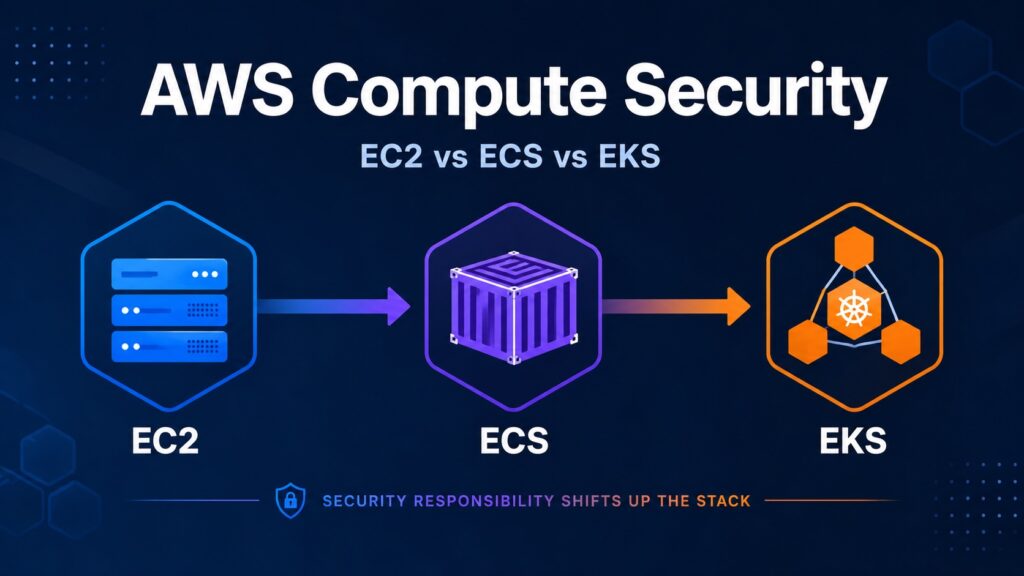
Virtualization is what makes cloud computing possible, and the virtual computer is the foundational building block. This is especially important when evaluating aws compute security ec2 ecs eks, where different compute models introduce different security assumptions. This includes both virtual machines and containers, enabling horizontal scaling and supporting the AWS concept of elasticity. These map to the AWS concepts of EC2, ECS, and EKS. EC2 corresponds to a virtual machine, and ECS and EKS correspond to containers. Since EC2, ECS, and EKS support virtualization, it is easy to assume they share the same compute security requirements. However, they have very fundamentally different security models that any ecosystem must support. This aligns with the architecture-first AWS security model, where security is defined by boundaries, isolation, and responsibility rather than individual services. For a deeper discussion of how isolation boundaries reduce blast radius and contain security events, see AWS Resource Isolation Security.
Their different security models result in security responsibility shifting across these services, which architects must take into account. EC2 places the security model on the instance, where the user has full control and full responsibility for the security of each EC2 instance. ECS provides a partial abstraction of the security model, where instances are tasks and containers, but the user still has responsibility over these. EKS goes further by maintaining an orchestration layer that introduces new risks architects need to manage. Therefore, abstraction does not inherently remove or reduce risk but shifts it to different layers of abstraction. This article provides a conceptual framework for architects to manage risk through boundaries, IAM models, and isolation. For a deeper discussion of AWS identity architecture, role design, permission boundaries, and least-privilege principles, see AWS IAM Architecture: Designing Identity Boundaries at Scale.
Understanding AWS Compute Security Models
Shared Responsibility Model Across Compute
AWS established the AWS shared responsibility model, where both AWS and its customers are responsible for the security of different architectural layers. Typically, AWS is responsible for the underlying infrastructure, including hardware, networking, data centers, and the services it provides. AWS customers are typically responsible for the workloads, configurations, identities, and access they manage. This shared responsibility for security is applicable to AWS compute resources, including EC2, ECS, and EKS. The key difference between these services in terms of shared responsibility is how much responsibility shifts to the customer for each compute type. For EC2, the customer has the highest level of responsibility, including OS, patching, and runtime. With ECS, the customer has a reduced level of responsibility due to container abstractions. For EKS, the customer has a shifted level of responsibility due to layers such as orchestration and RBAC.
Why Compute Abstraction Changes Security
Abstraction for compute resources refers to the level of direct infrastructure control that the user has. This is seen with EC2, ECS, and EKS, where abstraction progresses from direct instance control to container control and then to orchestration. For EC2, abstraction is minimal, where the user has direct control over the OS and its environment. With ECS, the container boundary abstracts the underlying host either partially or completely with Fargate. EKS also abstracts the underlying host through containers but introduces cluster, control plane, and RBAC. Therefore, abstraction reduces some of the operational burden but also introduces new control planes and misconfiguration risks. As a result, it does not inherently reduce risk but shifts it to identity, orchestration, and configuration layers.
EC2 Security Responsibilities and Boundaries
Instance-Level Security Control
EC2 users have full control over their virtual machines and their security at the OS level. Therefore, they have full responsibility over OS security, including OS patching and updates. This includes the selection of AMIs to establish a baseline security posture and deciding upon hardened images vs default. As a result, there is a need for a consistent patch management strategy as attack strategies evolve. Users also need to consider system hardening by disabling unnecessary services with the least privilege at the OS level, as one example. Security control also extends to runtime configuration and installed software. Therefore, flexibility comes with operational burden since full control equals full responsibility.
IAM Roles and Network Controls in EC2
Users are also responsible for how EC2 instances access other AWS services by attaching roles to EC2 instances to secure access to these services. The key advantage of roles is that it avoids accidental hardcoding of credentials, where role permissions define what the instances can access. Additionally, network controls isolate EC2 instances from other entities with Security Groups performing stateful, instance-level access control. NACLs are an additional layer of network control protection providing subnet-level, stateless filtering. Combining network controls with IAM access allows network controls to define boundaries, but they must be aligned for secure design.
Risks in EC2 Security Model
There are significant risks with EC2 security management, with the most significant being misconfigured OSs that have unpatched vulnerabilities. Another risk is granting overly permissive access with weak SSH/RDP controls, exposing instances to unauthorized login attempts. Open ports are another significant risk, as the instance may be unnecessarily exposed to the internet, which can be mitigated by protecting workloads at the edge with WAF and Shield. There is also the risk of lateral movement within the VPC if segmentation is weak, where security events are not contained. Segmentation follows the principle of watertight compartments on a ship, where a breach in one area is contained rather than spreading across the entire system. Furthermore, there is a reliance on manual configuration that increases the probability of human error. In summary, EC2 errors are usually configuration-driven, and control over these instances increases the risk surface if not managed properly.
ECS Security Responsibilities and Task Isolation
Task-Level Security and Isolation
Within the EC2–ECS–EKS continuum for AWS security, ECS abstracts EC2 compute through containers. Therefore, instead of instances being the fundamental unit of compute, it is the ECS task model. This means that isolation occurs at the container/task level rather than at the full OS level. There are two ECS launch types. The EC2 launch type still requires shared host responsibility, whereas the Fargate launch type removes host management responsibility. However, while abstraction reduces direct OS-level control, it still does not eliminate the need for secure configuration. Because containers still rely on their underlying host, it improves isolation, but it is not absolute. Overall, ECS simply shifts responsibility from the OS level to the container/task level.
IAM Task Roles Explained
Another key difference from EC2 is how ECS uses task roles for each task to provide fine-grained access. Therefore, over-permissioning the entire EC2 instance is avoided. As a result, ECS task roles improve the least privilege model at the application level, thereby reducing the risk of credential leakage across workloads. However, setting up task roles still requires careful permission scoping. Overall, identity becomes more granular, but this is also more complex to manage.
ECS Security Risks and Considerations
Containers are isolated to some extent, but risk remains through the shared host for the EC2 launch type, including a container breakout scenario. Additionally, while granular identity improves access security, there is a risk of misconfigured task roles due to over-permissioned applications. Container isolation is also weaker than that compared to full VM boundaries, along with the risk of insecure container images through unpatched vulnerabilities. Other considerations are a lack of visibility into runtime container behavior. Also, while Fargate reduces host risk, it still shifts trust to an AWS-managed runtime. However, as with EC2, security failures are still largely configuration-driven.
EKS Security Responsibilities and Kubernetes Model
Pod-Level Security and Kubernetes Abstraction
EKS builds on ECS compute abstraction within the EC2–ECS–EKS continuum for AWS security by introducing the Kubernetes orchestration layer. Instead of the ECS instance or task being the fundamental unit, it is the pod. Like the ECS task, pods run containers, but they are managed through Kubernetes constructs. EKS also extends abstraction from ECS to include clusters and the control plane. However, AWS still manages the control plane and partially reduces the operational burden. But the customer is still responsible for the worker nodes unless fully managed patterns are used. With EKS, isolation is now at the pod and namespace level with increased abstraction and less direct control over infrastructure. Hence, the orchestration layer becomes more complex, and responsibility for security shifts upward into Kubernetes constructs. This increased orchestration complexity also affects observability architecture, where Kubernetes environments often require different telemetry collection and monitoring models compared to traditional AWS-native monitoring. For a broader comparison, see Prometheus vs CloudWatch.
IAM Roles for Service Accounts (IRSA)
EKS extends the fine-grained identity construct by introducing IRSA for identity at the pod level. It also integrates Kubernetes service accounts with AWS IAM, which allows each pod to assume a specific IAM role. Similar to task roles in AWS, it improves least privilege compared to instance-level roles for EC2 compute. Like ECS, it removes the need for shared credentials across workloads. However, this requires mapping between Kubernetes and AWS identity models. This adds complexity around trust policies, role bindings, and service account configuration. While having a highly granular identity to improve segmentation, it is harder to manage correctly.
EKS Security Risks and Complexity
The EKS security model is more complex since Kubernetes introduces additional control layers, including RBAC (role-based access control), cluster configuration, and network policies, as part of the broader Kubernetes security model. Each of these layers has associated risks with RBAC becoming misconfigured with excessive permissions within the cluster. Cluster configuration introduces the risk of mismanagement, leading to insecure workloads or exposed services. Additionally, pod-level isolation is weaker than VM boundaries since it uses the shared kernel method. These additional layers can increase the attack surface through configuration errors. This complexity also reduces visibility to other systems, making security management more opaque. Another driver for complexity is reliance on multiple systems, with Kubernetes and AWS making operational complexity a primary risk. In conclusion, EKS does not reduce risk, but, similar to ECS, it shifts risk into the orchestration and configuration layers.
Key Differences in AWS Compute Security EC2 ECS EKS
Instance vs Task vs Pod Security Boundaries
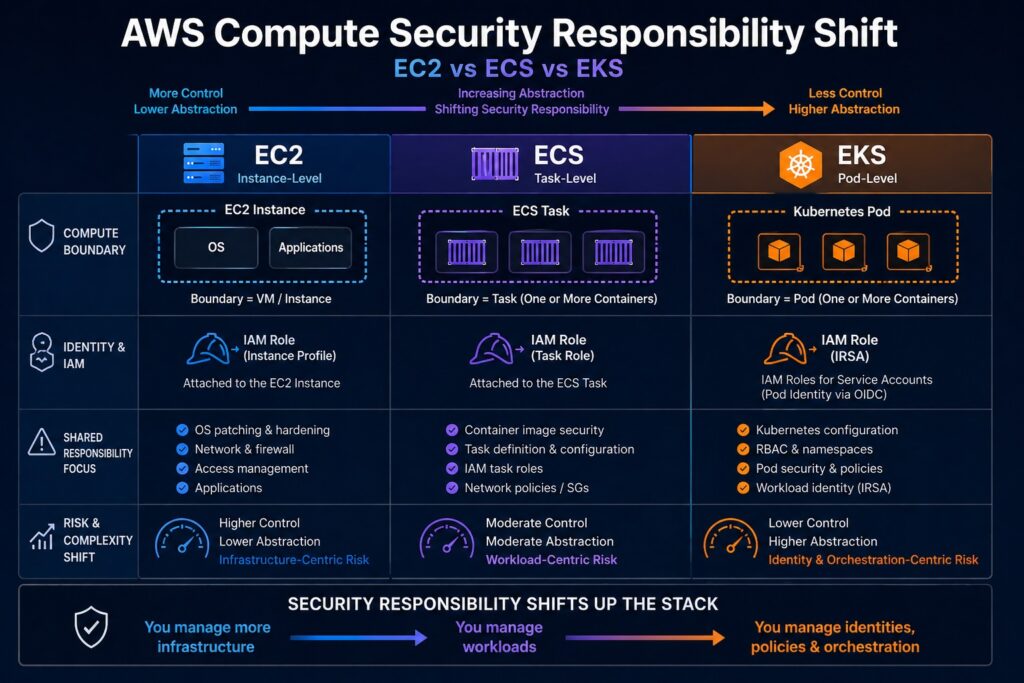
Security boundaries are fundamental to passive security architecture, where resources are isolated from each other for security event containment. These same principles underpin AWS Resource Isolation Security, where trust boundaries and workload separation limit blast radius. This is a key difference in EC2, ECS, and EKS compute security within AWS, where their isolation boundaries are at different levels. EC2 provides isolation at the instance or VM level, the strongest isolation level. ECS provides isolation at the task or container level, and EKS provides isolation at the pod or namespace level, which provides weaker isolation due to shared kernels. Therefore, the progression is increasing abstraction with decreasing infrastructure visibility, where isolation shifts from hardware-backed to logical boundaries. The implication is that higher abstraction requires stronger configuration discipline.
IAM Roles vs Task Roles vs IRSA
Roles form the active layer of architectural security, providing authorization for resources to access other resources. EC2 uses IAM roles at the instance level, where all running applications share the same role, therefore coarse-grained access. ECS uses task roles that are assigned to each workload, thereby having greater granularity. EKS introduced IRSA, providing identity at the pod level, making access highly granular. Hence, the progression is that identity becomes more fine-grained across services and improves least privilege enforcement. However, this increases the complexity of role design and mapping and the associated risk of misconfiguration.
Host Control vs Managed Abstractions
Another key difference in EC2, ECS, and EKS compute security is the level of infrastructure control within AWS. EC2 allows the user to maintain full infrastructure control over the host and OS. However, ECS moves toward partially abstracting infrastructure control, even though hosts remain relevant in the EC2 launch type. EKS further abstracts the infrastructure through the orchestration layer. Hence, control decreases as abstraction increases, reducing the operational burden at the infrastructure level. However, this shifts complexity into orchestration and configuration and introduces new responsibility layers.
Why EKS Shifts Risk Up, Not Away
There is a common perception that a higher level of abstraction in infrastructure control leads to a more secure environment. Subsequently, EKS is often perceived as more secure because it is managed. However, the reality is that while infrastructure burden is reduced, the associated risk is not. Instead, Kubernetes introduces the orchestration layer along with multiple control planes, including RBAC, networking, and scheduling. Therefore, security responsibility moves away from the infrastructure level and shifts into configuration, identity, and orchestration. In other words, risk is relocated but is never eliminated.
With the increased abstraction that EKS introduces, there are more moving parts to configure correctly. Misconfigurations can occur at the RBAC level, with service accounts (IRSA), and in cluster or network policies. The central implication is that complexity has become the dominant risk factor, with reduced visibility compared to simpler models. This means that abstracting the infrastructure requires stronger discipline since security is less implicit. Therefore, EKS demands architectural maturity and not just adoption. This increased operational complexity also elevates the importance of centralized monitoring and observability. For a comparison of AWS-native and enterprise observability approaches, see CloudWatch vs Datadog. Teams operating Kubernetes-based workloads should also evaluate pull-based observability models and telemetry scaling considerations. For a deeper comparison, see Prometheus vs CloudWatch.
Best Practices for Securing AWS Compute Workloads
Least Privilege IAM Across Compute Services
Least privilege is the most basic best practice for security hygiene and is reinforced in the AWS Well-Architected Security Pillar. Architects should enforce this across EC2, ECS, and EKS compute to enhance AWS security. For EC2, enforce least privilege by avoiding broad instance roles. With ECS, enforce least privilege by using task roles per workload. In EKS, enforce least privilege by using IRSA for pod-level identity. Additionally, avoid shared credentials across services and regularly review and refine IAM policies. This reinforces that identity is the primary control layer at higher abstractions and that misconfigured roles are the most common failure point.
Network Segmentation and Isolation
Segmenting workloads using VPCs, subnets, and security groups helps contain compromised workloads from impacting others. This is further strengthened by restricting inbound/outbound traffic to only required paths and reducing the attack surface area. Also, avoid exposing compute resources directly to the internet by using private subnets and controlled access points. Additionally, apply segmentation consistently across EC2, ECS, and EKS in order to contain any security events since segmentation limits blast radius but not risk.
Monitoring and Threat Detection
Whenever an incident arises, monitoring and threat detection are essential for effective response and remediation. Therefore, implement logging and monitoring across all compute layers and track access patterns, configuration changes, and runtime behavior using CloudWatch metrics and dimensions for monitoring compute workloads. Additionally, integrate AWS-native services such as CloudWatch, GuardDuty, and Config to provide visibility across the security ecosystem, including enforcing compliance with AWS Config conformance packs. These services enable early detection of anomalies and maintain visibility across compute layers despite abstraction, addressing the reduced visibility introduced by these layers. For a broader perspective on choosing the right monitoring tools for AWS environments, see our comparison of CloudWatch, Datadog, and Prometheus. For a focused comparison between AWS-native monitoring and enterprise observability platforms, see CloudWatch vs Datadog. Because EKS environments commonly rely on Kubernetes-native telemetry and container observability, architects should also understand the trade-offs between pull-based monitoring and AWS-native telemetry. See Prometheus vs CloudWatch.
Conclusion: Choosing the Right AWS Compute Security Model
From a security perspective, EC2, ECS, and EKS compute are not interchangeable within AWS. EC2 provides maximum control but requires the highest responsibility for infrastructure security. ECS balances abstraction and control, removing some responsibility but introducing complexity that requires management. EKS provides the highest level of abstraction, but also the highest level of complexity, requiring greater management and discipline. The implication is that the need to architect security is never reduced, but redistributed. This reflects the architecture-first AWS security model, where security outcomes are defined by system design rather than the choice of compute service. As a result, architects must choose based on the team’s maturity and operational capabilities, particularly in environments requiring aggregating security posture across accounts through governance mechanisms such as AWS Organizations and Service Control Policies (SCPs). Hence, architects should avoid framing one compute implementation as better than the others, but as a set of trade-offs. This reinforces the idea that effective security comes from understanding boundaries, identity, and abstraction.
Ultimately, securing AWS compute is not about choosing the most abstract service, but about understanding where responsibility lies and managing it effectively. As abstraction increases across EC2, ECS, and EKS, monitoring and observability become increasingly important for maintaining operational visibility. For a detailed comparison of AWS-native monitoring and enterprise observability platforms, see CloudWatch vs Datadog.
If you want to move beyond concepts and apply these security models in real environments, structured courses can help accelerate learning. Platforms like Pluralsight offer hands-on training across AWS compute services, IAM, and Kubernetes security.
Further Reading and Resources
- AWS Certified Security – Specialty (SCS-C02) Study Guide – Stuart Scott
- Amazon Web Services in Action – Wittig & Wittig
- Kubernetes Security and Observability – Brendan Creane et al.
Affiliate Disclosure: This article may contain affiliate links. As an Amazon Associate and partner with platforms like Pluralsight, I may earn commissions from qualifying purchases or sign-ups at no additional cost to you. This helps support the site and ongoing content creation.
